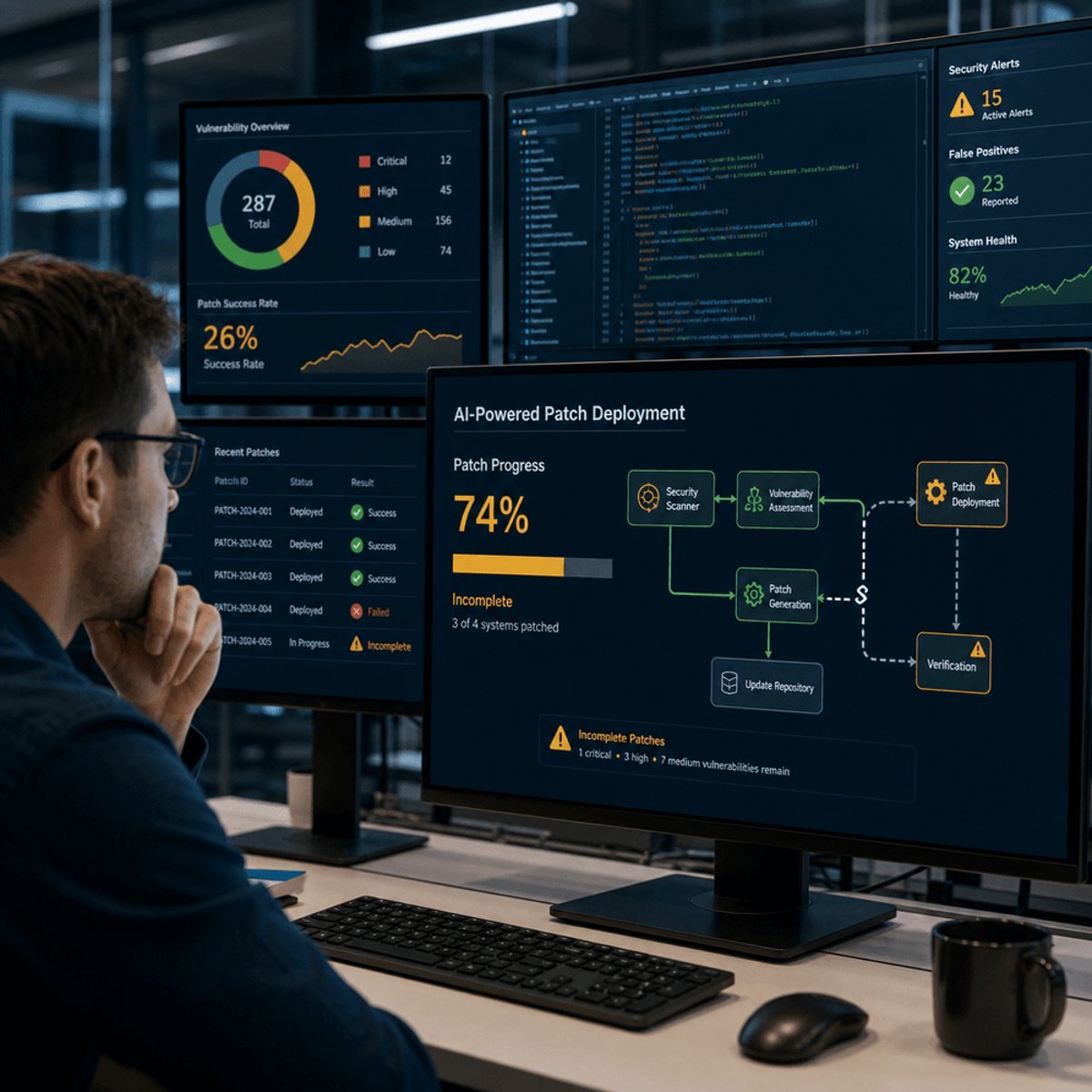
The AI automation wave hitting enterprise security just hit a major speed bump. 1Password released research showing that AI-powered tools failed to properly patch software vulnerabilities 74% of the time - a failure rate that's sending shockwaves through an industry racing to automate cybersecurity operations. The findings raise urgent questions about whether enterprises are moving too fast in handing over critical security tasks to AI systems that aren't ready for prime time.
1Password, the password management company, just dropped a reality check on the cybersecurity industry's AI ambitions. The company's research team tested AI-powered patching tools across real-world software vulnerabilities and found that nearly three out of four attempts resulted in incomplete or incorrect fixes.
The timing couldn't be more awkward for the dozens of startups and enterprise vendors pitching AI as the silver bullet for vulnerability management. Companies have been racing to deploy autonomous patching systems that promise to eliminate the human bottleneck in security operations. The 74% failure rate suggests those promises are dangerously premature.
What makes these findings particularly troubling is the false sense of security they create. When an AI tool reports a vulnerability as "patched," security teams typically move on to the next issue. But if the patch is incomplete or incorrect, the vulnerability remains exploitable - and now it's off the security team's radar entirely. It's arguably worse than not attempting the patch at all.
The 1Password research tested AI systems against common vulnerability patterns found in enterprise software. The tools struggled particularly with complex, multi-step patches that required understanding context across different parts of a codebase. Simple, isolated vulnerabilities saw better success rates, but those are exactly the kind of fixes that human developers already handle quickly.
This isn't just an academic exercise. Enterprise security teams are under immense pressure to accelerate patch cycles as breach incidents continue climbing. The average time to patch critical vulnerabilities remains measured in weeks or months at many organizations. AI promised to compress that timeline to hours or days. But a 74% failure rate means organizations might be trading slow patches for broken ones.
The vulnerability management market has exploded over the past two years, with AI-powered patching emerging as one of the hottest subsectors. Vendors have raised hundreds of millions pitching autonomous remediation platforms. Major cloud providers including Amazon Web Services and Microsoft Azure have quietly integrated AI-assisted patching into their security tooling.
Security researchers have been sounding alarms about rushing AI into critical infrastructure for months, but the drumbeat of vendor promises has largely drowned them out. The 1Password study provides hard numbers that are difficult to dismiss. A 26% success rate isn't production-ready by any reasonable standard, particularly when the stakes involve protecting enterprise systems from active exploitation.
The research doesn't mean AI has no role in vulnerability management. The technology shows promise in vulnerability detection, prioritization, and triage - tasks where mistakes are less catastrophic. But automatically applying code changes to production systems appears to require a level of reasoning and context understanding that current AI systems simply don't possess.
What happens next will likely reshape how enterprises approach AI in security operations. The 74% failure rate is high enough that it should trigger reevaluation of deployment timelines and use cases. Security leaders who've been feeling pressured to adopt AI patching tools now have cover to pump the brakes and demand better validation data from vendors.
The broader lesson extends beyond just patching. As enterprises rush to deploy AI across cybersecurity functions - from threat detection to incident response - the 1Password findings serve as a reminder that impressive demos don't always translate to reliable production performance. The gap between what AI can do in controlled tests and what it delivers in messy, real-world environments remains stubbornly wide.
For vendors who've built businesses around AI-powered patching, the study creates an urgent credibility problem. Expect to see a wave of blog posts and counter-research attempting to contextualize or dispute the 74% figure. But the core question will persist: if AI can't reliably fix known vulnerabilities with established patches, what exactly is it ready to handle autonomously?
The 74% failure rate isn't just a technical hiccup - it's a wake-up call for an industry that's been moving too fast on AI automation in critical security functions. Enterprises betting on AI to solve their vulnerability management problems need to reassess those timelines and expectations. The technology will likely get there eventually, but 1Password's research makes clear we're not there yet. Security teams would be wise to treat AI as an assistant rather than a replacement, at least until these tools can demonstrate reliability that matches the stakes involved in protecting production systems.