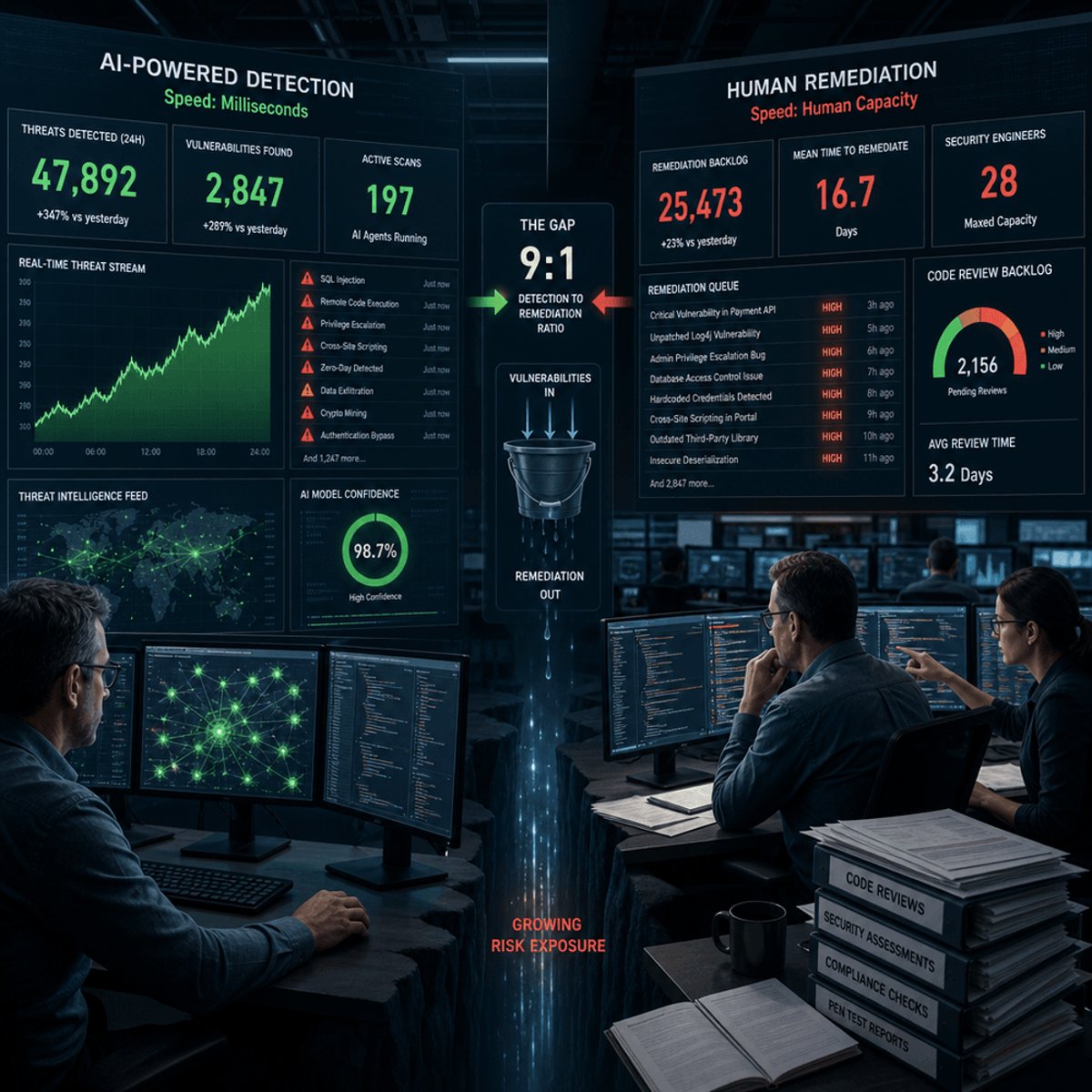
Enterprise security teams face a crushing new reality: AI-powered tools are discovering vulnerabilities at lightning speed, but the same technology meant to help fix them is making things worse. According to new research from ZDNet, AI-generated code introduces nine times as many security flaws as human developers, creating a dangerous gap between detection and remediation that's leaving organizations exposed. The asymmetry between finding bugs and actually fixing them has reached a breaking point.
Enterprise security is drowning in a flood of its own making. AI-powered vulnerability scanners are doing exactly what they were designed to do - finding security holes at unprecedented speed - but there's a critical problem nobody anticipated: the fixes can't keep up. And when companies turn to AI to help close that gap, they're actually making it worse.
The math is brutal. ZDNet reports that AI-generated code introduces nine times as many new vulnerabilities as code written by human developers. That's not a typo. For every security hole an AI tool helps patch, it's potentially creating nine more somewhere else in the codebase. It's like bailing out a sinking boat with a bucket that has holes in it.
This creates a vicious cycle that security teams are struggling to break. Modern AI scanning tools can analyze millions of lines of code in minutes, flagging potential vulnerabilities faster than any human review process. But each of those findings needs human judgment to assess severity, understand context, and implement a fix that doesn't break something else. The backlog grows exponentially while attack surfaces expand.
The problem gets worse when you look at how companies are responding. Faced with mounting vulnerability reports, many organizations are deploying AI coding assistants to speed up remediation. These tools can generate patches quickly, but they lack the security awareness and contextual understanding of experienced developers. A quick fix becomes a new exploit waiting to happen.
Security researchers have been sounding alarms about this asymmetry for months. It's far easier to find a vulnerability than to fix it properly - that's always been true. But AI has turbocharged the detection side while the remediation side remains bottlenecked by human capacity and expertise. The gap between what needs fixing and what actually gets fixed is widening every day.
Enterprise teams are learning the hard way that not all vulnerabilities are created equal. A critical remote code execution flaw demands immediate attention. A minor information disclosure in a deprecated API can wait. But when your scanning tools are generating thousands of alerts per week, figuring out which is which becomes its own full-time job. Triage processes that worked fine five years ago collapse under the weight.
The shift requires rethinking security workflows from the ground up. Instead of trying to fix everything AI finds, teams need intelligent filtering layers that can distinguish signal from noise. Automated remediation has its place, but only for well-understood, low-risk categories where the fix is standardized. Anything involving business logic or authentication still needs human eyes.
Some companies are experimenting with AI-assisted triage systems that rank vulnerabilities by actual exploitability rather than theoretical severity scores. Others are building automated testing pipelines that can validate fixes before they hit production. But these solutions require significant investment in tooling and process changes that many organizations aren't ready to make.
The irony is that AI was supposed to make security teams more effective, not overwhelm them. The technology works as advertised on the detection side - it's incredibly good at pattern matching and finding anomalies. But security isn't just about finding problems. It's about fixing them in ways that don't create new ones, and that's where the human element still matters most.
What's clear is that the old model of vulnerability management is breaking. You can't just scan everything, report everything, and expect developers to fix everything. There aren't enough hours in the day or developers on the planet. Enterprise security needs to evolve from a reactive patching mindset to a strategic risk management approach that accepts some level of vulnerability as inevitable while focusing resources where they matter most.
The AI vulnerability paradox reveals a fundamental truth about automation in security: speed without accuracy just creates different problems. Enterprise teams that adapt will be those who use AI for what it's genuinely good at - pattern detection and routine tasks - while preserving human judgment for the nuanced work of actually securing systems. The companies that try to automate everything will find themselves with cleaner scan reports and messier breaches. As AI tools continue proliferating across development workflows, the gap between finding and fixing will only widen until organizations fundamentally rethink how they approach vulnerability management in an AI-accelerated world.