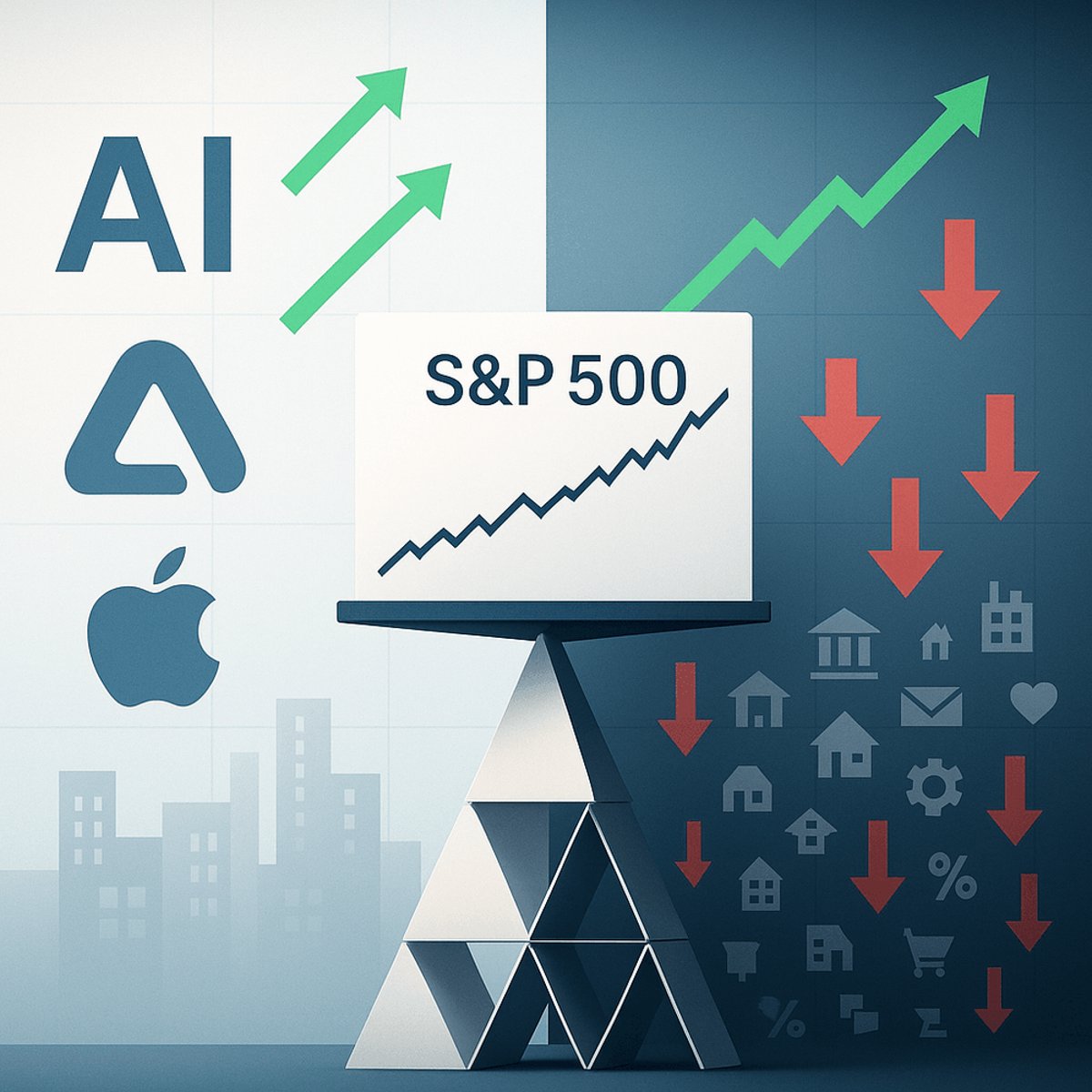
The market's telling two different stories right now. While Amazon just locked in a massive $38 billion cloud deal with OpenAI and pushed the S&P 500 to new highs, over 300 stocks in that same index actually fell Monday - revealing a dangerous concentration where only AI-powered giants are thriving while the broader market struggles.
The market just handed us a perfect example of how disconnected things have become. Amazon Web Services announced it's securing OpenAI as probably its biggest customer ever with a $38 billion infrastructure deal, and suddenly everyone's acting like the broader economy is booming. But dig beneath the surface, and you'll find a very different story.
More than 300 companies in the S&P 500 actually lost ground Monday, even as the index itself climbed higher. That's not a healthy market - that's a house of cards built on AI hype and a handful of tech giants. Amazon shares surged 4% to close at a record high, while Nvidia jumped 2.2% after Microsoft got approval to ship 60,400 additional A100 chips to the UAE.
The OpenAI deal is particularly telling. The ChatGPT maker is finally breaking free from its exclusive relationship with Microsoft, which had been its sole cloud provider until this year. According to CNBC's MacKenzie Sigalos, this diversification signals that OpenAI might be prepping for an IPO, trying to show "both independence and operational maturity."
But here's what's really happening: AI companies are burning through cash at unprecedented rates to secure computing power, and the only winners are the infrastructure providers. Amazon just locked in guaranteed revenue from one of the most well-funded startups in history, while everyone else fights for scraps.
The numbers tell the real story. Palantir beat earnings expectations with revenue guidance of $1.33 billion for Q4, crushing the $1.19 billion analysts expected. Yet shares still dropped 4.3% in after-hours trading because investors are getting pickier about which AI plays actually make sense.
Meanwhile, traditional sectors are getting hammered. European markets stayed flat despite auto stocks like Renault and Volkswagen showing some life. But that's not enough to offset the broader weakness across industries that don't have "AI" in their pitch decks.
The Microsoft-UAE chip deal adds another layer to this narrative. The Commerce Department license, granted back in September, allows shipment of Nvidia's advanced GB300 graphics processing units. It's a geopolitical chess move disguised as a business transaction, with AI chips becoming the new oil in international relations.
What we're seeing is market concentration at levels that should worry anyone who remembers previous tech bubbles. The S&P 500 and Nasdaq keep hitting new highs, but they're being carried by maybe a dozen companies while hundreds of others slide backward. According to recent CNBC analysis, only a narrow segment of the market is actually performing well.
This kind of bifurcation doesn't end well historically. When markets become this dependent on a few mega-cap stocks, any stumble in AI sentiment or earnings disappointment from the tech giants can trigger widespread selling. We've already seen hints of this with Palantir's post-earnings drop despite beating expectations.
The Amazon-OpenAI deal might look like a win-win on paper, but it's really just another example of how AI is creating winner-take-all dynamics across the economy. Small and mid-cap companies that can't afford $38 billion infrastructure deals are getting left behind, and that's showing up in the market's internal metrics.
The market's current rally is built on shaky foundations. While AI deals like Amazon's $38 billion OpenAI contract grab headlines and push indices higher, the fact that 300+ S&P 500 stocks declined on the same day reveals dangerous concentration risk. Investors betting on this narrow tech leadership continuing indefinitely might want to reconsider - markets this lopsided rarely stay balanced for long.