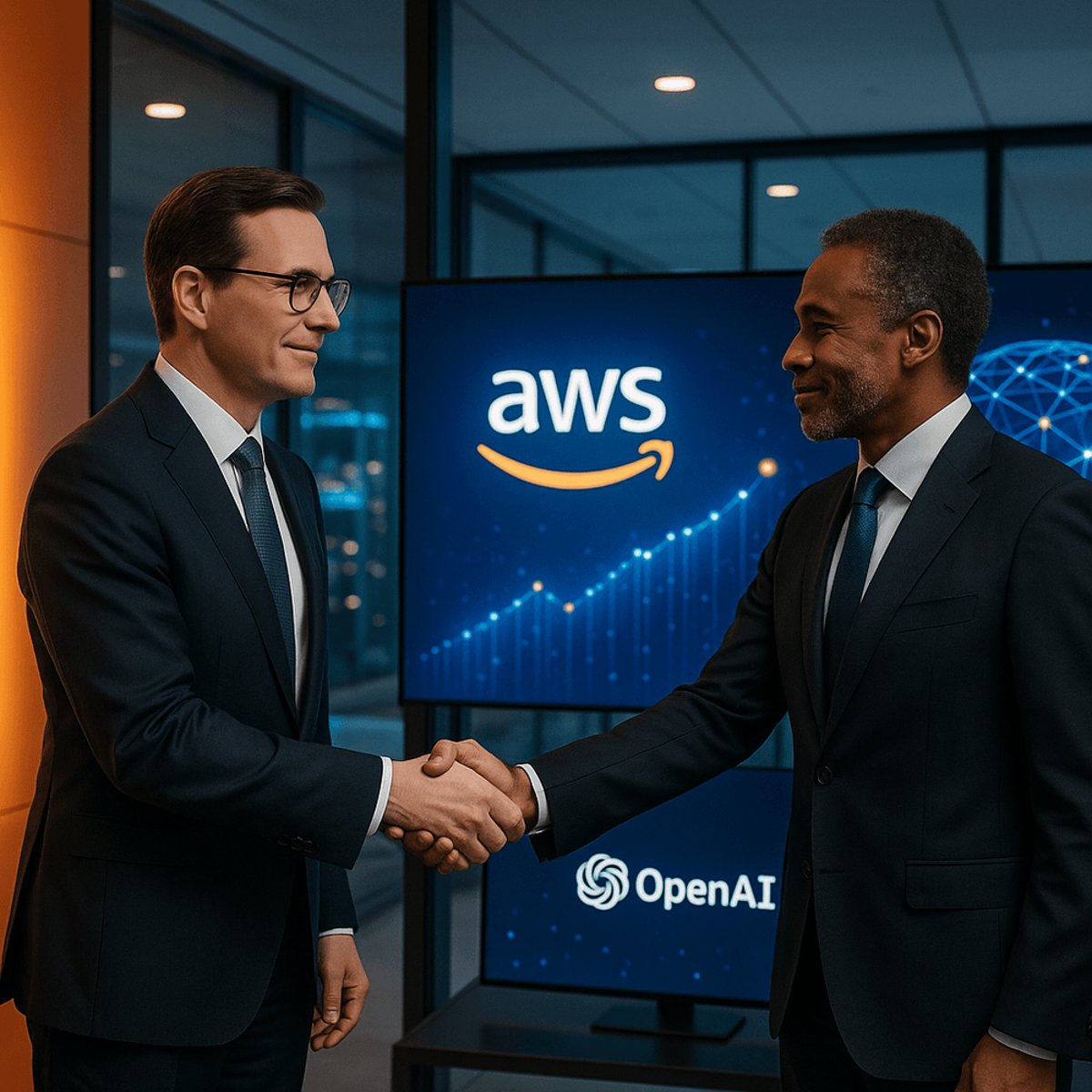
Amazon just dropped the biggest AI deal of the year. CEO Andy Jassy announced a $50 billion investment in OpenAI as part of a sweeping multi-year strategic partnership that could reshape the enterprise AI landscape. The move positions Amazon Web Services as OpenAI's primary cloud infrastructure partner while giving Amazon unprecedented access to cutting-edge AI models for its e-commerce and cloud businesses.
Amazon CEO Andy Jassy just made the company's boldest AI bet yet. The $50 billion investment in OpenAI announced today represents one of the largest strategic partnerships in tech history, according to Amazon's official announcement. The deal comes as Amazon races to catch up with Microsoft and Google in the generative AI arms race.
The partnership centers on making AWS the primary cloud infrastructure provider for OpenAI's compute-intensive operations. OpenAI will leverage AWS's massive data center footprint to train and deploy its next generation of AI models, while Amazon gets privileged access to integrate OpenAI's technology across its entire ecosystem. It's a win-win that threatens to upend existing alliances in Silicon Valley.
Jassy's move directly challenges Microsoft's existing relationship with OpenAI, which has invested roughly $13 billion since 2019. That partnership made Microsoft the exclusive cloud provider for OpenAI and powered the integration of ChatGPT into Microsoft's product suite. But Amazon's massive investment - nearly four times Microsoft's total commitment - changes the calculus entirely.
The timing couldn't be more strategic. Amazon has faced mounting criticism that it's lagged behind competitors in generative AI despite its cloud dominance. While Microsoft embedded AI across Office and Azure, and Google rushed out Bard and Gemini, Amazon's AI efforts felt scattered. The company's Alexa assistant has struggled to evolve beyond basic commands, and AWS customers have increasingly looked to competitors for cutting-edge AI capabilities.
This deal addresses those gaps head-on. Amazon plans to integrate OpenAI's models into Alexa, making the voice assistant dramatically more conversational and capable. AWS customers will get streamlined access to OpenAI's APIs and models through native integrations, eliminating the friction of working with external providers. Amazon's e-commerce platform will leverage the technology for everything from customer service to product recommendations to automated content generation.
The financial structure reveals Amazon's commitment to making this work. The $50 billion investment will flow to OpenAI over multiple years, funding the astronomical compute costs required to train ever-larger AI models. In exchange, Amazon secures preferred pricing, priority access to new models, and deep technical collaboration on optimizing AI workloads for AWS infrastructure. Sources familiar with the deal say Amazon also negotiated governance rights, though specifics remain undisclosed.
For OpenAI, the partnership solves a critical challenge - diversifying beyond Microsoft while securing the resources needed to maintain its lead in AI research. The company's compute requirements have grown exponentially as models scale from GPT-4 to future iterations. Having two hyperscale cloud providers competing to support its infrastructure gives OpenAI negotiating leverage and technical redundancy.
The deal sends shockwaves through the competitive landscape. Google now faces the combined forces of Amazon's distribution and OpenAI's models, intensifying pressure on its Gemini AI efforts. Meta, which has pursued an open-source AI strategy with Llama, must contend with even deeper-pocketed rivals. Startups building on OpenAI's platform gain access to AWS's global infrastructure, but may face pressure to choose sides in an increasingly polarized ecosystem.
Wall Street is already recalibrating expectations. The partnership validates Amazon's cloud dominance while confirming that AI leadership requires massive capital commitments. Analysts at Wedbush estimate the deal could add $15-20 billion in annual revenue to AWS within three years as enterprise customers adopt AI workloads at scale. But the investment also raises questions about profitability timelines, given the notoriously expensive nature of training and running large language models.
Industry observers note the deal's implications extend beyond technology. By anchoring OpenAI more firmly in the US tech ecosystem, Amazon and OpenAI are making a strategic bet on American AI leadership at a time of intensifying global competition with China. The partnership could accelerate regulatory scrutiny, as lawmakers grow concerned about concentration of AI power among a handful of tech giants.
What happens next will shape the industry for years. Amazon must execute flawlessly on integrating OpenAI's technology across its sprawling businesses while avoiding the missteps that plagued Google's Bard launch. OpenAI faces the delicate challenge of maintaining its relationship with Microsoft while building deep technical ties with Amazon. And every other company in tech must now reassess its AI strategy in light of this new reality.
Amazon's $50 billion bet on OpenAI represents a watershed moment in the AI wars. It's not just about money - though the scale is staggering - it's about Amazon leveraging its cloud dominance to finally claim a leadership position in generative AI. For enterprise customers, this means AWS just became a far more compelling AI platform. For consumers, it promises a dramatically smarter Alexa and AI-powered shopping experiences. And for the broader tech industry, it confirms that winning in AI requires hyperscale resources and strategic partnerships. The next chapter of the AI revolution will be written by companies willing to invest at this magnitude, and Amazon just forced every competitor to match or fold.