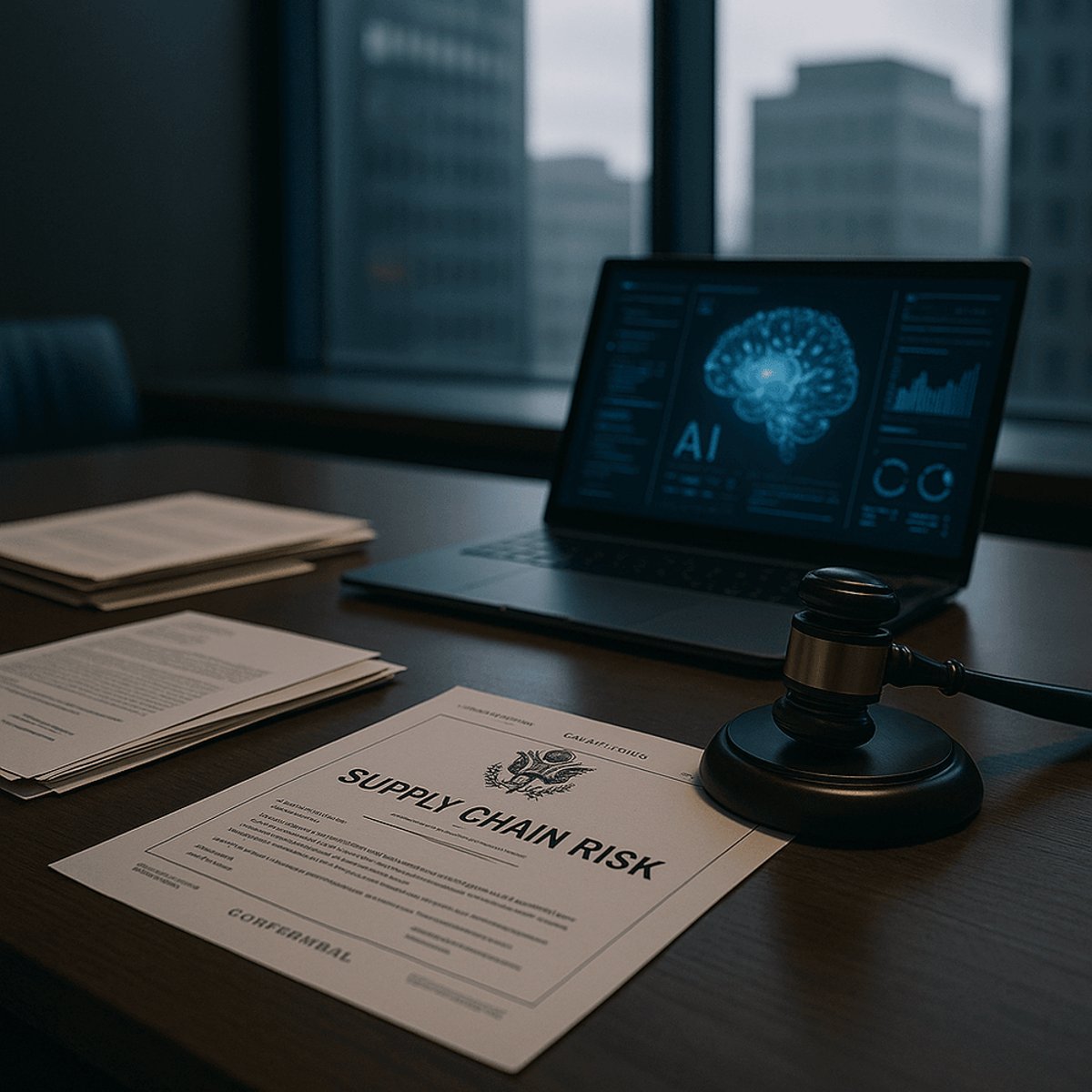
A federal appeals court just denied Anthropic's emergency request to temporarily halt the Pentagon's blacklisting of the AI startup, dealing a significant blow to the company's ability to compete for defense contracts. The ruling means Anthropic remains on the Department of Defense's supply chain risk list while its lawsuit challenging the designation moves forward, potentially shutting the company out of lucrative government AI deals at a critical moment for the industry.
Anthropic hit a major legal roadblock in its fight against Pentagon blacklisting. A federal appeals court denied the AI company's request for a stay, leaving the startup on the Department of Defense's supply chain risk list while its lawsuit grinds through the court system.
The decision, handed down Wednesday evening according to court documents via CNBC, means Anthropic can't bid on or participate in DOD contracts for the foreseeable future. That's a painful setback for a company that's been positioning itself as a safer, more transparent alternative to rivals like OpenAI and Google in the enterprise AI market.
The Pentagon's supply chain risk designation typically gets applied to companies with foreign ownership concerns or security vulnerabilities that could compromise national defense systems. What landed Anthropic on the list remains unclear from public filings, but the company clearly considers the designation damaging enough to wage an aggressive legal battle.
Timing couldn't be worse for Anthropic. The federal government has become one of the biggest potential customers for AI technology, with agencies from the Pentagon to the intelligence community racing to integrate large language models into everything from logistics to threat analysis. Microsoft recently scored a multi-billion dollar contract to provide AI services across defense agencies, while Amazon has been building out its AWS GovCloud specifically for classified AI workloads.
Anthopic raised $7.3 billion in its last funding round, reaching a valuation near $18 billion with backing from Google, Salesforce, and others. The company built its reputation on Claude, its AI assistant designed with what it calls "constitutional AI" principles focused on safety and reliability. That positioning made government contracts seem like a natural fit.
But the appeals court wasn't convinced that Anthropic faced immediate irreparable harm from staying on the blacklist during litigation. The legal standard for granting a stay requires showing not just potential damage, but harm so severe that monetary compensation later wouldn't suffice. The court's denial suggests judges didn't buy Anthropic's argument that missing out on Pentagon contracts while the case proceeds crosses that threshold.
The broader context here involves increasing scrutiny of AI companies' foreign ties and data security practices. Congress has been pushing the Pentagon to tighten restrictions on which AI providers can access sensitive defense systems, worried about potential backdoors or data leakage to adversaries. Several bills working through committees would impose new security certifications and auditing requirements on AI contractors.
Anthopic's competitors aren't sitting idle. OpenAI recently announced it was lifting its ban on military applications, explicitly opening the door to defense contracts. Palantir, already deeply embedded in defense and intelligence work, has been integrating various AI models into its platforms and promoting itself as the secure gateway for government AI deployment.
The lawsuit itself continues in district court, where Anthropic is challenging both the process by which it was blacklisted and the underlying justification. The company argues the designation was arbitrary and violated administrative procedure rules. But without a stay, it faces months or potentially years on the sidelines of government contracting while that case unfolds.
For investors who poured billions into Anthropic partly on the promise of enterprise and government revenue, this ruling raises uncomfortable questions. Government contracts offer not just money but validation and sticky, long-term relationships. Being shut out of that market while competitors rush in could reshape the competitive landscape.
The Pentagon hasn't publicly commented on the specifics of Anthropic's case, citing ongoing litigation. But defense officials have made clear they're taking supply chain security seriously after years of warnings about vulnerabilities in everything from semiconductors to software providers.
What happens next depends partly on how aggressively Anthropic pursues its lawsuit and whether it can convince a trial court that the blacklisting was unjustified. But the appeals court's refusal to grant even temporary relief suggests the company faces an uphill battle.
The appeals court denial leaves Anthropic in legal limbo, barred from Pentagon contracts while its competitors move aggressively into government AI. For a company that built its brand on safety and trustworthiness, being labeled a supply chain risk by the DOD carries reputational damage beyond just lost revenue. The case will test whether Anthropic can prove the blacklisting was unjustified, but in the fast-moving AI market, months on the sidelines might prove costly regardless of the eventual legal outcome. Investors and customers will be watching closely to see whether this becomes a temporary speed bump or a fundamental obstacle to Anthropic's growth trajectory.