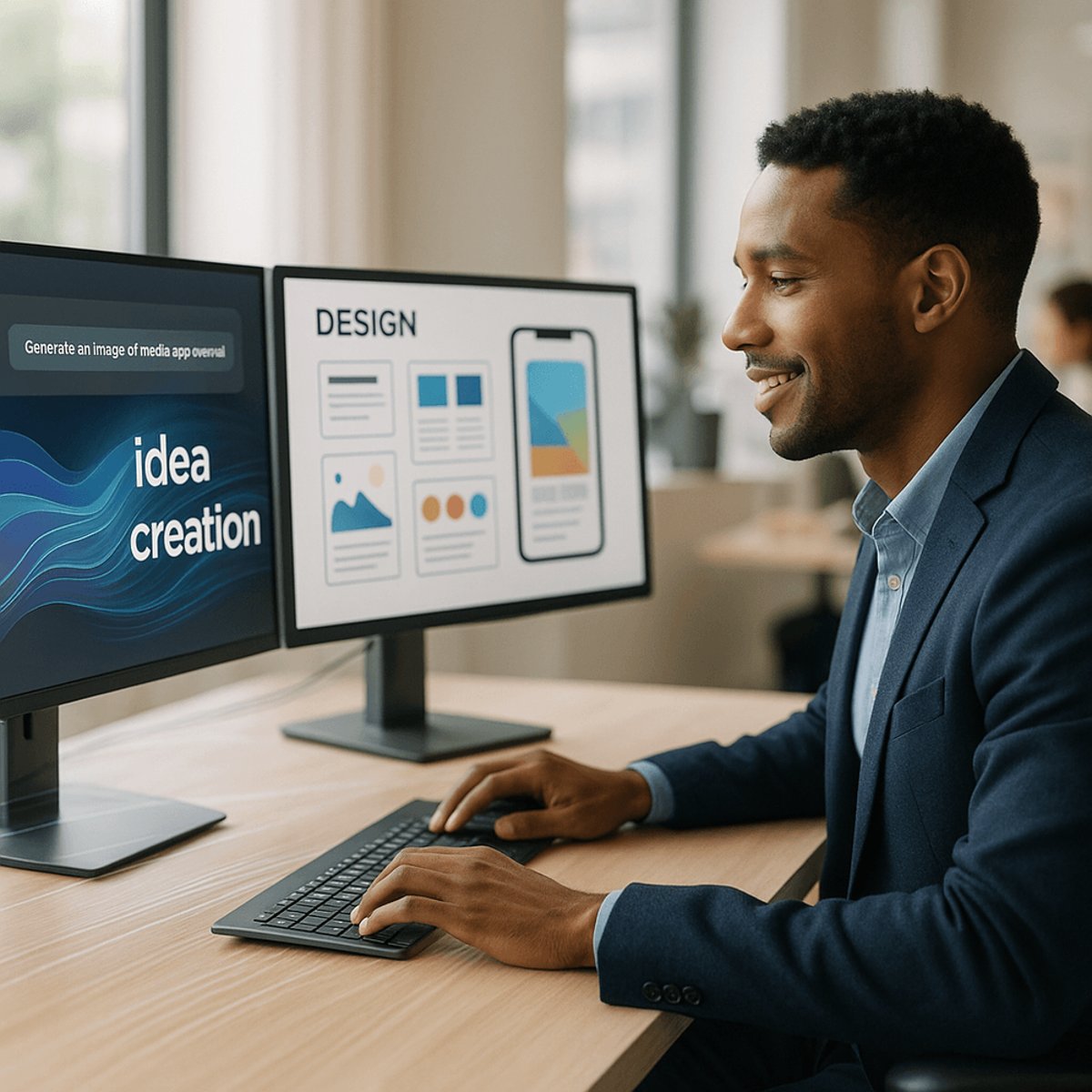
Anthropic just expanded Claude's capabilities beyond conversation. The AI lab today unveiled Claude Design, a new product that lets founders, product managers, and other non-designers create visuals without touching Figma or hiring a designer. It's the company's latest move to push AI into enterprise productivity workflows, targeting the massive gap between having an idea and being able to show it. According to TechCrunch, the tool is specifically built for people who need to share ideas quickly but lack design backgrounds.
Anthropic is making a play for the design tools market with Claude Design, a new product that promises to turn text prompts into presentation-ready visuals. The launch positions the AI lab squarely against the growing field of AI-powered design assistants, from Canva's Magic Design to Microsoft's Designer.
The timing is strategic. As companies race to reduce design bottlenecks, the market for AI design tools is exploding. Claude Design targets a specific pain point - the product manager who needs a quick mockup for a stakeholder meeting, or the founder sketching out a pitch deck at midnight. "The company says Claude Design is intended to help people like founders and product managers without a design background share their ideas more easily," according to TechCrunch's report.
This marks a significant shift for Anthropic, which has primarily focused on conversational AI and advanced reasoning capabilities with its Claude models. While competitors like OpenAI have expanded into image generation with DALL-E and code generation with tools embedded in ChatGPT, Anthropic has remained relatively focused on text-based interactions. Claude Design represents the company's first major move into visual creation tools.
The product arrives as enterprises struggle with visual communication bottlenecks. Design teams are overwhelmed, while non-designers waste hours in Figma trying to create basic wireframes or slides. Claude Design appears designed to fill that gap - not replacing professional designers, but enabling quick iteration and idea-sharing for teams moving at startup speed.
What sets this apart from existing AI design tools isn't entirely clear from the initial announcement, but Anthropic's track record with Claude suggests a focus on natural language understanding and contextual awareness. If Claude Design can understand nuanced requests like "make this look more professional but keep the playful vibe," it could have an edge over template-based competitors.
The competitive landscape is crowded. Canva has been aggressively integrating AI features into its platform, while Adobe's Firefly brings generative AI to creative professionals. Microsoft Designer targets Office users, and dozens of startups are building AI-first design tools. But none of these competitors have Claude's conversational AI foundation, which could make Claude Design more intuitive for complex, multi-step design requests.
For enterprise customers, the appeal is obvious - faster iteration cycles, reduced dependency on design resources, and the ability to visualize ideas in real-time during brainstorming sessions. Startups, perpetually strapped for design budget, could use Claude Design to create investor decks, product mockups, and marketing materials without hiring contractors.
The launch also signals Anthropic's broader strategy to embed Claude across enterprise workflows. After securing major partnerships and reportedly reaching billions in annualized revenue, the company is pushing beyond chatbots into specialized productivity tools. Claude Design could be the first of several vertical-specific products built on top of the core Claude models.
What remains to be seen is how Claude Design handles complex design requirements, brand consistency, and the kind of iterative feedback loops that professional designers navigate daily. Early adopters will likely test the tool's limits quickly - can it maintain visual consistency across a 30-slide deck? Does it understand design principles like hierarchy and white space? Can it adapt to specific brand guidelines?
The product's success will hinge on whether it can deliver genuinely useful output without the learning curve of traditional design tools. If Claude Design produces generic-looking visuals that still require significant cleanup, it risks becoming another AI novelty rather than a genuine workflow enhancer. But if it can nail the 80% use case - the quick mockup, the draft slide, the rough concept - it could fundamentally change how non-designers communicate visually.
Anthropic hasn't disclosed pricing, availability, or technical details about how Claude Design works under the hood. The company also hasn't revealed whether the tool will be integrated into existing Claude subscriptions or offered as a standalone product. Those details will be critical for assessing its market impact.
Claude Design represents Anthropic's bet that the future of enterprise productivity involves AI handling more than just text. If the tool can deliver on its promise of making visual creation accessible to non-designers, it could accelerate how quickly ideas move from concept to communication. But the real test will be whether it produces work that's actually useful - not just impressive for an AI, but genuinely good enough to replace the scrappy mockups and slide decks that founders and PMs currently struggle to create. The launch positions Anthropic directly against established design platforms and AI-native competitors, turning what was primarily a conversational AI company into a broader enterprise productivity player. Watch how quickly teams actually adopt it versus how much it gets hyped.