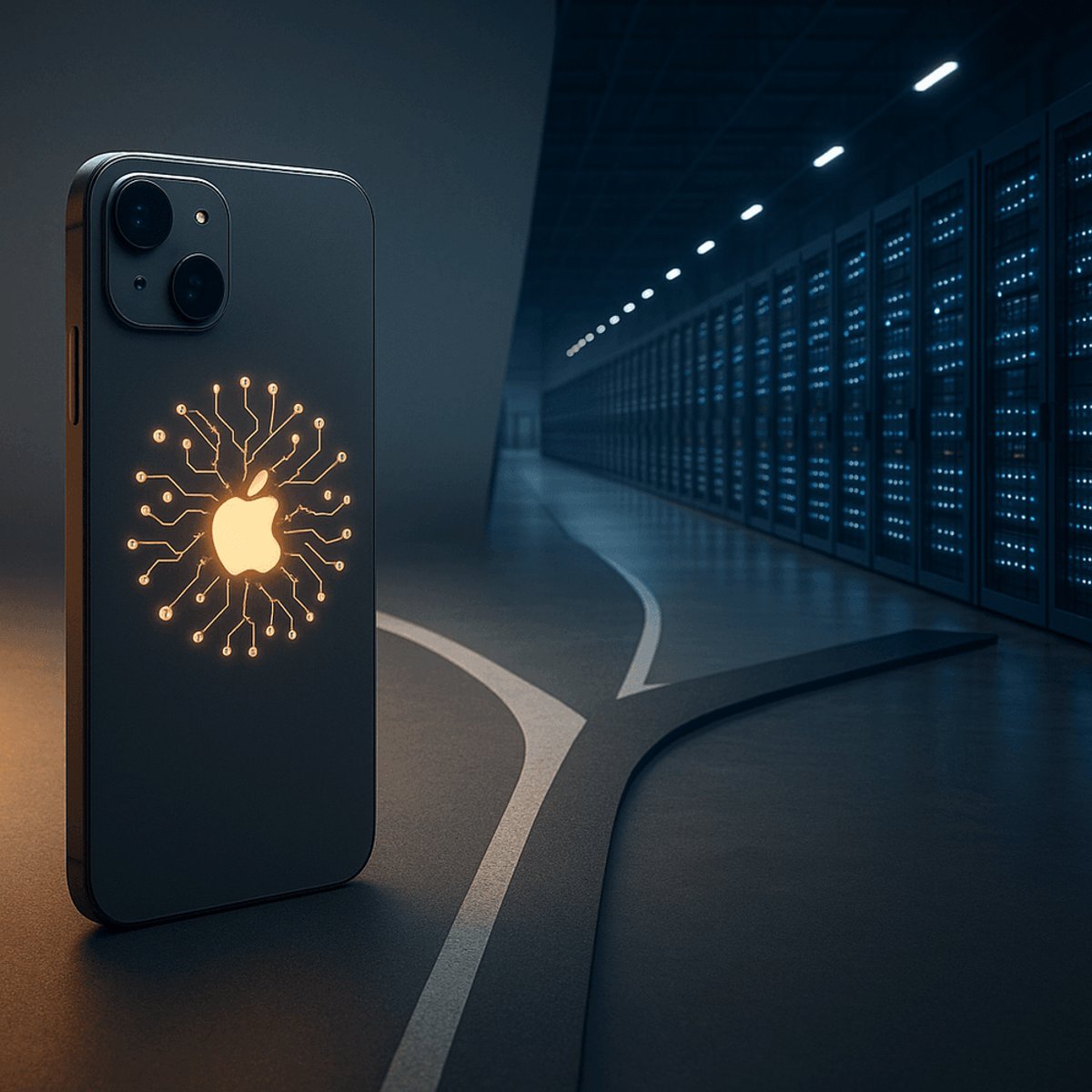
Apple is taking a radically different approach to the AI infrastructure war, and Wall Street's starting to wonder if it's brilliant or reckless. The iPhone maker allocated just $12.72 billion to AI-related capital expenditures in fiscal 2025, according to CNBC's analysis of recent filings. That's pocket change compared to the hyperscalers—Microsoft, Google, Amazon, and Meta are each pouring $50 billion-plus into data centers, chips, and AI infrastructure. The question now: Can Apple's restrained, device-first strategy actually win in an era where raw compute seems to be everything?
Apple just laid bare the starkest divide in Big Tech's AI strategy. While every other tech giant scrambles to outspend each other on data centers and GPUs, Apple's staying conspicuously disciplined. The company's $12.72 billion in AI-related capital expenditures for fiscal 2025 looks almost quaint next to the infrastructure arms race unfolding across Silicon Valley.
Microsoft is expected to spend upwards of $80 billion this year on AI infrastructure alone, according to analyst estimates. Google and Amazon aren't far behind, each committing $50-75 billion to build out cloud AI capabilities and custom chip development. Meta recently announced plans to acquire 350,000 Nvidia H100 GPUs, a spend that dwarfs Apple's entire AI capex budget. The hyperscalers are essentially in a Cold War-style buildup, treating AI infrastructure as existential.
But Apple's playing a different game entirely. The company's approach centers on what it calls "Apple Intelligence"—AI that runs primarily on-device rather than in the cloud. This strategy leverages Apple's custom silicon advantage, particularly the Neural Engine built into its A-series and M-series chips. Instead of building massive data centers to train frontier models, Apple's optimizing for inference at the edge, keeping user data local while delivering AI features through its installed base of 2 billion active devices.
The financial logic is compelling. Cloud AI infrastructure carries brutal economics: constant hardware refreshes, massive energy costs, and razor-thin margins on compute services. Apple's approach preserves its legendary 40%+ gross margins while staying true to its privacy-first positioning. "We're not in the business of collecting user data," Apple executives have said repeatedly, and the capex strategy backs that up.
But there's real risk in this restraint. Enterprise AI is rapidly becoming a winner-take-all market, and it runs on cloud infrastructure that Apple simply doesn't have at scale. Microsoft's Copilot is now embedded across Office and Azure, generating billions in new revenue. Google's Gemini powers everything from search to workspace tools. Amazon Web Services is the backbone of AI startups everywhere. Apple has virtually no presence in this massive and fast-growing segment.
Consumer AI is shifting too. The most impressive AI experiences—real-time language translation, advanced image generation, complex reasoning—still require cloud-scale models that exceed what on-device chips can handle. Apple's partnership with OpenAI to integrate ChatGPT into iOS feels like an admission of this reality. The company that prides itself on vertical integration is outsourcing one of technology's most strategic capabilities.
Wall Street is split on whether Apple's discipline is visionary or dangerous. Bulls argue the company's capital efficiency and ecosystem lock-in mean it doesn't need to win the infrastructure race—it just needs to deliver enough AI features to keep users upgrading iPhones. The device-first approach could age better than today's data center spending spree, especially if on-device AI catches up to cloud capabilities faster than expected.
Bears counter that Apple's underinvesting in the defining technology shift of the decade. The company's late to the party on generative AI, lacks competitive large language models, and has no cloud platform to speak of. If AI becomes table stakes in consumer devices—something rivals can easily replicate through partnerships—Apple loses its premium pricing power. And if enterprise becomes an AI-first market, Apple's sitting out entirely.
The timing adds pressure. Apple's Services revenue growth is slowing, iPhone sales are flat, and the company needs a new growth driver. AI was supposed to be that catalyst, but the fiscal 2025 capex numbers suggest Apple's not betting the farm on it. Compare that to Microsoft, which is restructuring its entire business around AI, or Meta, which is treating Llama and AI infrastructure as its future.
There's also a geopolitical dimension. The U.S. is treating AI infrastructure as national security, with massive subsidies for domestic chip production and data center buildouts. Apple's limited AI capex means less leverage in policy conversations and potentially less access to government support that rivals are securing. China's AI infrastructure push is even more aggressive, and Apple's already navigating a complicated relationship there.
The real test comes this year. Apple needs to show that its on-device AI can deliver experiences that justify its premium pricing, even without the massive cloud infrastructure rivals possess. If Siri actually becomes useful, if Apple Intelligence features drive iPhone 17 upgrades, if the company can monetize AI without compromising privacy—then the restrained capex will look like genius. But if consumers start favoring Android devices with more powerful cloud-backed AI, or if enterprises standardize on Microsoft and Google AI tools, Apple's $12.72 billion might be remembered as the bet that lost the AI era.
Apple's walking a tightrope between capital discipline and strategic risk. The $12.72 billion AI capex figure isn't necessarily a mistake—it reflects a genuine architectural bet that on-device AI can compete with cloud-scale models, preserving both margins and privacy principles that define the brand. But the gap with rivals is staggering, and it's growing. If the next phase of AI competition favors massive infrastructure and enterprise integration, Apple's restraint could cost it dearly. The company has surprised skeptics before, turning constraints into advantages. Whether it can pull that off again in the AI era depends on execution we haven't seen yet—and a market that might not wait for Apple to catch up.