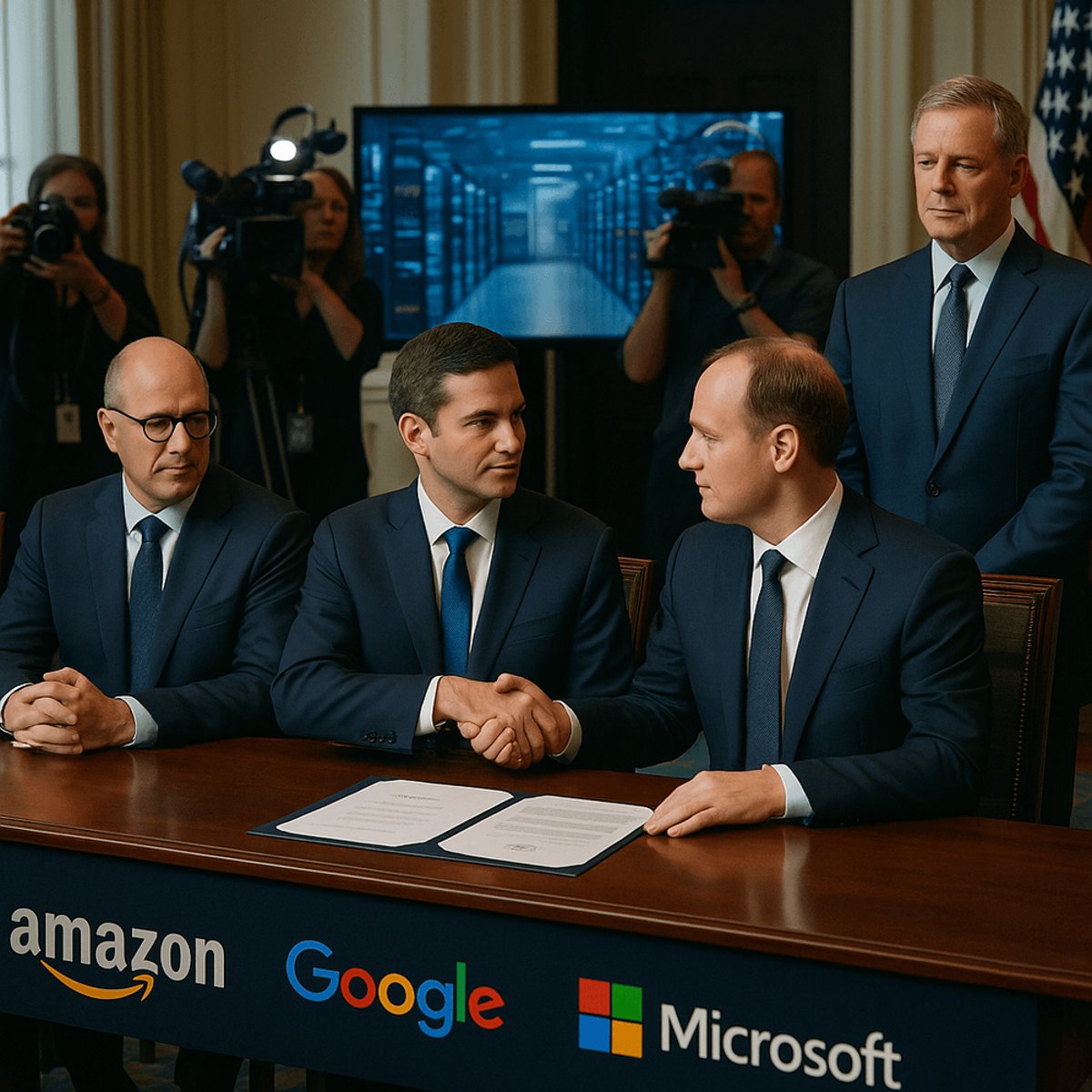
President Trump convened tech's biggest players at the White House this week for what he admitted was a PR exercise. "Data centers... they need some PR help," Trump said at an event where Amazon, Google, Microsoft, and Meta signed a pledge on AI infrastructure that's drawing criticism for lacking concrete commitments. The signing comes as data center energy consumption threatens to outpace the national grid's capacity, yet industry observers say the agreement offers little beyond optics.
The White House rolled out the red carpet for Big Tech this week, but what emerged was more photo opportunity than policy breakthrough. President Trump gathered executives from Amazon, Google, Microsoft, and Meta to sign a data center pledge that even he acknowledged was primarily about image management.
"Data centers... they need some PR help," Trump told attendees at the event, in a rare moment of candor that captured the essence of the gathering. The statement underscores what critics have been saying for months - that the AI industry's infrastructure boom has created a public relations problem as much as a technical one.
The timing isn't accidental. Data centers powering AI models like ChatGPT and Google's Gemini now consume electricity at rates that alarm utility companies and climate advocates alike. Microsoft alone plans to triple its data center capacity by 2027, while Amazon Web Services is on track to become one of the nation's largest power consumers. Yet the pledge signed at the White House contains few binding commitments on energy efficiency, renewable power sourcing, or grid impact mitigation.
Industry watchers note the agreement's language focuses heavily on collaboration and best practices - the kind of corporate speak that sounds substantive but commits companies to little. There are no specific emissions targets, no enforceable timelines, and no penalties for non-compliance. It's a voluntary framework in an industry that's shown little inclination to voluntarily slow its infrastructure expansion.
The political calculus is straightforward. The Trump administration wants to position itself as AI-friendly while addressing mounting concerns about data centers straining local power grids and water supplies. Tech companies get White House validation and the appearance of taking action without actual regulatory constraints. Everyone leaves with what they came for - except perhaps the communities dealing with data center impacts.
Google and Microsoft have both made previous climate commitments that include data center operations, yet both companies have seen emissions rise as AI workloads grew. Meta continues building massive facilities across the country despite local opposition in several markets. Amazon has faced criticism for the environmental impact of AWS expansion even as it touts renewable energy investments.
The gap between corporate sustainability messaging and actual infrastructure growth has never been wider. Data centers built today will operate for decades, locking in energy consumption patterns that pledges and press releases can't easily change. Nuclear power options, which some tech companies are exploring, remain years away from deployment at scale.
Energy experts point out that voluntary agreements have a poor track record in industries facing explosive growth. Without regulatory frameworks or market incentives, companies optimize for speed and capacity rather than efficiency. The AI arms race between tech giants only intensifies this dynamic, with each company racing to build more compute power than competitors.
The White House event also sidesteps thornier questions about data center locations, water usage for cooling systems, and impacts on local electricity rates. These issues have sparked conflicts in Virginia, Arizona, and other data center hubs, where residents find themselves competing with tech facilities for power and resources.
What the pledge does accomplish is giving tech companies political cover to continue expansion plans largely unchanged. By participating in a White House initiative, they can point to government engagement while pursuing the same infrastructure trajectory that prompted criticism in the first place. It's a classic Washington maneuver - create the appearance of action to forestall demands for actual regulation.
The White House data center pledge represents everything that's wrong with voluntary corporate commitments on critical infrastructure issues. Trump's own assessment - that it's about PR - may be the most honest thing said at the event. As AI continues its exponential growth, the industry needs actual regulation and enforceable standards, not photo ops and vague promises. The question isn't whether data centers need better optics, but whether policymakers will demand substance to match. So far, the answer appears to be no.