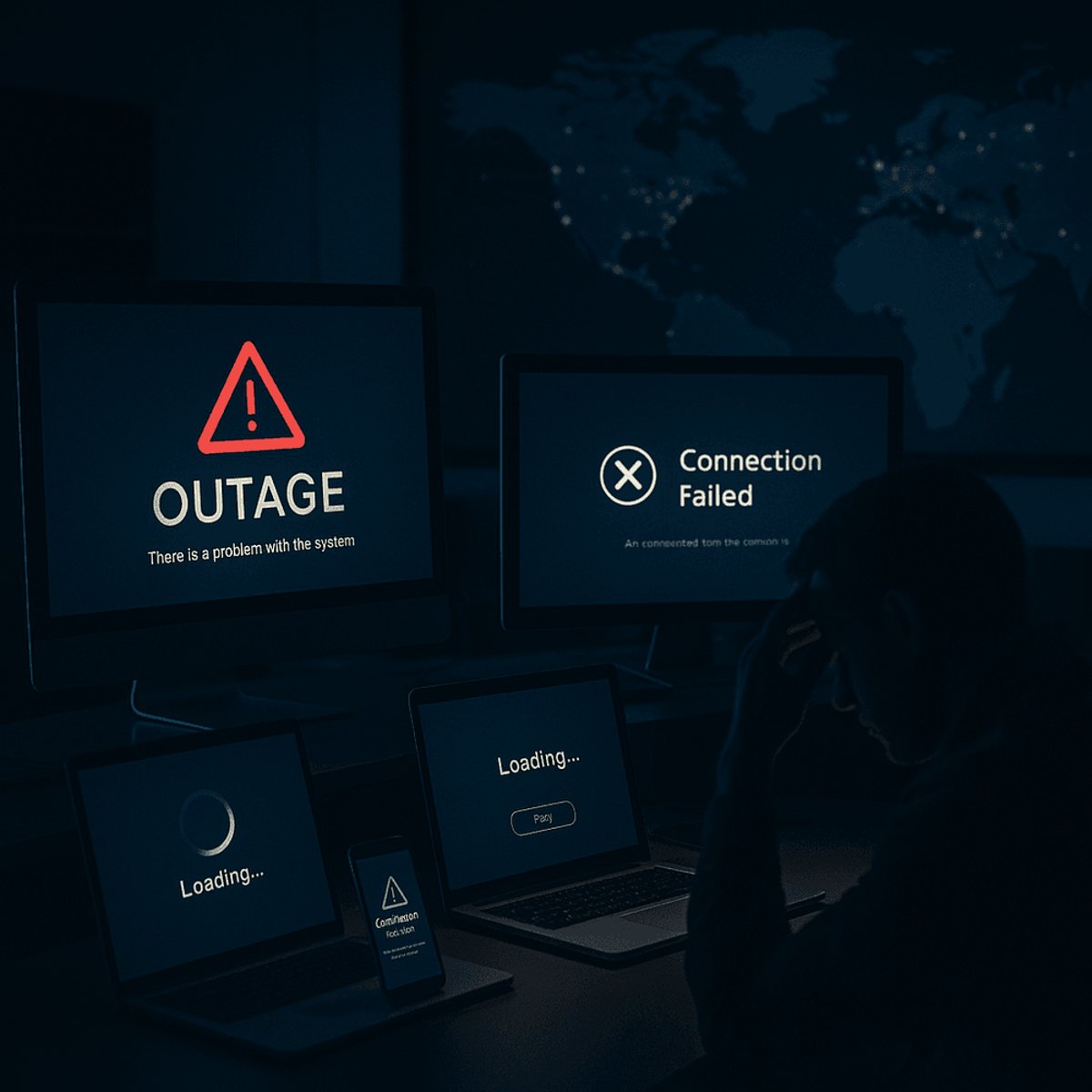
OpenAI is battling a widespread ChatGPT outage that's leaving millions of users staring at error messages instead of AI responses. The company acknowledges "increased error rates" across its flagship chatbot and says it's applied a mitigation while monitoring recovery. With over 800 million weekly users depending on the service, this outage hits right at the heart of the AI revolution OpenAI sparked three years ago.
OpenAI is scrambling to fix a major ChatGPT outage that's disrupting service for users worldwide, marking one of the most significant disruptions to hit the AI giant's flagship product in recent memory.
The company confirmed it's "currently experiencing issues" with ChatGPT, including what it describes as "increased error rates," according to updates posted on OpenAI's status page. Users attempting to access the chatbot are encountering connection failures and timeout errors instead of the usual AI-powered responses they've come to rely on.
"We have applied the mitigation and are monitoring the recovery," OpenAI stated on its status page, though the company hasn't provided a timeline for when full service might be restored. The measured language suggests this isn't a quick fix - the kind of technical hiccup that gets resolved in minutes rather than hours.
The scale of the disruption becomes clear when you consider ChatGPT's massive user base. As of October, OpenAI reported that more than 800 million people use the chatbot each week - that's roughly one in ten people on the planet. Even a brief outage affects millions of users who've integrated ChatGPT into their daily workflows, from students drafting papers to professionals analyzing data.
Downdetector, which tracks service outages across the web, logged roughly 3,000 user reports of ChatGPT issues on Tuesday. That number likely represents just the tip of the iceberg, as most users don't actively report outages to tracking sites when services go down.
The timing adds another layer of concern. This outage comes just days after OpenAI disclosed a significant security breach at Mixpanel, one of its key data analytics providers. That incident saw an attacker export "a dataset containing limited customer identifiable information and analytics information," including user names, emails, and other details tied to the OpenAI API.
While OpenAI hasn't suggested any connection between the security breach and today's outage, the rapid succession of incidents will likely raise questions about the company's infrastructure stability. For a company that's positioned itself as the leader of the AI revolution, reliability concerns could prove costly as competitors like Google and Microsoft push their own AI offerings.
The outage also highlights how dependent businesses and individuals have become on AI services in just three short years. Since ChatGPT launched in November 2022, it's fundamentally changed how people approach writing, research, coding, and problem-solving. Companies have built entire workflows around AI assistance, making outages like this more than just an inconvenience.
For OpenAI, maintaining uptime isn't just about user satisfaction - it's about proving AI can be trusted for mission-critical applications. Enterprise customers paying for ChatGPT Plus and API access expect the same reliability they'd demand from any essential business tool.
The company's response will be closely watched by both users and investors. OpenAI's recent $157 billion valuation partly rests on its ability to deliver consistent, scalable AI services that can handle massive global demand.
This ChatGPT outage serves as a stark reminder that even the most revolutionary technology platforms can stumble. For OpenAI, the challenge isn't just fixing today's technical issues - it's proving that AI services can match the reliability expectations that come with their growing importance in daily life. As millions of users wait for service to resume, the incident underscores both how far AI has come and how much we now depend on it working smoothly.