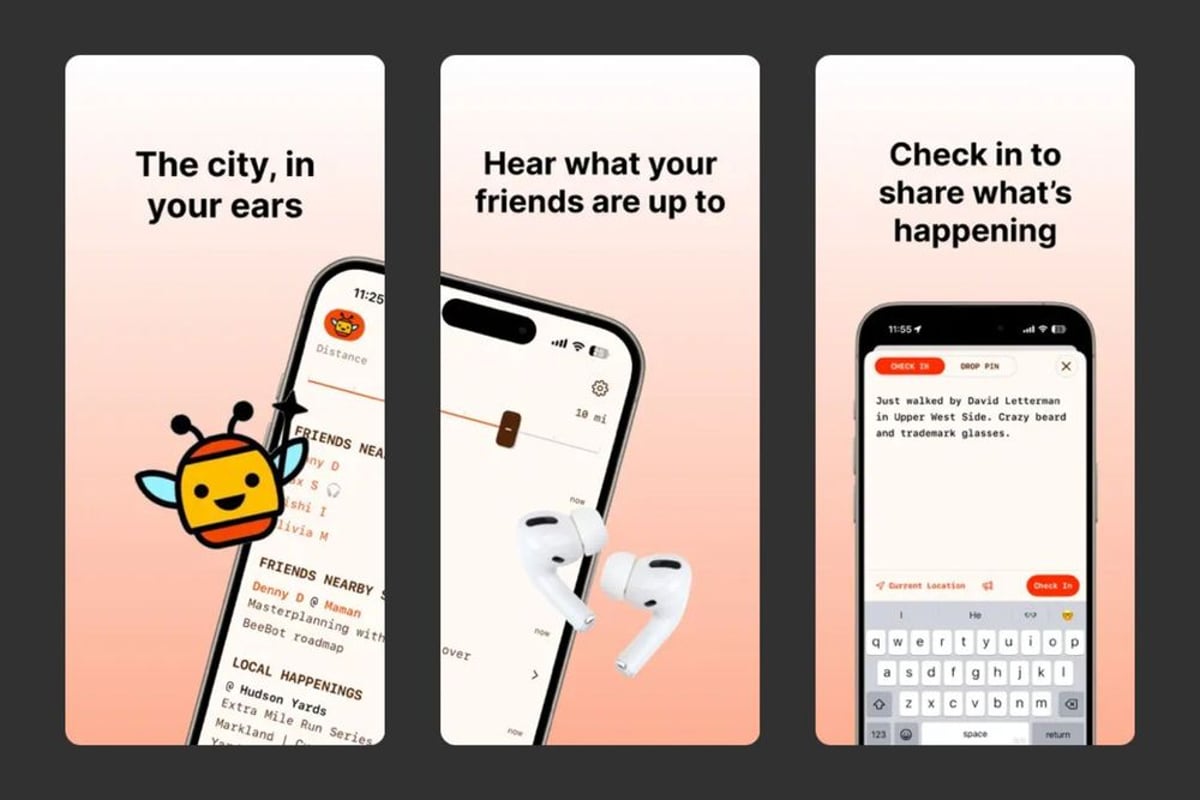
Dennis Crowley just dropped BeeBot, an AI-powered app that turns your daily walk into a personalized audio newscast about your neighborhood. The Foursquare co-founder's latest venture acts like a location-aware radio DJ, whispering updates about friends, local events, and neighborhood happenings directly into your headphones - but only a few times a day to avoid being annoying.
Dennis Crowley just pulled off something that sounds straight out of Black Mirror, but in a good way. The Foursquare co-founder launched BeeBot today, an AI-powered app that whispers hyperlocal news directly into your ears as you walk around your neighborhood.
The concept is brilliantly simple yet eerily futuristic. Pop in your headphones, and BeeBot becomes your personal neighborhood correspondent, delivering bite-sized audio updates about what friends are doing nearby, local events happening around the corner, and the kind of hyperlocal gossip that makes city living feel more connected. "The vibe we're going for is more 'Waze meets Gossip Girl,' and less 'Wikipedia in your ears,'" Crowley explained in his Medium announcement.
This isn't just another notification app trying to grab your attention. BeeBot is designed to be ambient and unobtrusive - users get updates only a few times per day, "but not 10x/day," Crowley promises. The app automatically activates when you put headphones in and politely lowers your music volume to share its updates, then seamlessly returns you to whatever you were listening to. It won't interrupt phone calls or video chats, showing a level of social awareness that most apps lack.
The technical execution is impressive for a beta release. Despite being called "BeeBot for AirPods," the app works with any audio device - wired headphones, Bluetooth speakers, car stereos, and even Meta Ray-Ban smart glasses. This broad compatibility suggests Crowley's team is thinking beyond just the Apple ecosystem, even though the app is currently iOS-only.
What makes BeeBot particularly intriguing is its data sources. The app pulls information from live locations and status updates from other BeeBot users, creating a real-time social layer over physical spaces. Users provide keywords about their interests, and the AI uses these to surface relevant local places and events. It's essentially turning your daily routine into a personalized audio tour guided by both AI and your social network.
The timing feels right for this kind of ambient social app. We're seeing a shift away from the constant notification bombardment of traditional social media toward more contextual, location-aware experiences. BeeBot sits at the intersection of several hot trends - AI personalization, audio-first interfaces, and hyperlocal content - while solving a real problem many urban dwellers face: feeling disconnected from their immediate surroundings despite being constantly connected online.
Crowley acknowledges the app is "still very much in beta" and works best in walkable US cities rather than suburban or rural areas where you're primarily driving or taking public transit. This limitation makes sense given the app's focus on pedestrian experiences, but it also hints at potential expansion opportunities as the platform matures.
The app's "more gossip'y than news'y" approach is a clever positioning choice that sets expectations appropriately while differentiating from traditional news apps. This isn't trying to replace your morning news briefing - it's trying to make your neighborhood feel more alive and connected.
A CarPlay version is already in development, suggesting Crowley's team is thinking about how to adapt the concept for different contexts and use cases. The question will be whether BeeBot can build the critical mass of users needed to make its social features truly compelling, especially when limited to iOS users in walkable US cities.
BeeBot represents a fascinating experiment in ambient social computing that could reshape how we experience our neighborhoods. If Crowley can solve the chicken-and-egg problem of building a user base large enough to generate compelling social content, BeeBot might just succeed in making our increasingly digital lives feel more grounded in physical spaces. The real test will be whether people want their neighborhoods to literally talk to them - and whether the AI can avoid becoming just another source of digital noise in our already overstimulated lives.