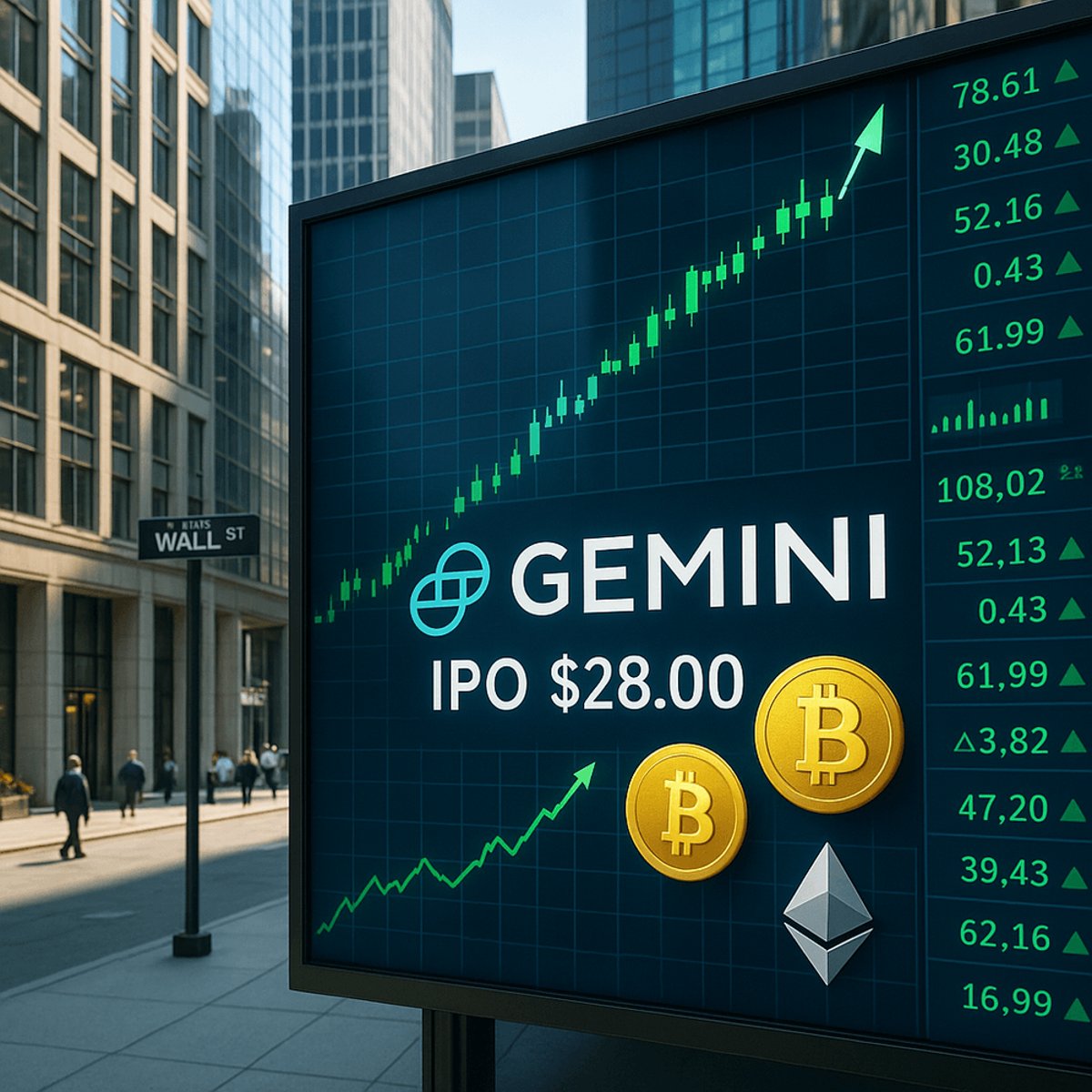
The Winklevoss twins just pulled off one of the year's most anticipated crypto IPOs. Gemini priced its public offering at $28 per share late Thursday, valuing the cryptocurrency exchange at $3.3 billion and raising $425 million in a deal that came in well above expectations. The pricing signals renewed investor appetite for crypto stocks after a challenging market stretch.
The crypto IPO drought is officially over. Gemini just pricing its public debut at $28 per share - a full $2 above the high end of expectations - shows Wall Street's renewed hunger for digital asset plays. The Winklevoss brothers' exchange raised $425 million while achieving a $3.3 billion valuation that puts it squarely in unicorn territory.
That pricing power tells a story about demand. Gemini initially planned to sell 16.67 million shares but ended up moving just 15.2 million because of the higher price point. The company had already bumped its range from an initial $17-$19 to $24-$26 earlier this week, according to Bloomberg's reporting.
The timing couldn't be more interesting. While bitcoin and ether have been consolidating after their latest runs, institutional money is clearly still flowing into crypto infrastructure plays. Nasdaq's surprise $50 million strategic investment announcement earlier this week provided the kind of validation that IPO investors love to see. The exchange operator wants access to Gemini's custodial services and plans to use the crypto company as a distribution partner for its Calypso trade management system.
But here's where it gets tricky. Unlike recent crypto IPO successes Circle Internet and Bullish, which went public with strong profitability stories, Gemini is hemorrhaging cash. The company posted a $159 million net loss in 2024, then doubled down with $283 million in losses during just the first six months of this year, according to SEC filings.
Founded by Cameron and Tyler Winklevoss in 2014, Gemini has grown into a major player in the crypto exchange space with over $21 billion in assets under management as of July. The platform has been diversifying beyond pure trading, launching crypto-backed credit cards and recently partnering with Ripple on a new card product that generated over 30,000 sign-ups in August alone - more than doubling the previous month's numbers.
The IPO structure shows Gemini learned from recent retail investor enthusiasm around crypto stocks. Up to 30% of shares will be reserved for retail investors through platforms like Robinhood, SoFi, and international brokers including Hong Kong's Futu Securities and Singapore's Moomoo Financial. That's a smart play given how retail has driven much of the crypto rally over the past few years.
Goldman Sachs, Citigroup, and Morgan Stanley are leading the underwriting syndicate, with the standard 30-day greenshoe option to sell additional shares if demand stays strong. The stock will trade on Nasdaq under the ticker 'GEMI' - keeping things simple for investors who might stumble over more complex crypto company names.
What makes this IPO particularly fascinating is its timing within the broader crypto cycle. We're not at the peak euphoria of 2021, but we're also not in the crypto winter depths of 2022. Instead, Gemini is going public during what feels like a more mature, institutionally-driven phase of crypto adoption. The Nasdaq partnership reinforces that narrative - traditional financial infrastructure companies see crypto as a must-have capability now, not a speculative side bet.
The real test comes when 'GEMI' starts trading. Recent crypto IPOs have had mixed performance after their debuts, and Gemini's loss-making profile could make investors nervous if crypto prices remain volatile. But the strong pricing suggests institutional buyers see long-term value in owning a piece of the crypto infrastructure layer, even if the path to profitability isn't immediately clear.
Gemini's successful IPO pricing marks a turning point for crypto public markets, showing institutional appetite remains strong even for loss-making exchanges. With Nasdaq's backing and a diversified product suite, the Winklevoss brothers are betting they can grow into their $3.3 billion valuation. Whether they can stem losses while competing against established players like Coinbase will determine if this IPO represents smart timing or peak optimism.