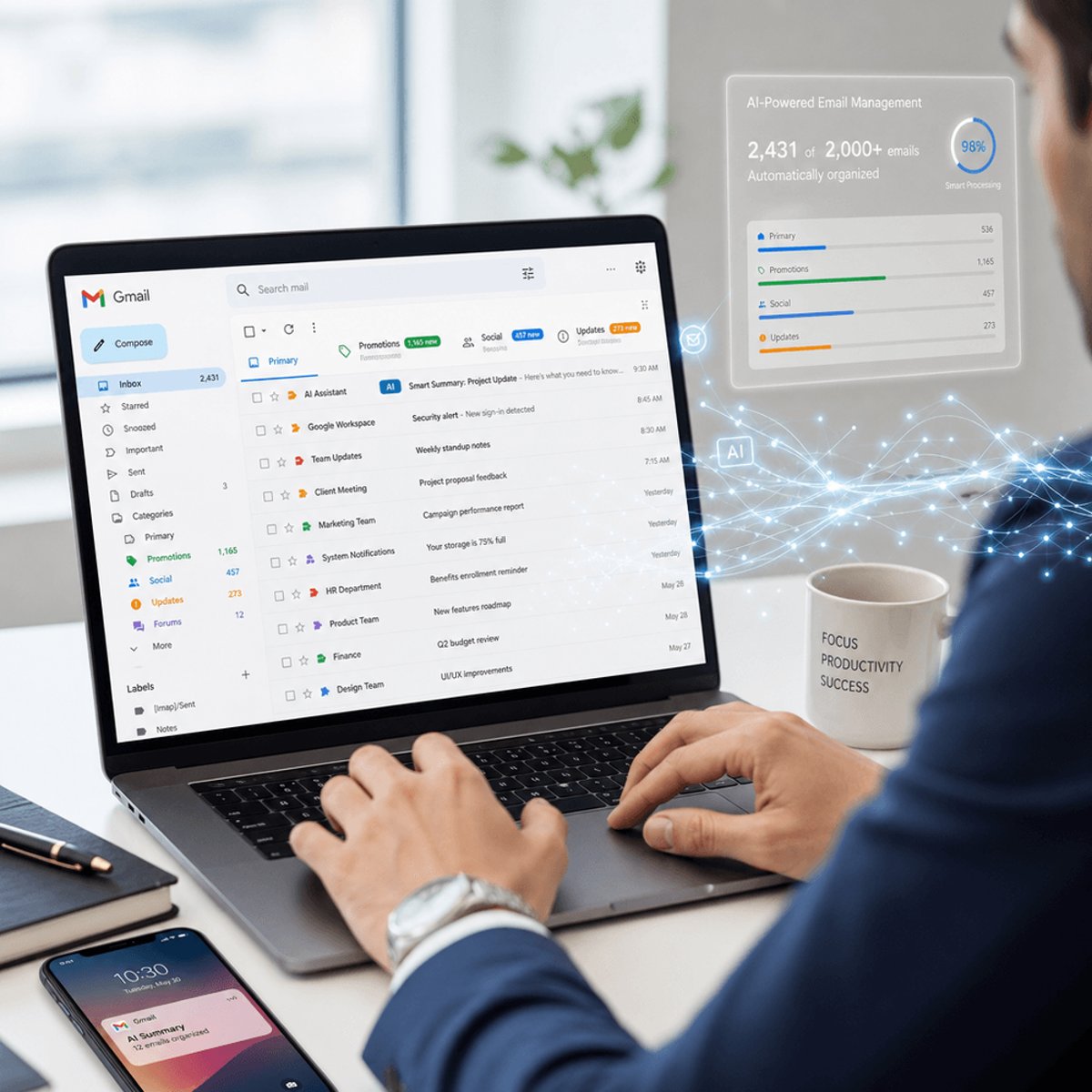
Google just rolled out Gemini Flows for Gmail, bringing AI-powered email filtering that promises to fix the clunky rule-based system users have tolerated for years. The feature uses natural language processing to automatically sort, label, and prioritize messages, but there's a catch that's already frustrating power users: it only works for your first 2,000 emails each month. After that, you're back to manual sorting or traditional filters.
Google is betting that AI can finally solve email overload. The company's new Gemini Flows feature for Gmail went live this week, transforming how users organize their inboxes by replacing decades-old filter logic with conversational AI commands.
Instead of wrestling with complex filter rules involving sender addresses, subject line patterns, and nested conditions, users can now tell Gemini what they want in plain English. "Move all newsletters to a reading folder" or "flag emails from my boss as urgent" - commands that would've required multiple steps and technical know-how now happen instantly through AI interpretation.
According to ZDNet's hands-on review, the system works remarkably well for understanding context and intent. It can identify promotional content, distinguish between urgent client requests and routine updates, and even learn from your email habits over time. The AI doesn't just match keywords - it understands semantic meaning, making it far more flexible than traditional filters.
But there's a hard stop at 2,000 emails per month. That's roughly 67 emails per day, which sounds reasonable until you consider that the average office worker receives 121 emails daily, according to industry research. Power users - executives, support teams, sales professionals - often handle double or triple that volume.
The limitation appears tied to computational costs. Running large language models on every incoming email isn't cheap, and Google is clearly testing where to draw the line between useful AI features and operational expenses. It's the same calculation Microsoft faced when pricing Copilot at $30 per user monthly, and that OpenAI navigates with ChatGPT's usage caps.
For Google, this launch is part of a larger Gemini integration across Workspace. The company has already embedded its AI into Docs for writing assistance, Sheets for data analysis, and Meet for real-time transcription. Gmail was the obvious next target - it's where 1.8 billion users spend hours each day, and where automation delivers immediate, tangible value.
The monthly cap creates an interesting user behavior dynamic. Some professionals might ration their AI filtering for only the most important emails, reverting to manual sorting for routine messages. Others might prioritize which email accounts get Gemini Flows treatment. The constraint forces users to think strategically about automation rather than treating it as an unlimited resource.
Google hasn't announced pricing for expanded limits, but the structure suggests a tiered model is coming. Workspace enterprise customers will likely get higher thresholds, while consumer Gmail users might need to upgrade to paid plans for increased capacity. It mirrors how Anthropic and other AI companies tier their API access based on usage volume.
What makes Gemini Flows genuinely useful, despite the cap, is its learning capability. The AI observes which emails you open first, which you delete unread, and which trigger immediate responses. Over time, it refines its sorting without requiring you to update complex filter rules manually. That adaptive intelligence is what distinguishes AI-powered tools from their rule-based predecessors.
Competitors are watching closely. Microsoft already offers similar AI sorting through Outlook's Focused Inbox, though it doesn't yet match Gemini's natural language control. Superhuman, the $30/month email client, built its entire product around AI-assisted inbox management. Google's move with Gemini Flows brings enterprise-grade AI filtering to the masses, even if rationed.
The 2,000 email limit might actually be strategic product design rather than just cost control. By making users conscious of their email volume, Google could be nudging behavior toward better email hygiene - unsubscribing from unnecessary lists, consolidating accounts, or using chat tools instead of email threads. It's a subtle way to address inbox bloat while delivering AI value where it matters most.
Gemini Flows represents Google's pragmatic approach to AI integration - powerful enough to genuinely improve daily workflows, but constrained enough to manage costs and user expectations. The 2,000 email monthly cap will frustrate heavy users, but for the average Gmail account, it delivers meaningful automation without requiring technical expertise. What matters now is whether Google treats this as a permanent limit or a temporary testing phase. If competitors offer unlimited AI filtering, that cap could become a liability. But if the industry settles on usage-based pricing, Google just set the baseline that others will need to match or beat.