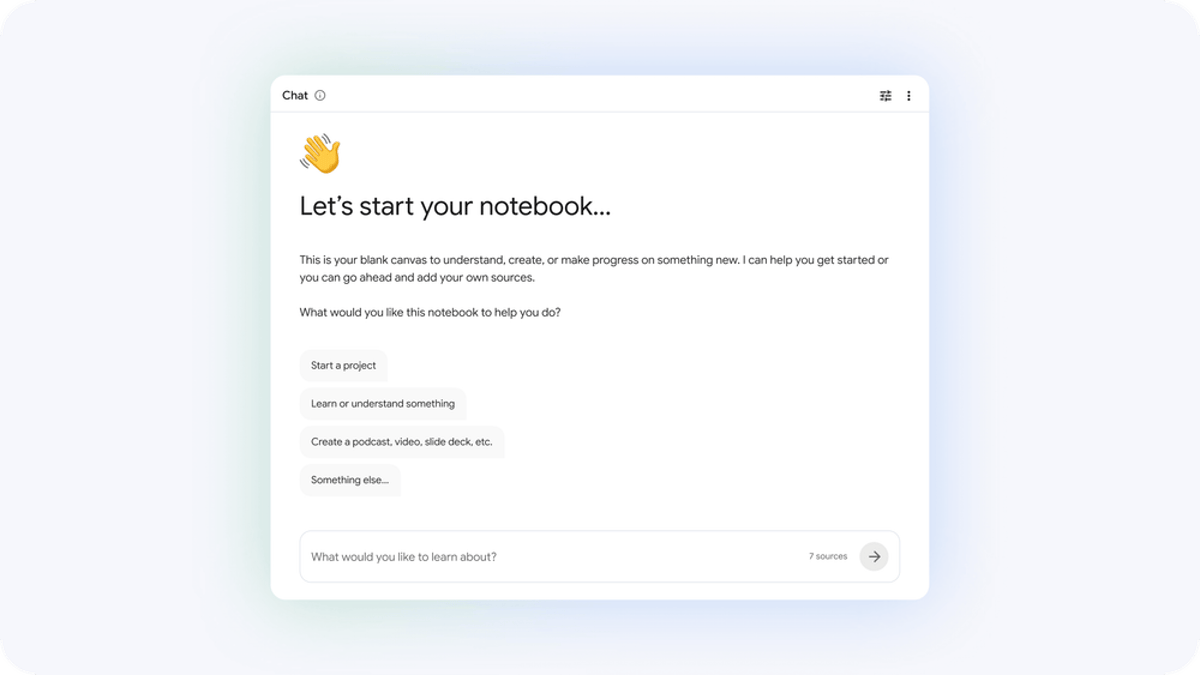
Google just dropped a major upgrade to NotebookLM that fundamentally changes how the AI note-taking tool works. The company's rolling out Gemini 3.5 across the entire platform, promising more accurate responses while adding a killer new feature - you can now start research projects from scratch without uploading a single document. Instead, NotebookLM will tap Google Search to find and suggest relevant sources for you, turning the app from a document analyzer into a full-fledged research assistant.
Google is betting big on making NotebookLM smarter and more autonomous. The AI-powered note-taking app that launched back in 2023 is getting what the company calls "across the board" updates, headlined by integration with Google's upgraded Gemini 3.5 model. According to a blog post published Monday, the new model will let NotebookLM respond with "more accurate and reliable information."
But the real story here isn't just the model swap - it's how Google is rethinking the entire research workflow. Until now, NotebookLM required you to feed it materials first. Upload your PDFs, paste in YouTube links, drop in your Google Docs, and then start asking questions. That's changing. With this update, you can flip the script entirely and start with questions instead of sources.
Here's how it works now: open NotebookLM, ask it about a topic you're researching, and the app will use Google Search to hunt down relevant sources for you. It's building on the app's existing "discover" feature that previously helped users find related materials after they'd already started a project. Now that discovery happens right from the jump, turning NotebookLM from a passive analysis tool into something more like an AI research partner.
This shift puts Google in direct competition with tools like Perplexity and ChatGPT's web search mode, which have made their names by letting users ask questions and getting back synthesized answers with sources attached. The difference is NotebookLM keeps everything organized in a project structure, making it easier to build up a knowledge base over time rather than just getting one-off answers.
The Gemini 3.5 upgrade matters too, though Google's being characteristically vague about what "more accurate and reliable" actually means in practice. The Gemini 3.5 model family launched earlier this year with improvements to reasoning and context handling. For NotebookLM users, that should translate to better understanding of complex documents, more nuanced answers to questions, and fewer hallucinations when the AI synthesizes information from multiple sources.
Google's also been quietly turning NotebookLM into one of its most interesting AI products. The app started as Project Tailwind, an experimental AI notebook announced at Google I/O 2023, and has steadily picked up features that make it genuinely useful for research-heavy work. It can generate audio overviews that turn your notes into podcast-style discussions, cite specific sources when answering questions, and now apparently play digital librarian by finding materials you haven't even thought to look for yet.
The timing is notable. As enterprise AI tools proliferate and companies like Microsoft push Copilot into every corner of Office, Google is carving out a different lane with NotebookLM - one focused on research, learning, and synthesis rather than pure productivity. The app remains free to use, which suggests Google sees it as a way to showcase what Gemini can do when it's purpose-built for a specific workflow rather than bolted onto existing products.
What's less clear is how this search integration will actually perform. Finding relevant sources is one thing - finding the right sources is another. Anyone who's done serious research knows that search results can be hit or miss, and adding an AI layer on top doesn't automatically solve the signal-to-noise problem. Google will need to prove that NotebookLM's source suggestions are actually helpful and not just flooding users with generic articles that happen to match their keywords.
The cloud computing angle mentioned in some early reports about this update remains fuzzy. It's unclear whether Google is adding computational capabilities beyond the search and analysis features, or if "cloud computer" is just a generous description of the app's existing cloud-based architecture. Either way, the core value proposition is shifting from "bring your sources and I'll help you understand them" to "tell me what you want to know and I'll help you find and understand it."
For students, researchers, and anyone who spends their days deep in documents, this could be a meaningful upgrade. The ability to start projects with questions rather than sources lowers the barrier to entry and makes NotebookLM useful earlier in the research process. Instead of needing a pile of PDFs before you fire up the app, you can use it to help build that pile in the first place.
Google's NotebookLM update signals a clear strategic bet - that the future of AI research tools isn't just about analyzing what you already have, but helping you find what you need in the first place. By combining Gemini 3.5's improved reasoning with Google Search's reach, NotebookLM is evolving from a smart document reader into something closer to an AI research assistant. Whether that's actually useful or just creates a fancier way to drown in search results will depend entirely on execution, but the direction is right. The best research tools don't just answer your questions - they help you figure out what questions to ask.