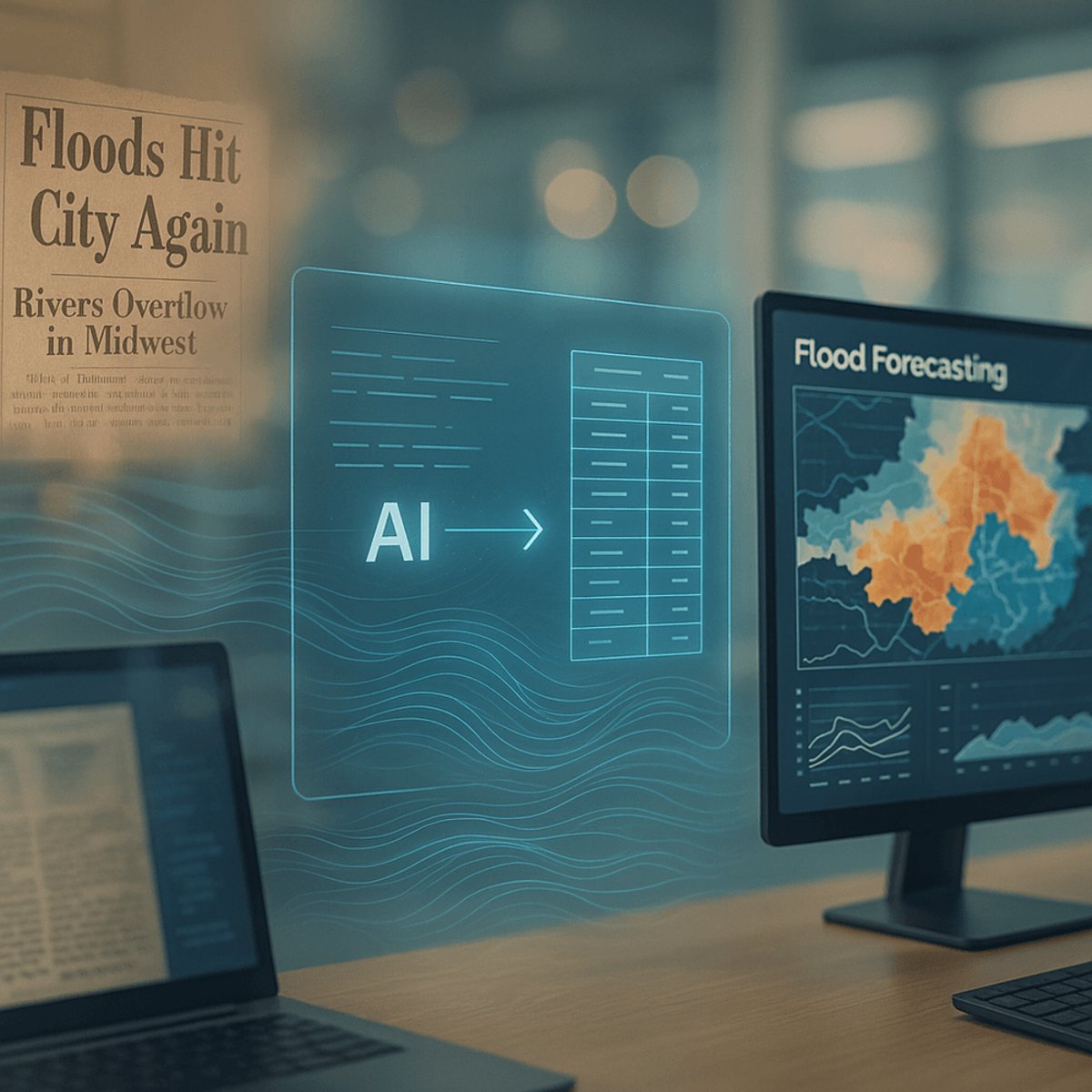
Google just cracked a novel approach to one of climate tech's thorniest problems: how do you predict disasters when historical data barely exists? The company's researchers are deploying large language models to transform decades of qualitative news reports into quantitative training data for flash flood forecasting systems. It's a clever workaround that could reshape how AI tackles data scarcity across disaster prevention, turning narrative accounts into the structured datasets machine learning models desperately need.
Google is teaching machines to read between the lines of old newspaper archives, and the implications stretch far beyond flood prediction. The company's latest research demonstrates how large language models can extract structured, quantitative information from narrative news reports spanning decades, creating training datasets where none previously existed.
The flash flood forecasting challenge has long frustrated researchers. Unlike hurricanes or major river floods that generate extensive sensor data and historical records, flash floods are localized, sudden, and often occur in regions with minimal monitoring infrastructure. Traditional machine learning approaches stumble when training data is this sparse. You can't predict what you haven't systematically measured.
That's where Google's LLM approach gets interesting. Instead of waiting for sensor networks to materialize in vulnerable regions, the company is mining historical news archives for implicit data points. A 1995 newspaper report describing how floodwaters reached "waist-high" near a specific bridge becomes a quantifiable data point when processed through an LLM trained to extract measurements, locations, and timelines from prose.
The methodology represents a fundamental shift in how AI systems can learn from human knowledge. According to TechCrunch, the approach turns qualitative reports into quantitative datasets, effectively creating a bridge between narrative human observation and the structured inputs machine learning models require.
Google's flood prediction initiatives have been expanding globally over the past few years. The company previously launched flood forecasting systems in India and Bangladesh, regions where seasonal monsoons and inadequate infrastructure create deadly conditions. But those systems relied heavily on hydrological models and whatever sensor data existed. This news archive approach could extend forecasting capabilities to areas where historical sensor coverage simply never existed.
The technical execution involves training LLMs to recognize and standardize the varied ways humans describe flooding in news reports. One article might mention "ankle-deep water covering Main Street" while another describes "vehicles submerged to their door handles." The AI needs to translate these narrative observations into consistent metrics: water depth, affected area, duration, and impact severity.
What makes this particularly clever is how it sidesteps the data scarcity problem that hamstrings so many climate adaptation efforts. Developing nations often lack the decades of sensor data that Western countries take for granted, yet their newspaper archives contain detailed accounts of past disasters. By treating journalism as an untapped data source, Google is essentially crowdsourcing historical observations through reporters who documented events in real time.
The broader implications extend well beyond hydrology. This same methodology could apply to tracking disease outbreaks from historical medical reports, analyzing past droughts through agricultural journalism, or reconstructing wildfire patterns from decades of local news coverage. Anywhere qualitative human observations exist in written form, LLMs can potentially extract quantitative training data.
There are obvious limitations and risks. News coverage is inherently biased toward populated areas and significant events. A flash flood affecting a remote village might never make the papers, creating gaps in the historical record. The LLM's extraction accuracy also matters enormously. If the model misinterprets "waist-high" as a precise measurement rather than an approximation, prediction models built on that data will inherit those errors.
Google isn't alone in exploring AI applications for climate adaptation, but this news-mining approach represents a creative solution to the cold-start problem that plagues so many disaster prediction systems. As extreme weather events intensify with climate change, the urgency around better forecasting grows. Flash floods already kill thousands annually, with the death toll concentrated in regions that lack both infrastructure and early warning systems.
The timing matters too. LLM capabilities have reached a point where nuanced language understanding makes this kind of extraction feasible. Five years ago, attempting to standardize flood descriptions from varied news sources would have produced unreliable results. Today's models handle context, units of measurement, and implicit information with enough accuracy to generate useful training data.
What's particularly striking is how this inverts the traditional data pipeline. Instead of sensors generating structured data that humans then interpret, Google is using AI to structure the interpretations humans already recorded. It's a recognition that valuable data doesn't always arrive in machine-readable formats, and that journalism represents a vast, underutilized dataset spanning more than a century.
Google's news-mining approach signals a maturation of LLM applications beyond chatbots and content generation. By transforming qualitative human observations into quantitative training data, the company is addressing real infrastructure gaps in disaster prediction while demonstrating how AI can unlock value from existing information in unexpected ways. As climate change accelerates and extreme weather becomes harder to predict using historical patterns alone, these kinds of creative data solutions may prove as valuable as the prediction models themselves. The real test will be whether forecasts built on news archive data can match the accuracy of sensor-based systems, and whether this methodology scales across the dozens of other domains where data scarcity limits our ability to prepare for the future.