Two days of cross-examination put OpenAI's president on the record about $30 billion in equity acquired without a dollar of personal cash, undisclosed personal stakes in companies that did business with OpenAI, and a 2017 journal that asked the only question that ended up mattering.
The most damaging moment of the second week of Musk v. Altman did not come from a document. It came from a question.
OpenAI co-founder and President Greg Brockman had been on the stand for the better part of two days when Musk attorney Steven Molo asked him a question with no obvious trick to it.
Q. Did this lawsuit prevent you from publishing the new charter?
A. I've honestly never really been certain what I'm being sued for.
Q. You're not? Did you read the complaint?
A. In great detail.
Q. They hired some really well-known lawyers, well-known law firms, and they never explained to you what you're being sued for?
A. I understand the claims. I've seen how they've changed over time too. But —
Q. So you do understand?
A. I do stand by my testimony.
Q. I thought you said that you didn't understand what you were being sued for.
A. Those are the words I used. Yes.
Molo then read the lawsuit's core charge into the record. The original OpenAI charter, he reminded the court, required the development of safe AI on an open-source basis for the benefit of humanity, with no individual permitted to profit personally. He asked Brockman if he understood that this was the breach Musk's team was alleging.
Brockman's response: "That's not what we did."
The exchange spread on X overnight. By morning, the line "I've honestly never really been certain what I'm being sued for" was the most-shared moment of the trial. It was also the cleanest summary anyone has produced of where this case actually sits.
OpenAI was founded in December 2015 as a 501(c)(3) nonprofit. The original charter committed the organization to building safe artificial general intelligence for the benefit of all humanity, with the work to be open-sourced and no individual to gain personally from the venture.
Elon Musk provided early funding above $38 million. Sam Altman became CEO. Brockman became president. Ilya Sutskever was chief scientist.
In 2018, Musk departed the board. In 2019, OpenAI created a "capped-profit" subsidiary underneath the nonprofit parent, which allowed it to take outside investment, including roughly $13 billion from Microsoft. In October 2025, OpenAI restructured again, with the nonprofit foundation arm holding 26 percent of the new entity and OpenAI employees holding another 26 percent.
The company is currently valued at $852 billion. It is reportedly preparing for an initial public offering that could land near a trillion-dollar valuation.
The lawsuit alleges this conversion was, in plain terms, the theft of a charity by its own directors.
The $30 Billion Number
Asked under oath what his OpenAI stake was worth, Brockman said it was close to $30 billion. He confirmed he had invested zero personal cash. The equity was granted to him as a co-founder.
Molo did not let the figure pass.
Q. Do you think, sitting here today, given that you're good with the $1 billion, do you think you should give the $29 billion back to the charity?
A. That's not how I think about it. There are assumptions baked into the question.
Q. It takes $30 billion to get you out of bed in the morning, but $1 billion doesn't get you out of bed in the morning?
A. That's not what I'm saying.
OpenAI's counsel objected to that line of questioning as theatrical. The judge let it stand.
"He's speaking as the director and officer of a nonprofit, a publicly subsidized nonprofit, and he's writing secretly."
— Marc Toberoff, Musk's lead attorney, on Brockman's journal entries
The reason Molo could press the question without it landing as theater is what came next.
The Cerebras Conflict
In 2017, Brockman personally invested in Cerebras, the AI chip startup. So did Altman, separately. During roughly the same period, Brockman participated in OpenAI discussions about a financial transaction with Cerebras.
In December 2025, OpenAI signed a $10 billion compute agreement with Cerebras, plus a $1 billion loan. In February 2026, Cerebras's valuation tripled, from roughly $8 billion to $23 billion, on the strength of OpenAI's commitments. In April, OpenAI expanded the relationship through 2029 to over $20 billion. Cerebras filed for an IPO at a valuation of up to $26.6 billion.
Molo walked Brockman through the disclosure question.
Q. When you were having discussions about a financial transaction between OpenAI and Cerebras, you were actually an owner of Cerebras, weren't you?
A. There was some overlap between discussions and being an investor in Cerebras. Yes.
Q. Can you point to an email in which you told Elon you were an owner of Cerebras at the same time you were advocating that OpenAI do this transaction with Cerebras?
A. I do not believe an email that says that exists.
Q. How about a chat?
A. I did not.
Q. A text?
A. No.
Q. And yet you stood to gain personally if there was a transaction between OpenAI and Cerebras.
A. I suppose so, but it wasn't something on my mind.
That last answer is the kind of sentence that, in any other context, would simply hang in the air. In a federal civil trial centered on whether the directors of a charity engaged in self-dealing, "it wasn't something on my mind" is not a defense. It is the admission.
- 2017: Brockman acquires personal Cerebras equity. OpenAI internal discussions about Cerebras transaction begin in same period. Altman separately invests.
- No written disclosure of Brockman's Cerebras stake to Musk in any email, chat, or text, per Brockman's own sworn testimony.
- December 2025: OpenAI signs $10 billion compute deal with Cerebras plus $1 billion loan.
- February 2026: Cerebras valuation triples from roughly $8 billion to $23 billion.
- April 2026: OpenAI expansion to over $20 billion through 2029. Cerebras files IPO at up to $26.6 billion.
- May 2026: Brockman testifies under oath about ownership overlap with no contemporaneous disclosure.
Helion Energy and the Altman Family Office
The Cerebras stake was not the only undisclosed financial entanglement.
Brockman also confirmed he holds shares in Helion Energy, the fusion company where Altman has personally invested hundreds of millions. And in 2017, Altman gifted Brockman a stake in Altman's personal family office valued at $10 million at the time.
A subpoenaed email surfaced during testimony, written by the head of Musk's family office, captured the concern in advance. The email warned that the family office gift would shift Brockman's allegiance toward Altman. Musk's team argued the warning proved prescient.
These three financial threads, Cerebras, Helion, and the family office stake, sat alongside Brockman's role as a director of a 501(c)(3) charity governed by California law. None of them were disclosed in writing to Musk.
The 2017 Journal
The most powerful evidence in the trial is not a deal document. It is a personal notebook.
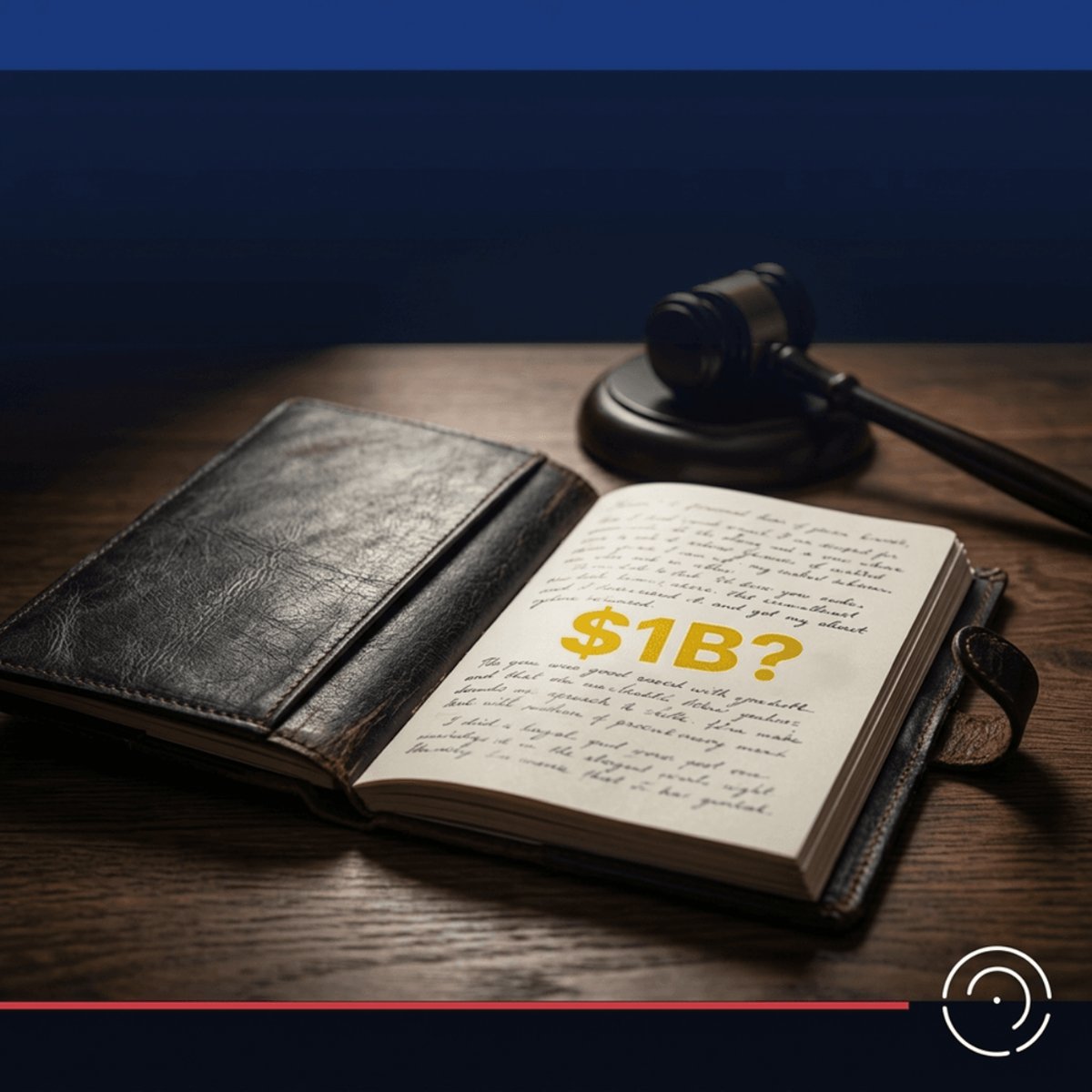
Brockman's 2017 journal, subpoenaed during discovery and entered into evidence, contains a series of contemporaneous entries about OpenAI's direction. One asked, "Financially, what will take me to $1B?" Another weighed the moral cost of converting the nonprofit and concluded that doing so would be "morally bankrupt."
A third entry, written six weeks after Brockman had reassured Musk that the nonprofit structure was intact, called that reassurance "a lie." That single phrase, surfaced in discovery last year, was the opening line of my January coverage of this case for The Tech Buzz. What was a private notebook entry then is now sworn testimony.
On the stand, Brockman characterized the entries as expressions of frustration rather than a plan. Molo asked him how often he had rehearsed that explanation before testifying.
The journal is the legal weight of the case. It is one thing to argue that the conversion of OpenAI from a charity into a for-profit was a necessary structural adaptation to compete with Google. It is another thing to defend that argument when the defendant's own private writings, from eight years before the lawsuit was filed, show him asking what it will take to get him personally to $1 billion and acknowledging in writing that the conversion would be morally bankrupt.
That is the evidentiary record now in front of the jury.
When you sit on the board of a 501(c)(3) charity in California, you owe the organization three duties:
- Duty of loyalty. You must act in the interest of the charity, not yourself.
- Duty of care. You must make decisions with the diligence a reasonable person would use.
- Prohibition on self-dealing. You cannot direct the charity into transactions that personally benefit you, unless the conflict is fully disclosed and approved by independent directors who reviewed it without you in the room.
A charity's assets are held in trust for the public. They are not the directors' personal property. Converting a charity's mission, or steering its assets in a way that enriches insiders, is not just bad form. Under California law, it is a breach of fiduciary duty that the state attorney general can enforce, that private parties with standing can sue over, and that courts can remedy by removing directors and clawing back gains.
That is the legal frame Musk's team is operating in.
The Settlement Texts
Two days before the trial began, Musk texted Brockman directly.
According to a court filing OpenAI tried to enter into evidence, Musk wrote that he wanted to gauge interest in settlement. Brockman proposed mutual dismissal. Musk replied that if OpenAI did not settle, by the end of the week, he and Altman "will be the most hated men in America."
Judge Yvonne Gonzalez Rogers ruled the texts inadmissible. She told OpenAI's lawyers they should have submitted them earlier, during Musk's own testimony.
The texts did not enter the trial record. They did, however, enter the public record through the filing.
What Happens Next
Brockman's testimony continues this week. Sam Altman is expected to take the stand later. Shivon Zilis, who served on OpenAI's board, is expected sooner. Microsoft CEO Satya Nadella may appear.
The jury is advisory. Judge Gonzalez Rogers will issue the final ruling on liability and remedies. Musk is asking for $150 billion in damages, with proceeds returning to the OpenAI nonprofit arm rather than to Musk personally, plus the removal of Altman and Brockman from leadership.
The verdict will land sometime in the next several weeks. Whatever the court decides, the evidentiary record from this trial is now permanent. Two co-founders of a charity built to ensure the safe development of AI for humanity directed billions of charity-controlled dollars to vendors in which they personally held undisclosed equity, while one of them privately wrote down the question of how to personally clear $1 billion, and neither could produce a written disclosure to the largest early donor.
That is the case Brockman could not identify on the stand.
The most notable part of this is what it means beyond OpenAI. The structural conditions that made this possible, a charity governed by directors with discretion over its conversion, no automated transparency, no on-chain accounting of where money flowed, no independent enforcement until a co-founder happened to be a billionaire willing to fund a federal lawsuit, are the conditions under which most American philanthropy still operates.
This case is the costliest test yet of whether trust-based nonprofit governance can hold up to the pressure of a $852 billion outcome. The evidence so far suggests it cannot. I laid out the structural alternative in January, before the trial began. Four months later, the courtroom record is doing the rest of the work.
Aaron Rafferty is co-founder of WYDE, a Wyoming 501(c)(4) building automated charitable funding infrastructure on Base. He is the author of "The New Money Order," available for pre-order at thenewmoneyorder.com. He covers AI governance, philanthropy accountability, and crypto for The Tech Buzz.