While AI apps struggle to monetize beyond Silicon Valley's prosumer base, Koah just raised $5 million seed funding to solve what one investor calls "the elephant in the room" — how developers actually make money from AI products. The startup is betting that contextual advertising will unlock profitability for the thousands of AI apps built on top of major models, particularly those serving global markets where $20 monthly subscriptions aren't viable.
Koah just cracked open the AI industry's biggest unsolved puzzle: how to actually make money from artificial intelligence without charging users $20 a month. The San Francisco-based startup announced its $5 million seed round today, led by Forerunner with participation from South Park Commons and AppLovin co-founder Andrew Karam.
The timing couldn't be more critical. While OpenAI and other AI giants rake in subscription revenue from Silicon Valley's prosumer crowd, thousands of developers building on top of these models face a brutal math problem. "Once these things get outside San Francisco, there's only one way to make them profitable on a global scale," CEO Nic Baird told TechCrunch. "It's happened time and time again."
The economics are stark. An AI app serving millions of users in Latin America faces the same inference costs as any Silicon Valley startup, but those users "are not paying 20 dollars a month," Baird explained. This leaves developers caught between expensive AI model costs and users who won't convert to premium subscriptions — a gap that's suffocating innovation in emerging markets.
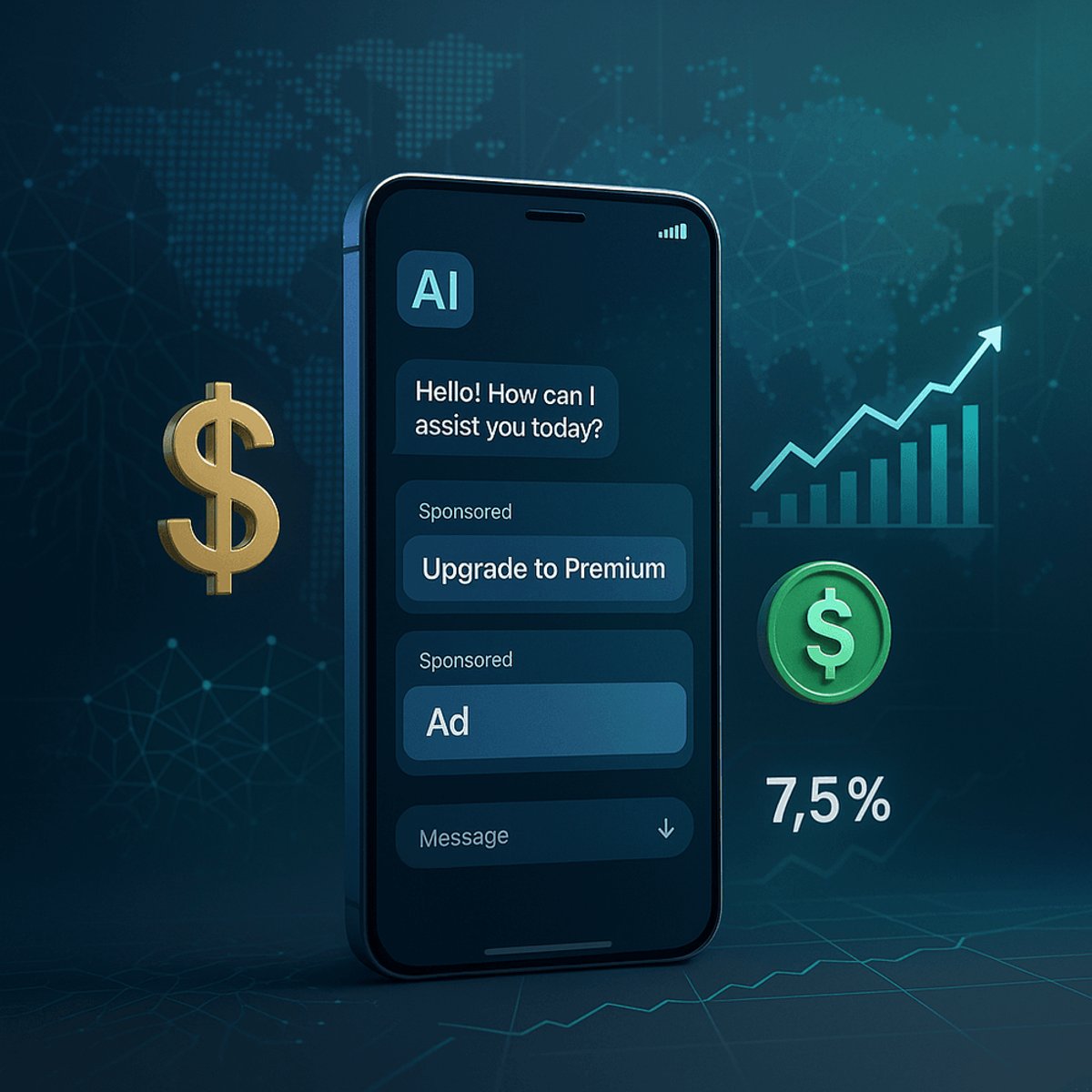
Koah's solution inserts contextual ads directly into AI chat conversations, marked as sponsored content that appears at relevant moments. Ask for startup business advice, and you might see an UpWork ad connecting you with freelancers. The company is already live across AI assistant Luzia, parenting app Heal, student research tool Liner, and creative platform DeepAI, with advertisers including UpWork, General Medicine, and Skillshare.
The early results suggest Baird might be onto something transformative. Koah delivers click-through rates of 7.5% — roughly 4 to 5 times more effective than traditional adtech companies like Admob and AppLovin when applied to AI contexts. Early partners are earning $10,000 in their first 30 days on the platform, while maintaining user engagement levels that actually improve over time as the ads become more contextually relevant.
"Multiple revenue models in Consumer AI are inevitable, and if the past decades of internet services are any indicator, ads will play a major role," Forerunner partner Nicole Johnson said via email. She described Koah as "building the essential monetization layer for consumer AI services" — addressing what she calls "the elephant in the room amongst builders and investors."
The monetization crisis runs deeper than just geography. Even well-funded AI apps are hitting subscription fatigue as users grow tired of $20 monthly fees across multiple AI services. Johnson noted that focusing exclusively on subscriptions "can quickly lead to fatigue and churn," forcing developers to explore alternative revenue streams or risk unsustainable unit economics.
Koah's approach recognizes that AI chats occupy a unique position in the advertising funnel — somewhere between the awareness-building of Instagram ads and the purchase-driving power of Google search ads. "People are not transacting on AI — they're just not," Baird observed. Users might ask chatbots for product recommendations or details, but "they're going to Google to buy." This insight shapes how Koah captures commercial intent without disrupting the conversational flow.
The company deliberately avoids what Baird calls the "display ad in AI" approach. Instead, the focus is understanding "what is the user looking for and how do we give that to them?" This philosophy extends to Koah's broader mission of unlocking "vibe coded" apps — creative AI experiments that might otherwise be "too expensive to operate at scale" without venture capital backing.
By solving the monetization puzzle, Koah could unleash a wave of AI innovation currently constrained by unsustainable economics. The startup's success would validate advertising as a viable path forward for the thousands of developers building the next generation of AI applications, particularly those serving global markets where premium subscriptions remain out of reach.
Koah's $5 million seed round represents more than just another AI startup funding announcement — it's a potential solution to the industry's most pressing economic challenge. As AI applications proliferate globally, the company's contextual advertising approach could determine whether thousands of innovative AI products survive beyond Silicon Valley's subscription-friendly bubble. With impressive early metrics and backing from Forerunner, Koah is positioned to become the monetization infrastructure that the next wave of AI innovation desperately needs.