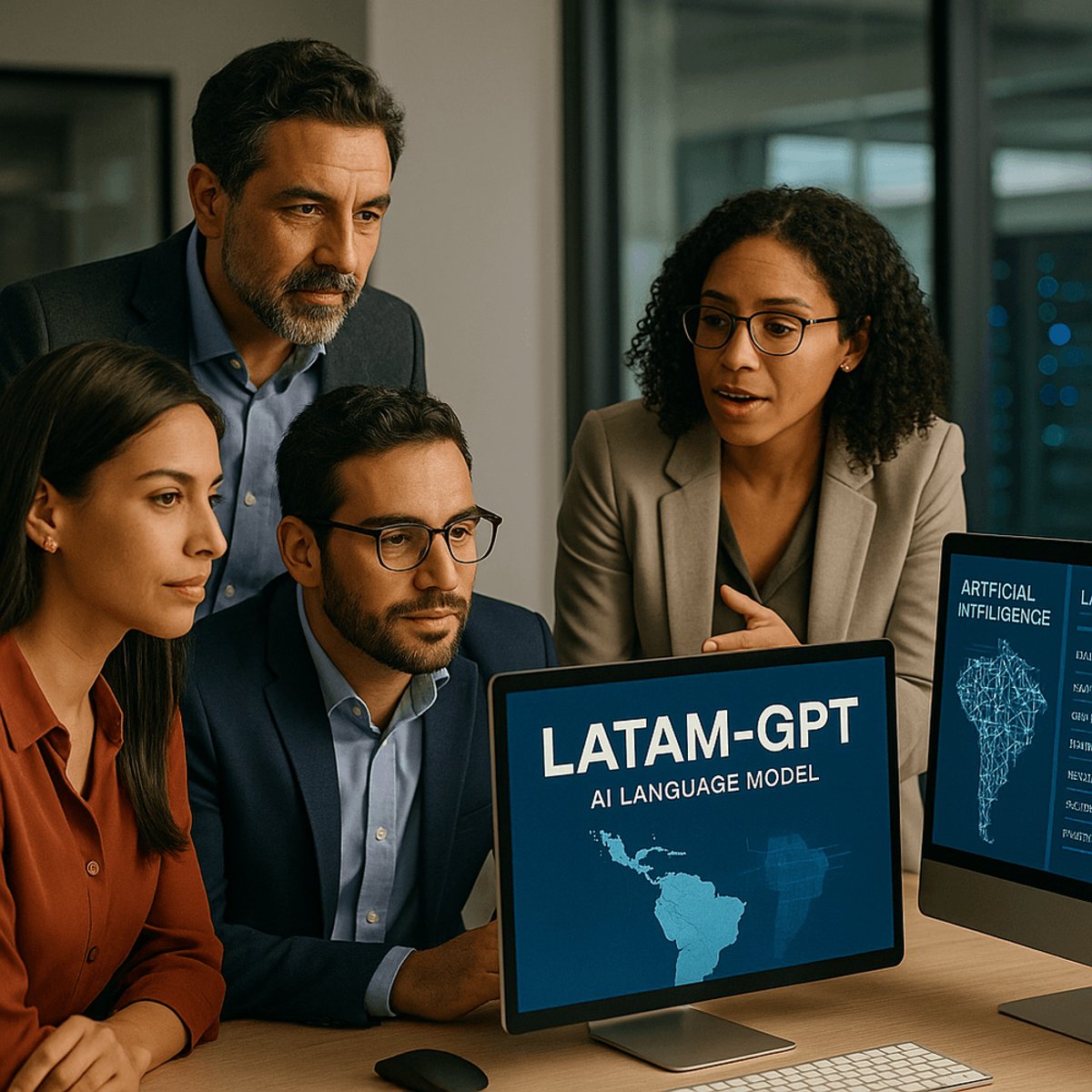
Latin America is building its own ChatGPT rival. CENIA, Chile's National Center for Artificial Intelligence, just unveiled Latam-GPT — a 50-billion parameter language model trained exclusively on Latin American languages, dialects, and cultural contexts. The open-source project launches this year with backing from 33 regional institutions and represents the region's boldest challenge yet to US AI dominance.
The AI revolution just got a Latin American accent. CENIA, Chile's nonprofit AI research center, is preparing to launch Latam-GPT — a massive language model designed specifically for Latin America and the Caribbean — challenging the dominance of OpenAI, Google, and other tech giants in the region.
"We're not looking to compete with OpenAI, DeepSeek, or Google," CENIA director Álvaro Soto told WIRED en Español. "We want a model specific to Latin America and the Caribbean, aware of the cultural requirements and challenges that this entails, such as understanding different dialects, the region's history, and unique cultural aspects."
The ambitious project reflects growing concerns about AI colonialism — the idea that US-trained models impose American cultural biases on the rest of the world. When Soto asks existing models about Latin American education, "it would probably tell you about George Washington," he explains. "We should be concerned about our own needs; we cannot wait for others to find the time to ask us what we need."
Latam-GPT boasts impressive technical specifications that put it on par with OpenAI's GPT-3.5. The model features 50 billion parameters and has been trained on over 8 terabytes of regional text data — equivalent to millions of books. This massive corpus combines information from 20 Latin American countries plus Spain, totaling 2.6 million documents.
The data distribution reveals the project's collaborative scope: Brazil leads with 685,000 documents, followed by Mexico (385,000), Spain (325,000), Colombia (220,000), and Argentina (210,000). The numbers reflect each country's digital development and content availability, but the team actively seeks balanced representation. "If we notice that Nicaragua is underrepresented in the data, for example, we'll actively seek out collaborators there," Soto notes.
Underpinning this effort is Latin America's most powerful AI supercomputer. The University of Tarapacá in Arica, Chile, recently installed a $10 million computing cluster featuring 12 nodes, each equipped with eight state-of-the-art NVIDIA H200 GPUs. This 96-GPU powerhouse represents unprecedented computing capacity for the region and enables large-scale model training for the first time in Latin America.
The infrastructure investment signals serious regional commitment to AI sovereignty. "If you want to play football, you need a field and a ball," Soto explains. "Here, computing power is the field. We need to develop it, whether in the cloud or in our own data centers. It's a necessary infrastructure for this new technological era."
Latam-GPT's collaborative model stands in stark contrast to the secretive development approaches of major tech companies. The project involves 33 strategic partnerships across Latin America and the Caribbean, with both grassroots participation and government backing. "This work cannot be undertaken by just one group or one country," Soto emphasizes. "It is a challenge that requires everyone's participation."
The first version launches this year as a text-only model, with plans for multimodal capabilities including image and video processing. The open-source nature means regional institutions can adapt the technology for specific use cases — from Colombian education systems to Brazilian healthcare applications. "The idea is to open the door for different organizations to generate specific models for particular areas like agriculture, culture, and others," Soto explains.
Future development will incorporate indigenous languages including Mapuche, Rapanui, and Guaraní. While the initial version focuses on cultural information about ancestral peoples like the Aztecs and Incas, language integration represents a uniquely Latin American capability that no US tech giant is likely to prioritize.
The project arrives as AI geopolitics intensify globally. China's rapid AI development, Europe's regulatory approach, and now Latin America's collaborative model suggest the US-dominated AI landscape faces increasing fragmentation. For Latin America, technological sovereignty isn't just about competitiveness — it's about cultural survival in an AI-driven world.
Soto envisions success measured not in market share but in educational impact: "That new generations of Latin Americans are better prepared because they had access to tools that spoke to them in their context, with their cultural references, with figures from our history, and not just using examples from other parts of the world."
Latam-GPT represents more than technological ambition — it's a declaration of digital independence. As the model prepares for launch, it challenges the assumption that AI must be developed in Silicon Valley to be world-class. For Latin America's 650 million people, having an AI that understands their contexts, languages, and cultures could prove transformative. The real test isn't whether Latam-GPT can match ChatGPT's capabilities, but whether it can deliver something no US model can: authentic Latin American intelligence.