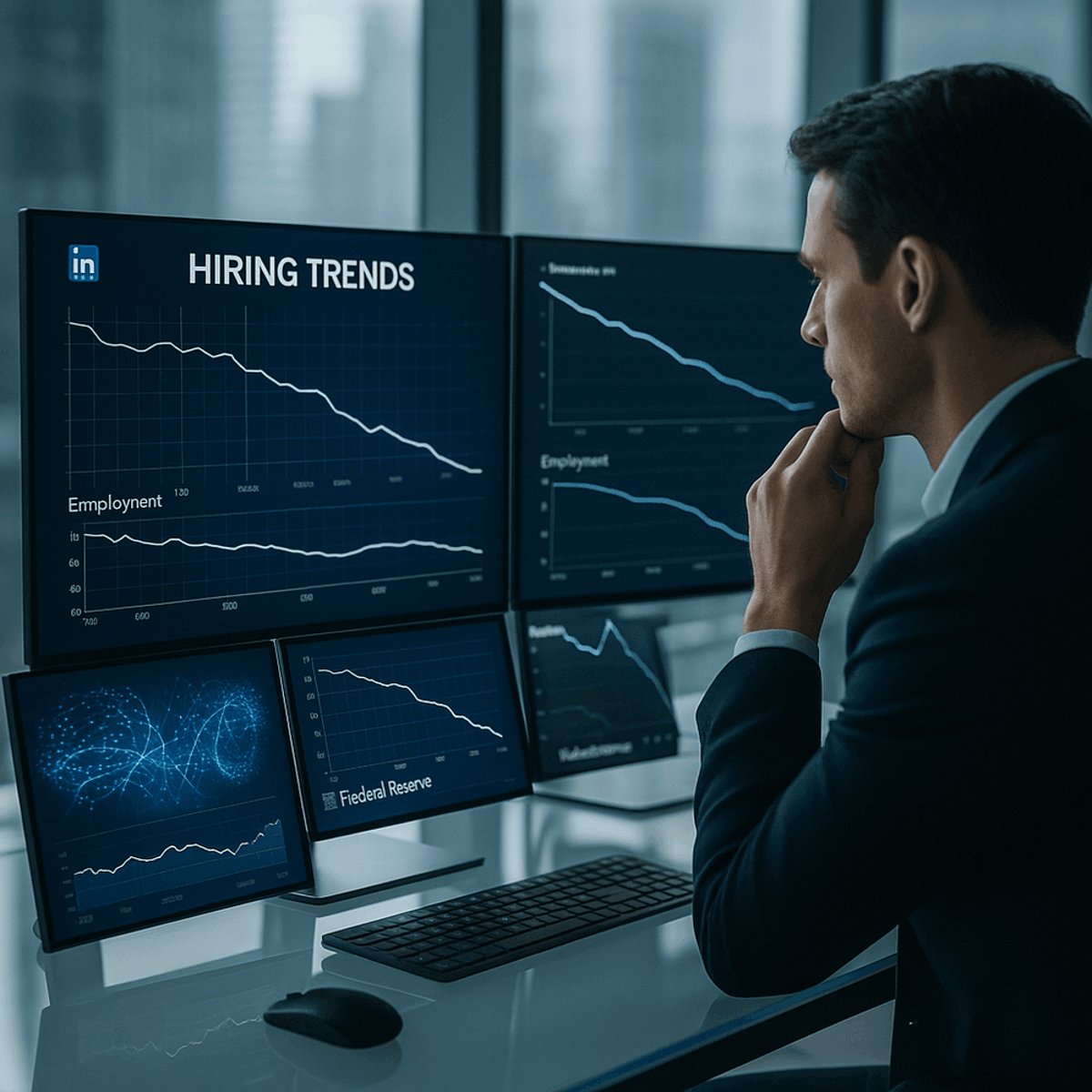
The job market's been bleeding positions for nearly four years, but LinkedIn has a surprising take on who's responsible. The Microsoft-owned platform just dropped data showing hiring has plummeted 20% since 2022, yet the company insists AI automation isn't driving the decline. Instead, LinkedIn's pointing fingers at macroeconomic forces, particularly elevated interest rates that have kept companies cautious about headcount expansion. It's a bold claim that runs counter to mounting fears about AI-driven job displacement.
LinkedIn just threw cold water on one of tech's hottest debates. While executives from OpenAI to Google tout AI tools that can handle tasks once requiring human workers, the world's largest professional network says the real job killer has been sitting in plain sight: the Federal Reserve's interest rate policy.
The timing of LinkedIn's data drop is notable. Companies across sectors have been racing to integrate AI capabilities, from Microsoft's Copilot assistants to autonomous customer service systems. Yet hiring hasn't just stagnated, it's actively contracted by a fifth over four years, according to LinkedIn's internal metrics reported by TechCrunch. That's a significant workforce contraction happening precisely as AI adoption exploded.
But LinkedIn isn't buying the automation narrative. The company argues that elevated borrowing costs have forced businesses into defensive mode, freezing expansion plans and scrutinizing every hire. It's the classic economic squeeze: when capital gets expensive, companies hunker down. Hiring managers who might have brought on three new employees in 2021's zero-rate environment are making do with existing teams in today's higher-rate reality.
The "yet" in LinkedIn's hedged statement does heavy lifting here. By acknowledging AI isn't to blame "yet," the platform tacitly admits what many economists and workforce analysts have been warning about. Current AI systems might not have triggered mass layoffs, but the technology's still maturing. Google's recent demonstrations of AI agents that can navigate complex workflows and OpenAI's latest models capable of coding entire applications suggest we're approaching an inflection point.
What makes LinkedIn's position particularly interesting is the company's dual vantage point. As a Microsoft subsidiary since 2016's $26.2 billion acquisition, LinkedIn has front-row seats to enterprise AI deployment. Microsoft's been aggressively pushing AI tools across its product stack, from Azure cloud services to Office productivity suites. If anyone should see early signals of AI-driven workforce displacement, it's LinkedIn's data scientists tracking hiring patterns across 900 million members.
The interest rate explanation holds water from a macro perspective. The Fed's aggressive rate hikes through 2022 and 2023 fundamentally changed corporate behavior. Startups that raised massive rounds at frothy valuations suddenly faced a reckoning when the cash spigot shut off. Enterprise buyers became more cautious, elongating sales cycles. The result: companies extended runway by cutting the biggest variable cost, which is almost always headcount.
But there's a counterargument brewing in the data trenches. While overall hiring dropped 20%, certain sectors have seen divergent patterns. Tech companies announced waves of layoffs even as they ramped up AI investments. Meta called 2023 its "year of efficiency" while simultaneously pouring billions into AI infrastructure. The pattern suggests companies might be reallocating resources rather than simply retrenching across the board.
LinkedIn's framing also conveniently sidesteps a more uncomfortable question about productivity gains. If companies are maintaining or growing output with 20% fewer hires than four years ago, something's filling that gap. It might be existing employees working harder, operational efficiencies, or yes, automation and AI tools handling tasks that previously required new headcount. The platform's data doesn't appear to break out productivity metrics that would illuminate which factor dominates.
The "yet" caveat suggests LinkedIn's economists know the script might flip. As AI capabilities advance from narrow task automation to broader role replacement, the hiring dynamics could shift dramatically. We're already seeing early signals in customer service, content moderation, and entry-level coding positions where AI tools are demonstrably reducing human headcount needs.
What's clear is that LinkedIn has a vested interest in this narrative. The platform's business model depends on a robust job market. Hiring managers pay for recruiter licenses, job postings generate revenue, and an active talent marketplace drives engagement. A story that pins hiring declines on temporary monetary policy feels more optimistic than structural technological displacement. One's reversible with rate cuts; the other might be permanent.
The real test comes in the next 12-18 months. If the Fed cuts rates as many economists expect and hiring doesn't bounce back proportionally, LinkedIn's thesis starts looking shaky. Conversely, if job postings surge when borrowing costs decline, the platform will have been vindicated. For now, we're left with dueling narratives about whether AI's job market impact is already here or still gathering on the horizon.
LinkedIn's drawn a line in the sand, betting that macroeconomic factors trump technological displacement in explaining today's hiring drought. It's a reassuring message for workers anxious about AI competition, but that qualifying "yet" lingers like a warning label. The company's sitting on the most comprehensive employment dataset in existence, which makes their analysis worth taking seriously. But as AI capabilities accelerate and rate cuts potentially loom, we'll soon get a natural experiment that tests whether LinkedIn's economists called it right or if they're underestimating the quiet transformation already reshaping who companies hire and why. The gap between what executives say about AI's potential and what LinkedIn's data shows about hiring might not stay wide for long.