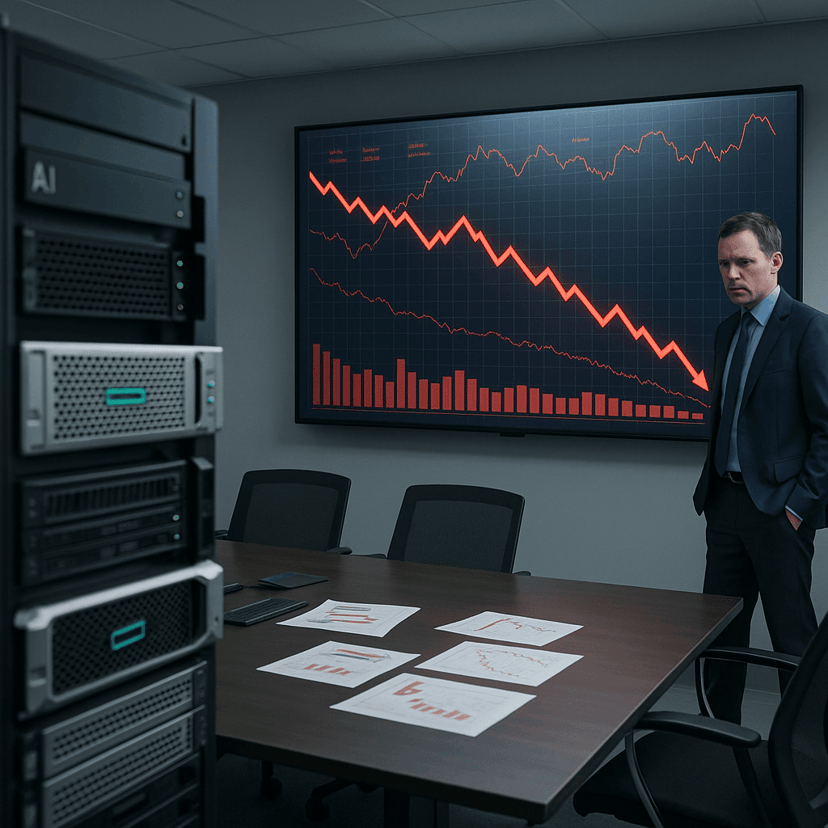
Marvell Technology shares cratered 15% Friday after the AI chipmaker's critical data center segment missed Wall Street expectations and delivered underwhelming guidance for the current quarter. Despite record Q2 revenue driven by AI demand, investors are questioning the company's ability to maintain momentum as hyperscaler buildouts show signs of lumpiness.
Marvell Technology just delivered a harsh reality check to investors betting on the AI chip boom. The semiconductor company's shares plummeted 15% Friday morning after earnings revealed that even record-breaking revenue can't satisfy Wall Street's insatiable appetite for AI growth stories.
The numbers tell a complex story. Marvell posted $2.01 billion in Q2 revenue, exactly meeting analyst estimates and representing a stunning 58% jump from last year. The company flipped from a $193.3 million loss to a $194.8 million profit, beating earnings expectations at 67 cents per share versus the 66 cents consensus.
But here's where the celebration stopped: data center revenue hit $1.49 billion, falling $20 million short of Wall Street's $1.51 billion projection according to StreetAccount data. For a company positioning itself as a critical AI infrastructure play, any miss in the data center segment sends shockwaves through investor confidence.
[embedded image: Marvell Technology headquarters in Santa Clara]
CEO Matt Murphy tried to reassure investors during Thursday's earnings call, attributing the guidance to "nonlinear growth" in custom AI chips business. "Overall data center revenue in Q3 to be flat sequentially," Murphy explained, though he promised "substantially stronger" fourth-quarter growth. The executive framed this "lumpiness" as normal behavior from large hyperscalers building infrastructure.
That explanation didn't satisfy analysts. Bank of America moved swiftly Friday morning, downgrading Marvell from buy to neutral and slashing their price target from $90 to $78. The downgrade specifically cited concerns around the company's "AI growth prospects in the near/medium term."
Cantor analysts were even more pointed in their criticism. "Without this, we find it very difficult underwriting the company's 20% data center market share target," they wrote in a Thursday client note. "Thus, we wait for more bottoms up granularity before potentially turning more positive."
The broader context makes Marvell's stumble particularly significant. While Nvidia dominates GPU headlines, Marvell plays a different but crucial role in AI infrastructure, creating customized chips and hardware for cloud giants like Amazon and Microsoft. The company's custom silicon and electro-optics products have become essential components as hyperscalers build out their AI capabilities.
This positioning should theoretically insulate Marvell from some competitive pressures, but it also makes the company vulnerable to the spending patterns of a small number of massive customers. When Amazon or Microsoft adjusts infrastructure timelines, Marvell feels it immediately.
The Q3 revenue guidance of $2.06 billion, plus or minus 5%, represents the crux of investor disappointment. That midpoint falls roughly $50 million short of the $2.11 billion consensus, according to LSEG estimates. In the current market environment, where AI stocks trade on growth trajectories rather than fundamentals, any deceleration signals trouble.
What makes this particularly painful for Marvell is the timing. The company had been successfully positioning itself as a key beneficiary of the AI infrastructure buildout, distinct from pure-play GPU makers. Custom chip design for hyperscalers represents a high-margin, sticky business that should provide more predictable revenue streams than commodity semiconductors.
Investors now face a critical question: Is this a temporary pause in an otherwise robust AI infrastructure cycle, or early evidence that hyperscaler spending is becoming more selective? Murphy's promise of Q4 strength suggests the former, but Wall Street clearly wants more concrete visibility into the customer pipeline before regaining confidence.
Marvell's earnings miss exposes the challenge facing second-tier AI infrastructure plays: exceptional growth is now table stakes, and any sign of deceleration triggers swift punishment from growth-hungry investors. While the company's custom chip business remains strategically positioned for the AI buildout, Murphy and his team must deliver clearer visibility into customer pipelines to restore Wall Street confidence. The Q4 guidance will be make-or-break for proving this was just a temporary speed bump in the AI infrastructure story.