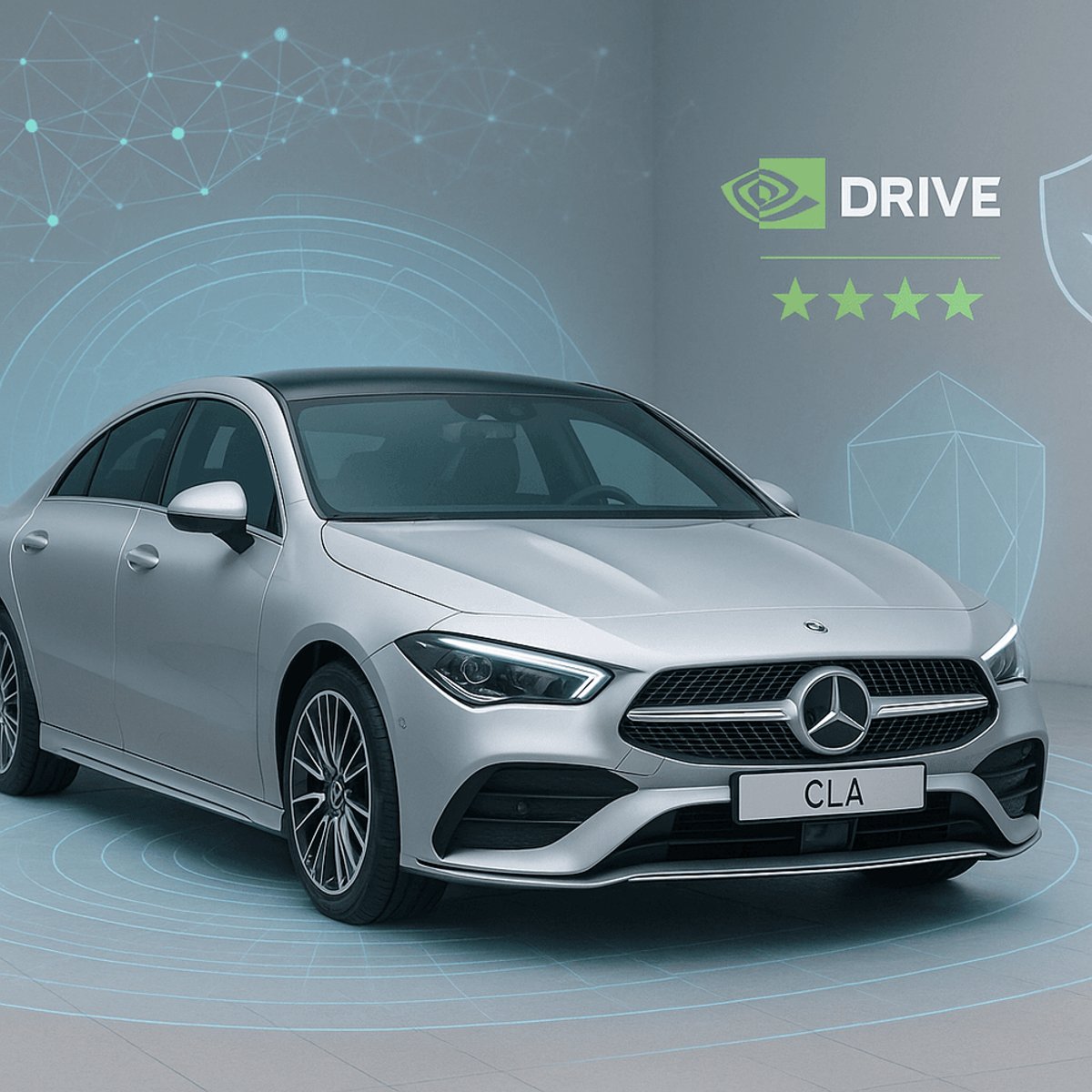
AI just redefined what it means to be the safest car on the road. The Mercedes-Benz CLA clinched Euro NCAP's Best Performer of 2025 award, powered by Nvidia's DRIVE AV software that helped it score the highest overall safety rating of the year. It's a watershed moment that signals active crash prevention, not just passive protection, now determines which vehicles earn top safety honors.
Mercedes-Benz just pulled off something remarkable in the automotive safety world. The company's new CLA secured Euro NCAP's Best Performer of 2025 award, earning the highest overall safety score of the year by pairing traditional crash protection with Nvidia's AI-powered driver assistance platform.
The win isn't just about airbags and crumple zones anymore. "When Euro NCAP assesses vehicle safety, it evaluates both passive and active systems - achieving a perfect score requires a state-of-the-art advanced driver assistance system," Mercedes-Benz Group CEO Ola Källenius told Nvidia's blog. "This milestone represents the culmination of five years of collaboration between Mercedes-Benz and Nvidia to enhance real-world safety and deliver tangible value to customers."
Euro NCAP, Europe's independent vehicle safety authority backed by European governments and consumer groups for nearly 30 years, is raising the bar. The organization now weighs AI-driven crash prevention as heavily as structural integrity. Categories like "Vulnerable Road User" and "Safety Assist" assess technologies including automatic emergency braking, lane-keeping support and speed assistance - areas where machine learning outperforms human reflexes.
Out of a record 49 models tested in 2025, only vehicles achieving five-star ratings with standard equipment qualified for "Best in Class" recognition. The CLA topped them all.
What's under the hood makes this possible. The CLA runs on Nvidia DRIVE AV, a dual-stack architecture that pairs an AI-driven end-to-end driving system with a parallel classical safety stack. Think of it as two brains working simultaneously - one learning and adapting through neural networks, the other following rule-based logic to catch edge cases the AI might miss.
This redundancy extends across the entire sensing, planning and execution pipeline. The vehicle's built on Nvidia DRIVE Hyperion architecture, which bakes sensor diversity and hardware redundancy into the design from day one. If one system falters, another takes over.
At the core sits Nvidia Halos - a comprehensive safety framework spanning hardware, software, development processes and certification support. It's designed to keep AI-powered vehicles operating within safe boundaries even when encountering scenarios they weren't explicitly trained on.
Third-party validators are paying attention. TÜV SÜD granted Nvidia ISO 21434 Cybersecurity Process certification for its automotive system-on-a-chip, platform and software engineering. Nvidia DriveOS 6.0 also conforms to ISO 26262 Automotive Safety Integrity Level (ASIL) D standards. Separately, TÜV Rheinland completed an independent United Nations Economic Commission for Europe (UNECE) safety assessment of Nvidia DRIVE AV for complex electronic systems.
Nvidia recently released its Alpamayo family of open AI models, simulation tools and datasets. These enable autonomous vehicles to navigate rare "long-tail" events they haven't been trained on by breaking scenarios into smaller steps, reasoning through multiple possible actions and selecting the safest one. When combined with the classical safety stack, it adds another protection layer.
The training methodology is what separates modern AI safety systems from traditional approaches. Nvidia's cloud-to-car development pipeline transforms real-world data into billions of simulated miles using Nvidia DGX systems for neural network training, Nvidia Omniverse and Cosmos platforms for simulation, and Nvidia DRIVE AGX for in-vehicle computing.
This addresses a critical challenge: you can't safely test rare but high-risk scenarios in the real world. A pedestrian suddenly stepping between parked cars, black ice on a curve, sun glare obscuring traffic signals - these situations occur too infrequently for traditional testing but happen often enough to cause serious accidents. By generating synthetic scenarios representing these edge cases, AI systems learn appropriate responses during development without putting anyone at risk.
The implications ripple beyond Mercedes-Benz. As AI-driven safety becomes standard equipment, the definition of the "safest" car is shifting from how well it protects occupants during a crash to how effectively it prevents that crash from happening. Euro NCAP's recognition of the CLA signals this evolution is already underway.
Competitors are watching closely. The automotive industry is in the middle of a software-defined transformation, with legacy automakers racing to match the AI capabilities of electric vehicle startups. Nvidia's platform provides a shortcut - instead of building safety systems from scratch, automakers can license proven technology that's already passed rigorous third-party certification.
The CLA's success also validates Nvidia's broader automotive strategy. The company's been positioning itself as the AI brains behind autonomous and semi-autonomous vehicles for years, competing against Intel's Mobileye and startups like Waymo. Winning Europe's top safety award with a production vehicle, not a prototype, provides real-world validation that resonates with both automakers and regulators.
The CLA's Euro NCAP crown represents more than one automaker's engineering achievement - it's a preview of where the entire industry is headed. As AI-powered driver assistance becomes standard equipment and safety ratings increasingly reward crash prevention over crash protection, the vehicles earning top honors will be those that best integrate machine learning with robust safety frameworks. For automakers still developing their AI strategies, the message is clear: software is no longer a feature, it's fundamental to safety itself.