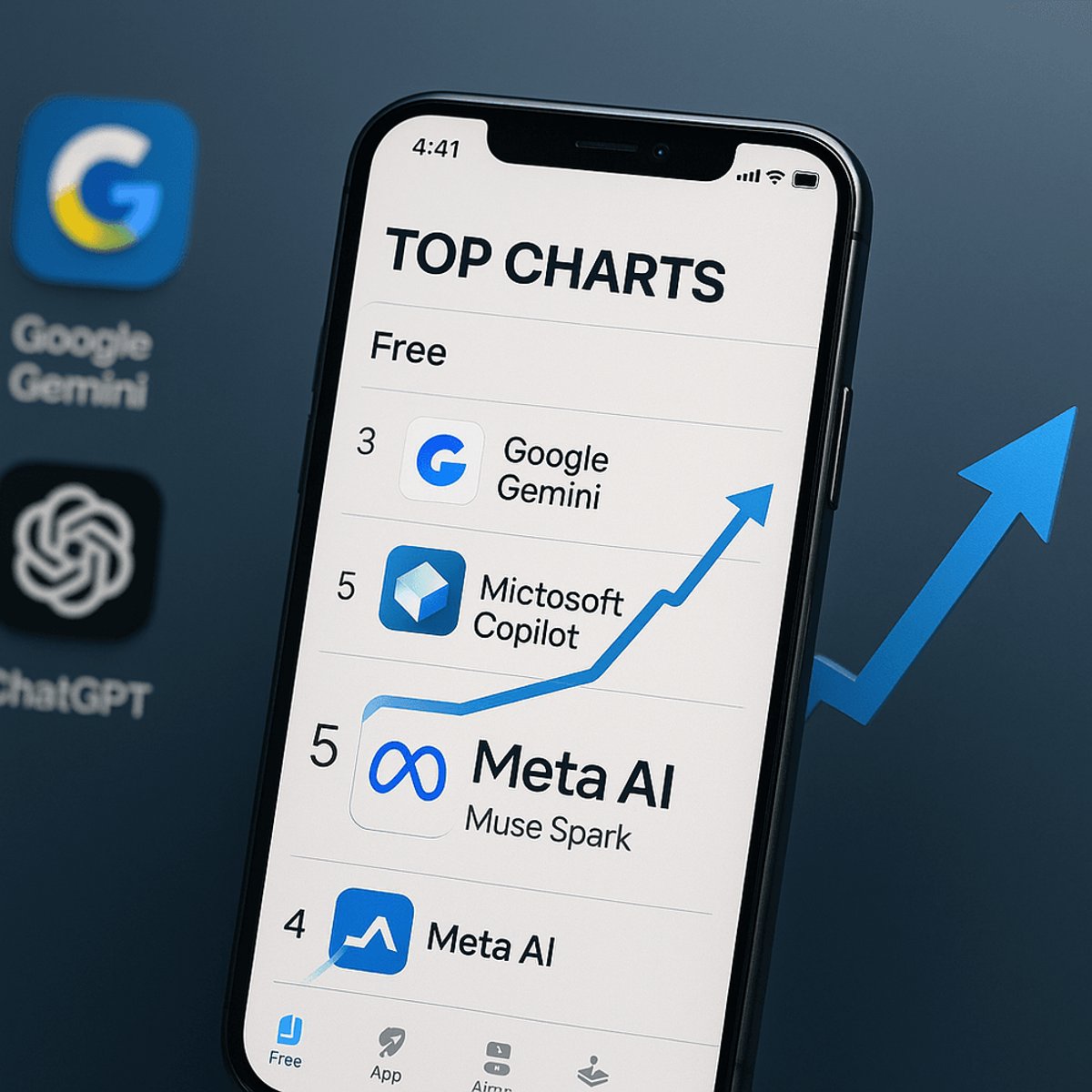
Meta just scored a major win in the AI app wars. The company's standalone Meta AI app rocketed from No. 57 to No. 5 on the App Store within hours of launching Muse Spark, its latest AI model. The dramatic surge signals that consumers are hungry for AI tools outside of chatbot interfaces, and it validates Meta's bet on building a dedicated AI experience separate from Facebook and Instagram.
Meta is watching its AI app tear up the App Store charts in real time. Just before the company unveiled Muse Spark, its newest AI model, the Meta AI app languished at No. 57. Now it's sitting pretty at No. 5, and the momentum shows no signs of slowing.
The jump represents one of the fastest App Store climbs for an AI application this year, according to app analytics data. It's a stark contrast to the app's previous trajectory, where it had been hovering in the mid-50s for weeks despite being integrated across Meta's family of apps including Facebook, Instagram, and WhatsApp.
Muse Spark appears to be the catalyst users were waiting for. The new model brings enhanced reasoning capabilities and faster response times compared to Meta's previous AI offerings. While Meta hasn't disclosed specific technical benchmarks, early user reports suggest noticeable improvements in handling complex queries and generating more nuanced responses.
The timing couldn't be better for Meta. The company has been pouring billions into AI infrastructure while watching OpenAI dominate consumer mindshare with ChatGPT. Meta AI's standalone app was widely seen as the company's answer to that challenge, but until now, adoption had been modest at best.
What changed? For one, Muse Spark gives users a compelling reason to download yet another app. The AI landscape is crowded, with Google's Gemini app, Microsoft's Copilot, and ChatGPT all vying for home screen real estate. Meta needed a differentiator, and Muse Spark's capabilities appear to be resonating.
The App Store rankings tell a broader story about how consumers interact with AI. While embedded AI features are convenient, users are increasingly willing to download dedicated apps when the experience is meaningfully better. Meta AI's surge suggests that the company has crossed that threshold with Muse Spark.
Competitors are taking notice. OpenAI's ChatGPT app has held a top-five position for months, and Google has been steadily pushing Gemini through its ecosystem. Meta's sudden ascent reshuffles the competitive dynamics, particularly as all three companies race to capture the next billion AI users.
The velocity of Meta AI's climb also reveals something about consumer behavior. The jump from No. 57 to No. 5 represents hundreds of thousands, if not millions, of downloads in a compressed timeframe. That kind of adoption doesn't happen organically - it suggests Meta leveraged its massive user base across Facebook and Instagram to drive awareness, likely through in-app promotions and notifications.
But awareness only gets you so far. Users have to actually want to use the app, and early retention metrics will be crucial. The App Store is littered with apps that spiked on launch day only to crater when users realized the experience didn't live up to the hype.
Meta has some advantages here. The company's AI has been embedded in its social platforms for months, giving users a preview of what to expect. Those who enjoyed the experience but wanted a dedicated interface now have an obvious option. And by branding it as Meta AI rather than tying it directly to Facebook, the company sidesteps some of the baggage associated with its social networks.
The next few weeks will be telling. If Meta AI can maintain its position or climb higher, it signals that the company has genuinely built something users want. A slide back down the charts would suggest the surge was driven more by curiosity than sustained utility.
For now, Meta is riding high. The company needed a win in consumer AI, and Muse Spark appears to be delivering. Whether this translates into long-term engagement or just a temporary spike remains to be seen, but the initial response suggests Meta's AI strategy is finally gaining traction where it matters most - in users' hands.
Meta's AI app just proved that in the attention economy, product quality still matters. The jump from No. 57 to No. 5 isn't just about rankings - it's validation that Meta can compete in the consumer AI space beyond its social platforms. But the real test starts now. Climbing the charts is one thing; staying there requires building something users return to daily. If Muse Spark can deliver on that promise, Meta just opened a new front in the AI wars. If not, this surge becomes a cautionary tale about the difference between download velocity and lasting engagement.