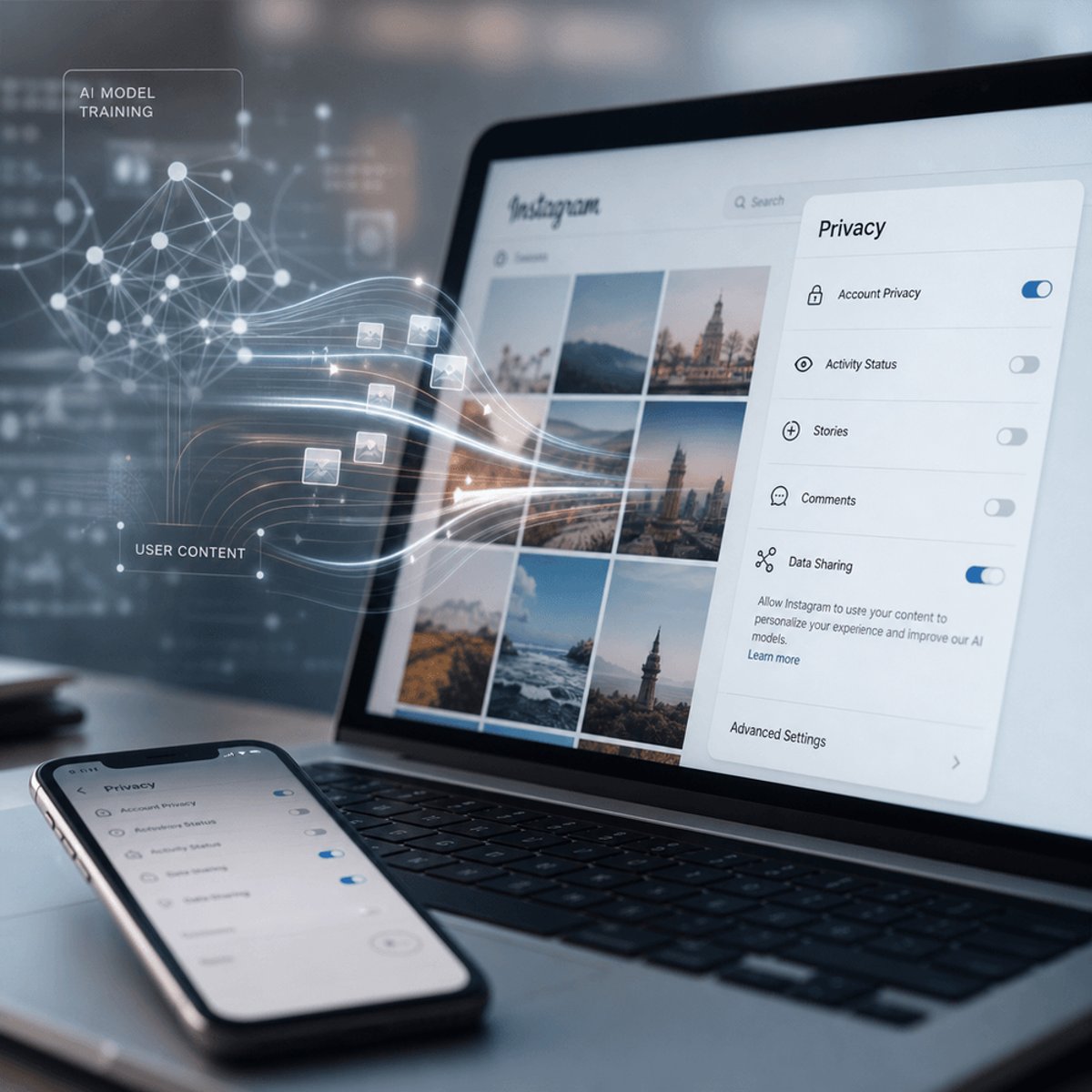
Meta is now using your public Instagram photos to train its latest AI image generator, Muse Image, and most users have no idea it's happening. The opt-out-by-default approach marks a significant shift in how the social media giant handles user content for AI training, raising fresh privacy concerns as generative AI companies face increasing scrutiny over training data practices. Unless you manually disable the feature, every public photo you've posted is fair game for Meta's AI systems.
Meta just made a quiet but significant change to how it uses your Instagram photos. The company's new AI image generator, Muse Image, is now scraping public Instagram posts to train its models - and unless you actively opt out, your content is already being fed into the system.
The feature launched with minimal fanfare, buried in a settings menu that most users will never find. According to Lauren Forristal at TechCrunch, who first reported the details, Meta is betting that most people won't notice or won't bother to disable the feature. It's a calculated move that mirrors the company's historical approach to privacy: ask for forgiveness, not permission.
To opt out, Instagram users need to navigate to Settings > Account > Privacy > AI Training Data and toggle off the option to allow Meta to use their public photos. The process isn't difficult, but it's deliberately obscure. Meta isn't sending notifications or making the choice visible during normal app usage. For a company that loves to push feature updates and policy changes through persistent banners, the silence is telling.
This isn't Meta's first dance with AI training controversy. The company has been feeding public posts from Facebook and Instagram into its large language models for months, but using photos specifically for image generation crosses a new line. Muse Image joins a crowded field of AI generators like Midjourney, Stable Diffusion, and OpenAI's DALL-E, but Meta has a distinct advantage: direct access to billions of photos uploaded by users who thought they were just sharing vacation snapshots and brunch pics.
The timing is particularly fraught. Adobe faced intense backlash earlier this year when it updated terms of service to suggest user content might be used for AI training. The company was forced to clarify and partially walk back the language after designers and photographers threatened to abandon the platform. Stability AI is currently defending itself in multiple lawsuits from artists who claim their copyrighted work was used without permission to train Stable Diffusion.
Meta's approach - making AI training opt-out instead of opt-in - puts it at odds with emerging regulatory frameworks. The EU's AI Act, which takes effect in phases starting this year, emphasizes user consent and transparency. California's pending AI training disclosure bills would require companies to clearly label when user content feeds AI systems. Meta's current implementation fails both tests.
The business logic is obvious. Training data is the new oil in the AI economy, and Meta sits on one of the world's largest reservoirs of human-created content. Instagram hosts over 2 billion monthly active users who collectively upload millions of photos daily. That's a training dataset competitors would pay billions to access. By using it to train Muse Image, Meta can compete with AI-native companies without licensing expensive third-party datasets or facing the legal risks of scraping copyrighted content from the open web.
But the ethical calculation is messier. When users uploaded photos to Instagram over the past decade, they consented to Meta displaying those images in feeds and using them for targeted advertising. They didn't consent to having their photography style, composition choices, and creative work synthesized into an AI that could generate infinite variations. The difference matters, especially for the photographers, illustrators, and visual artists who use Instagram as a portfolio platform.
Privacy advocates are already sounding alarms. The pattern is familiar: a major tech platform quietly changes how it uses data, buries the opt-out in settings, and waits to see if regulators or users push back hard enough to force a reversal. Sometimes it works. Facebook's facial recognition system operated for years before privacy concerns finally killed it. Other times, like with the disastrous 2018 Cambridge Analytica scandal, the backlash fundamentally damages trust.
What happens next depends partly on whether Instagram's creator community organizes opposition. If enough high-profile photographers and artists make noise - and threaten to leave the platform - Meta might add more prominent consent mechanisms. But the company is also betting that AI features will eventually become table stakes, and users will accept training as the price of free services.
For now, the opt-out exists. But it requires users to know it's happening, care enough to act, and successfully navigate Instagram's labyrinthine settings. That's a lot of friction for a feature that affects hundreds of millions of people's creative work.
Meta's decision to default users into AI training data collection represents a calculated bet that convenience beats consent. For the millions of Instagram users who won't dig through settings menus, their public photos are already teaching Muse Image how to generate new images. Whether this becomes another forgotten privacy erosion or sparks meaningful backlash depends on how quickly creators realize what's happening - and whether they care enough to push back. The opt-out exists, but in the attention economy, obscurity is often as effective as denial. This is how data practices change: not through dramatic announcements, but through buried toggles and passive acceptance.