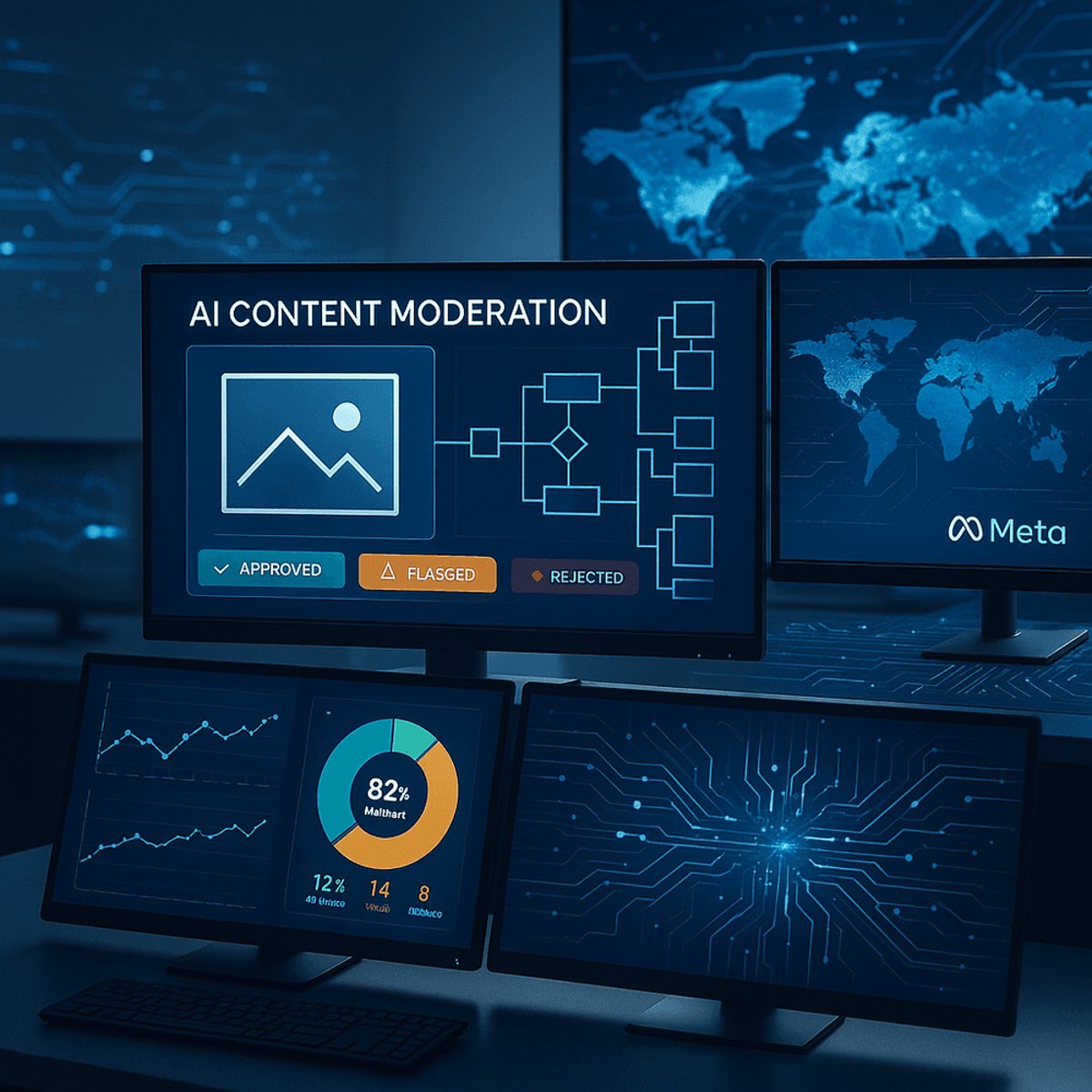
Meta is rolling out a multiyear plan to replace thousands of third-party content moderators with advanced AI systems designed to catch scams, illegal media, and policy violations across Facebook and Instagram. The shift marks one of the largest deployments of AI for platform safety to date, affecting an industry that currently employs tens of thousands of contract workers globally. According to CNBC, the transition will fundamentally reshape how the company polices content for its 3.2 billion daily users.
Meta just made its biggest bet yet that AI can do what tens of thousands of human moderators currently handle - and it's about to reshape an entire industry in the process.
The company confirmed it's beginning a multiyear deployment of advanced AI systems that will take over content enforcement tasks ranging from detecting financial scams to flagging illegal media across Facebook, Instagram, and WhatsApp. The systems represent a fundamental shift from Meta's reliance on third-party vendors like Accenture and Cognizant, which currently employ an estimated 15,000-20,000 contract moderators reviewing content flagged by Meta's algorithms.
CNBC first reported the strategic pivot, which comes as Meta continues investing billions in AI infrastructure while simultaneously cutting costs across other divisions. The timing isn't coincidental - Meta spent roughly $5 billion on content moderation in 2025, with the bulk going to third-party contractors who review millions of posts daily.
The new AI systems build on Meta's existing automated moderation tools but represent a significant leap in capability. While current systems flag potential violations for human review, the advanced models will make final enforcement decisions on an expanding range of policy violations. Meta's been testing these capabilities since late 2025, according to people familiar with the rollout, with early deployments focused on clear-cut cases like known scam patterns and previously identified illegal content.
But here's where it gets complicated. Content moderation has long been considered too nuanced for full automation - decisions about hate speech, misinformation, and context-dependent violations require cultural understanding and judgment calls that AI has historically struggled with. Meta's pushing forward anyway, betting that its latest AI models trained on years of moderation data can handle these gray areas better than previous attempts.
The company isn't completely eliminating human oversight. Internal teams will still handle appeals, edge cases, and policy development. But the dramatic reduction in third-party contractors signals Meta's confidence that AI can handle the volume - and it needs to, given the scale. Meta's platforms see roughly 350 million images and videos uploaded daily, creating an enforcement challenge that's always been partly about cost management.
For the content moderation industry, this is an existential threat. Companies like Accenture and Cognizant built multimillion-dollar divisions around social media moderation contracts. TikTok, YouTube, and Twitter all rely on similar third-party workforces. If Meta proves AI can do this work at scale, every platform will face pressure to follow.
The automation push also comes as Meta doubles down on AI across every product line. The company's investing over $60 billion in AI infrastructure in 2026, building custom data centers packed with Nvidia H100 chips to train increasingly sophisticated models. Content moderation represents one of the most obvious applications - a high-volume, rules-based task with clear training data from billions of past decisions.
What Meta isn't talking about publicly is the error rate. Human moderators make mistakes - studies suggest accuracy rates around 80-85% on nuanced decisions. If AI systems can match or beat that while processing 10x the volume, the economics become undeniable. But if the error rate climbs, Meta risks a flood of mistaken takedowns, missed violations, and the PR nightmares that follow.
There's also the geopolitical angle. Most third-party moderation centers operate in the Philippines, India, and Eastern Europe, where Meta's been criticized for labor conditions and low pay. Replacing these jobs with AI sidesteps those controversies while eliminating the human cost of exposing workers to traumatic content daily. It's a PR win that also happens to save billions.
Competitors are watching closely. Google already uses AI extensively for YouTube moderation but still employs thousands of human reviewers. TikTok recently expanded its content moderation workforce amid regulatory pressure. If Meta's transition succeeds without major blowback, expect every platform to accelerate similar plans.
The regulatory wild card remains unpredictable. The EU's Digital Services Act requires platforms to explain content decisions and maintain appeal processes. Fully automated enforcement complicates compliance, especially if users can't understand why AI flagged their posts. Meta's betting that better AI explainability tools will solve this, but regulators haven't weighed in yet.
For now, Meta's framing this as an efficiency upgrade rather than mass job cuts. The company hasn't disclosed how many vendor positions will be eliminated or over what timeframe. But the direction is clear - this is about replacing humans with algorithms at one of the largest scales attempted in the AI era.
Meta's shift to AI-powered content moderation isn't just about cutting costs - it's a statement about where the company thinks AI capabilities are today. If these systems can genuinely handle nuanced enforcement decisions at global scale, it validates years of AI investment while fundamentally changing how social platforms operate. But if the accuracy falls short or regulatory pushback intensifies, Meta could face a messy retreat to hybrid models. Either way, this is the test case the entire industry has been waiting for. What happens over the next 12-18 months will determine whether AI truly can replace human judgment in one of tech's most challenging tasks, or whether Meta just jumped too soon on automation that isn't ready for prime time.