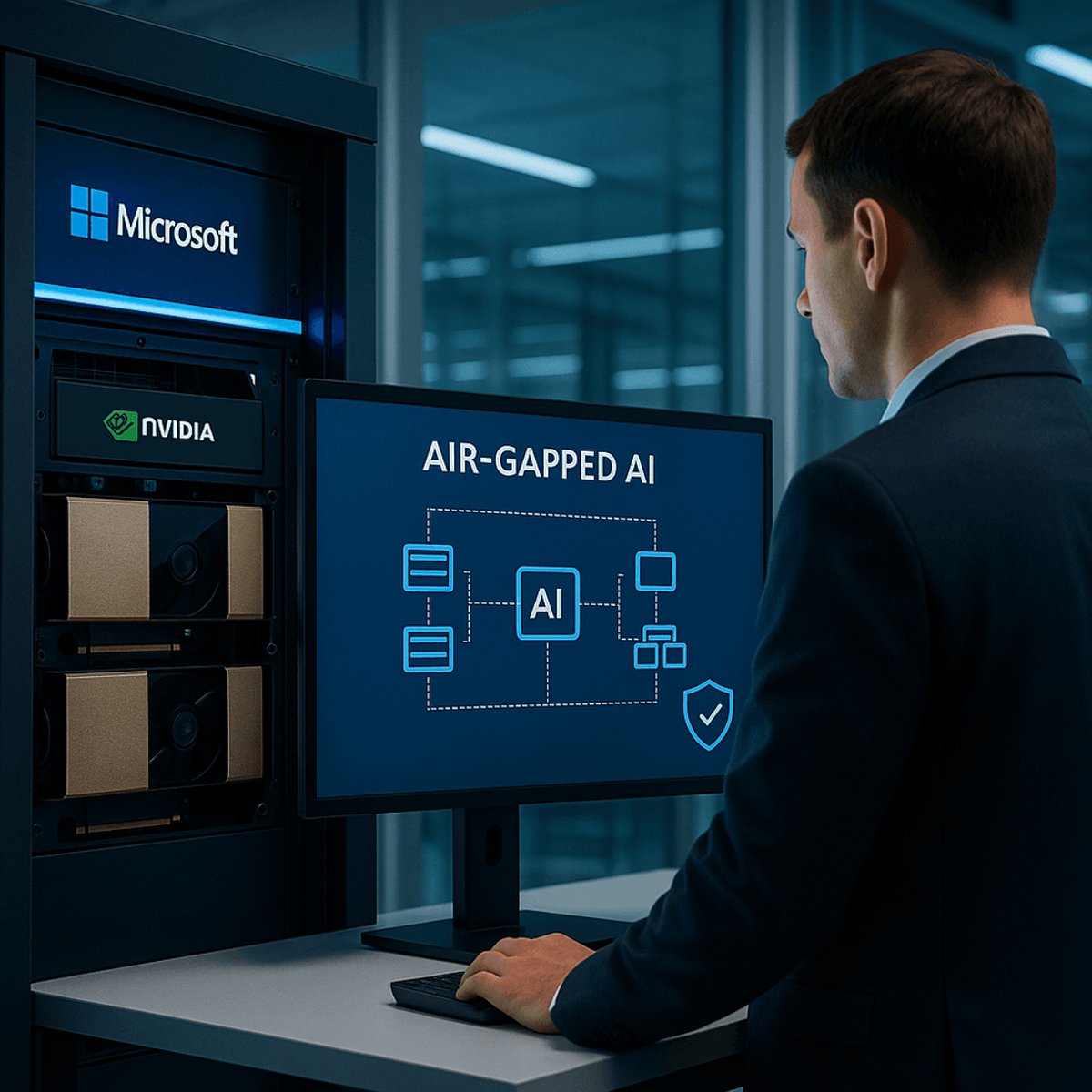
Microsoft just launched three major updates to its Sovereign Cloud platform that let enterprises run large AI models, productivity workloads, and cloud infrastructure in completely air-gapped environments. The move targets government agencies, defense contractors, and heavily regulated industries that need cutting-edge AI capabilities but can't connect to public cloud services. With Azure Local disconnected operations, Microsoft 365 Local, and Foundry Local with NVIDIA GPU support all now available, organizations can deploy multimodal AI models on-premises while maintaining strict data sovereignty.
Microsoft is rewriting the rules for enterprise AI deployment in sovereign environments. The company's latest Sovereign Cloud expansion brings three capabilities that were previously impossible: running large language models, maintaining full productivity suites, and managing Azure infrastructure without any connection to Microsoft's public cloud.
Azure Local disconnected operations went live today, letting organizations deploy mission-critical infrastructure with Azure governance but zero external dependencies. Management, policy enforcement, and workload execution all happen within customer-controlled environments. For defense contractors working on classified projects or financial institutions in jurisdictions with strict data residency laws, this changes what's technically possible.
"The availability of Azure Local disconnected operations represents a breakthrough for organizations that need control over their data without sacrificing the power of the Microsoft Cloud," Gerard Hoffmann, CEO of Proximus Luxembourg, told Microsoft in a statement. "For Luxembourg, where digital sovereignty is not just a principle but a strategic necessity, this model offers the resilience, autonomy and trust our market expects."
The productivity piece matters just as much as the infrastructure layer. Microsoft 365 Local disconnected now delivers Exchange Server, SharePoint Server, and Skype for Business Server entirely within customer boundaries, with support guaranteed through at least 2035. Teams can collaborate, share documents, and communicate without data ever touching external networks. Everything runs under customer-owned policies with full control over access, compliance, and data resiliency.
But the real headline is Foundry Local's expansion to support large-scale AI models. Microsoft is integrating NVIDIA GPUs to enable multimodal model inferencing completely offline. Organizations with highly secure environments can now run the same caliber of AI that powers connected services, just locally and within their sovereign boundaries.
The technical architecture is straightforward but powerful. In connected mode, the control plane lives in Microsoft's cloud region and manages on-premises components. In disconnected mode, that control plane runs as an appliance VM directly on customer hardware, managing Foundry Local, Microsoft 365 Local, and Azure Local without external calls. The experience stays consistent whether you're online or completely isolated.
This isn't a research project or limited preview. Azure Local disconnected operations and Microsoft 365 Local disconnected are available worldwide now. Large models on Foundry Local are shipping to qualified customers, which typically means organizations with existing sovereign cloud contracts or strict compliance requirements.
The timing matters. Digital sovereignty regulations are tightening globally, from Europe's operational resilience requirements to U.S. defense procurement standards. Microsoft built this stack by working backward from real customer constraints: external dependencies aren't acceptable, connectivity gets intentionally restricted, and operational continuity isn't negotiable.
Under the hood, Foundry Local uses modern infrastructure designed to handle large-scale models and the GPU compute they demand. Microsoft provides comprehensive support for deployments, updates, and operational health, even as inferencing demands scale over time. Customers retain complete control over their data and hardware throughout.
The competitive landscape just shifted. While Amazon Web Services offers Outposts and Google Cloud has Distributed Cloud, neither has announced comparable support for running large AI models in fully disconnected sovereign environments. Microsoft's decade-plus experience delivering on-premises server workloads through products like Exchange and SharePoint gives it institutional knowledge competitors lack.
For industries like defense, intelligence, healthcare in certain jurisdictions, and critical infrastructure, this opens up AI capabilities that were previously off-limits. A defense contractor can now run the same multimodal models used in commercial settings, just air-gapped inside a classified facility. A European bank can deploy large language models for internal tools without data crossing borders or touching external networks.
The architecture also solves a more subtle problem: operational complexity. Organizations don't need separate management planes, different governance models, or fragmented architectures for connected versus disconnected workloads. The same Azure-consistent management applies whether infrastructure is online, intermittently connected, or permanently offline.
Douglas Phillips, President and CTO of Microsoft Specialized Clouds, leads the engineering effort behind these capabilities. His team is responsible for bringing Azure, Microsoft's adaptive cloud portfolio, and the Microsoft 365 collaboration suite to customers with sovereignty, security, edge, and compliance requirements that standard cloud offerings can't address.
The implications ripple beyond just Microsoft customers. This level of sovereign AI capability sets a new baseline for what enterprises can expect from cloud providers. It proves that cutting-edge AI doesn't require compromising on data sovereignty, regulatory compliance, or operational independence.
Microsoft's Sovereign Cloud expansion fundamentally changes what's possible for enterprises operating under strict compliance regimes. By enabling large AI model deployment, full productivity suites, and cloud infrastructure to run completely disconnected from external networks, the company is opening up AI capabilities to sectors that were previously locked out by regulatory constraints. The question now isn't whether sovereign AI is technically feasible - Microsoft just proved it is. The question is how quickly competitors respond and how fast regulated industries adopt these capabilities to close the AI gap with their commercial counterparts.