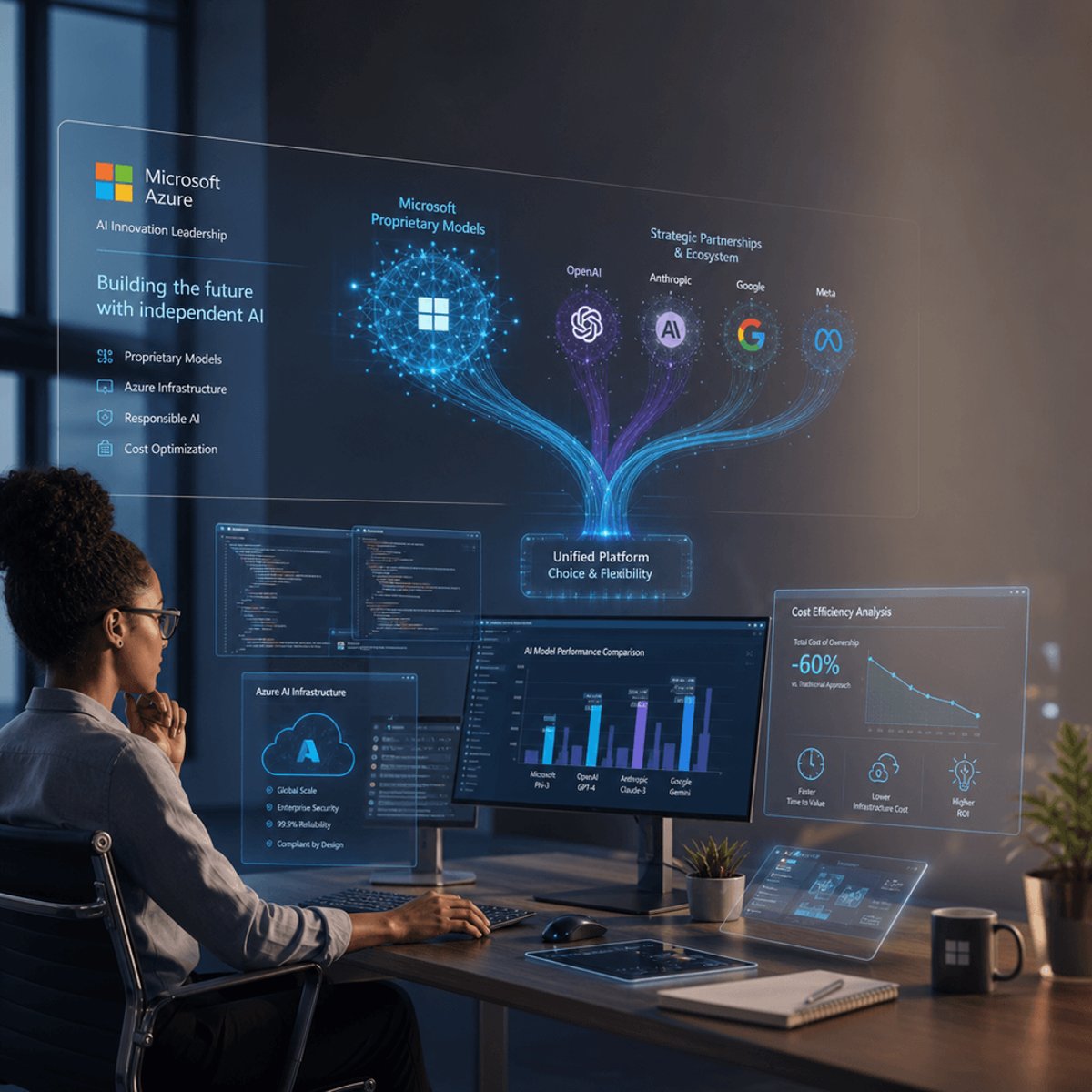
Microsoft just made its boldest move yet to break free from its OpenAI partnership. At its Build developer conference today, the company unveiled a new series of proprietary generative AI models designed to compete directly with OpenAI, Anthropic, and Google in the foundation model market. The announcement signals a strategic shift for Microsoft - reducing its costly dependence on OpenAI's technology while offering developers cheaper alternatives to power their applications.
Microsoft is making a calculated bet that it can outmaneuver its own partner. The tech giant's announcement at Build 2026 represents more than just new product launches - it's a fundamental restructuring of how Microsoft approaches the AI market it helped create through its massive investment in OpenAI.
The new models, announced at Microsoft's annual Build developer conference, are designed to give developers more affordable options for building AI-powered applications on Azure. By creating its own competitive alternatives to GPT-4 and other leading models, Microsoft is essentially building an exit ramp from what has become an expensive and strategically complicated partnership.
The timing couldn't be more telling. Microsoft has poured roughly $13 billion into OpenAI since 2019, securing exclusive cloud provider rights and early access to breakthrough models like GPT-4. But that partnership has created tension - Microsoft essentially resells OpenAI's technology at markup while simultaneously building competing products. Now the company appears ready to hedge its bets with homegrown alternatives.
The move puts Microsoft in direct competition with the foundation model triumvirate currently dominating the market: OpenAI, Anthropic, and Google. Each company has spent hundreds of millions developing their flagship models - ChatGPT, Claude, and Gemini respectively - and built substantial developer ecosystems around them. Microsoft's entry threatens to fracture that landscape, particularly if it can deliver on the promise of lower costs.
For developers, cost has become the defining issue in AI deployment. Running large language models at scale burns through compute resources at staggering rates. A single API call to GPT-4 can cost orders of magnitude more than traditional cloud services. If Microsoft can offer comparable performance at significantly reduced prices by leveraging its Azure infrastructure, it could trigger a major migration.
The announcement also highlights Microsoft's broader AI strategy, which has evolved considerably since the ChatGPT explosion in late 2022. Initially content to be OpenAI's primary distribution channel, Microsoft has steadily built out its own AI capabilities - from Copilot integrations across its product suite to custom silicon designed for AI workloads. The new models represent the logical next step: controlling the entire stack from chips to applications.
But building competitive foundation models isn't simple or cheap. Google has spent years and billions developing its AI infrastructure, drawing on decades of search and language processing expertise. Anthropic, founded by former OpenAI leaders, has raised over $7 billion specifically to develop safe, reliable AI systems. Microsoft will need to prove its models can match the quality and reliability enterprises have come to expect.
The announcement also raises questions about Microsoft's ongoing relationship with OpenAI. While the companies remain officially partnered, with Microsoft continuing to provide OpenAI's cloud infrastructure, launching competing products creates obvious friction. OpenAI has its own ambitions to expand beyond pure model development into applications and potentially hardware, putting it on a collision course with Microsoft's core businesses.
For the broader AI ecosystem, Microsoft's move could accelerate the ongoing commoditization of foundation models. As more players enter the market with competitive offerings, the premium pricing that early leaders commanded may erode. That's good news for developers and enterprises looking to deploy AI at scale, but it intensifies the pressure on pure-play AI companies to differentiate beyond raw model performance.
The Build announcement also comes as regulators worldwide scrutinize big tech's AI investments and partnerships. Microsoft's OpenAI stake has drawn particular attention from antitrust authorities concerned about consolidation in the AI market. Developing proprietary alternatives could help Microsoft argue it's fostering competition rather than monopolizing the space through exclusive partnerships.
Microsoft's Build announcement marks a turning point in the AI wars. By launching proprietary models to compete with OpenAI, Anthropic, and Google, the company is betting it can leverage its Azure infrastructure and enterprise relationships to capture a larger share of the foundation model market. For developers, the promise of lower costs and tighter Azure integration could prove compelling. But the real story is strategic - Microsoft is building insurance against overdependence on any single AI partner, even one it invested billions in. As the AI landscape continues to evolve at breakneck speed, controlling your own technology stack isn't just smart business, it's survival. The question now is whether Microsoft's models can deliver the performance and reliability needed to make developers switch, or if this becomes another expensive hedge in an already capital-intensive AI race.