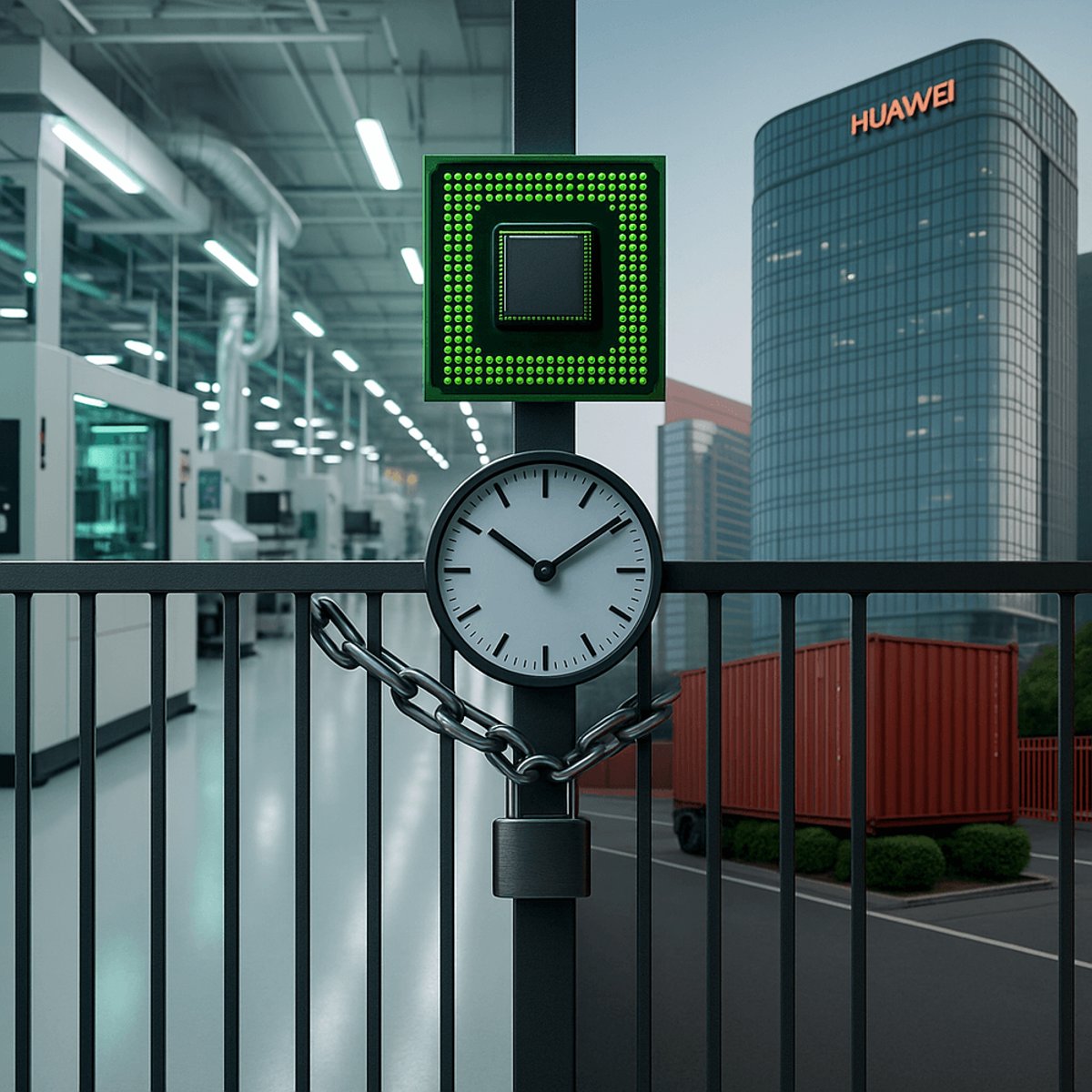
Nvidia is facing an unexpected crisis in China. Despite Washington easing export restrictions on advanced AI chips, the chipmaker still hasn't confirmed a single shipment to its once-largest market. The delay is more than a logistics problem - it's handing Chinese competitors like Huawei and Moore Threads a golden opportunity to lock in customers who've been desperately seeking alternatives to Nvidia's dominance. For a company that previously generated billions from China sales, the extended silence raises questions about whether regulatory approval means much when the window of opportunity is already closing.
Nvidia just got permission to play in China again, but it's sitting on the sidelines while homegrown rivals run up the score. The U.S. government's decision to relax export controls on certain advanced AI chips was supposed to reopen a multibillion-dollar market for the world's most valuable chipmaker. Instead, weeks after the policy shift, Nvidia hasn't confirmed shipping a single processor to Chinese customers.
The silence is deafening for a company that once counted China as its third-largest market. Before Washington clamped down on semiconductor exports in 2022, Nvidia was pulling in billions annually from Chinese tech giants hungry for GPUs to power everything from cloud computing to AI research. Those sales evaporated virtually overnight when the Biden administration added Nvidia's flagship chips to the restricted list, citing national security concerns about military applications.
Now the rules have changed again, at least partially. Washington approved a new category of export licenses for downgraded AI chips that meet specific performance thresholds - processors powerful enough to be commercially viable but supposedly limited enough to satisfy national security hawks. Nvidia designed chips specifically for this regime, tailored to squeeze under the technical ceiling while still offering meaningful computing power.
But approvals on paper don't translate to chips in data centers. The company's continued inability to confirm shipments suggests the regulatory process remains tangled in red tape, or that the approved specifications are so restrictive that Chinese customers aren't biting. Either way, the delay is proving costly in ways that go beyond immediate revenue.
Chinese AI companies didn't sit idle during the export ban. Huawei accelerated development of its Ascend series processors, positioning them as domestic alternatives to Nvidia's architecture. Startups like Moore Threads and Biren Technology raised hundreds of millions to build indigenous GPU capabilities. These weren't perfect substitutes - Nvidia's CUDA software ecosystem and years of optimization gave it enormous advantages - but they were available. And availability matters when you're trying to train large language models or scale autonomous vehicle simulations.
Every month Nvidia stays absent, those alternatives get stickier. Chinese tech giants are investing in optimizing their AI workloads for Huawei chips, rewriting software frameworks, training engineering teams on new architectures. That's switching cost Nvidia will have to overcome even when shipments finally resume. The company built its dominance partly on lock-in - once developers learned CUDA and optimized for Nvidia GPUs, moving to competitors meant painful reengineering. Now Chinese companies are building that same lock-in around local chips.
The competitive threat goes beyond pure performance specs. China's government is actively pushing tech independence through subsidies and procurement preferences. Beijing watched the export controls saga unfold and drew the obvious conclusion - relying on American semiconductors is a strategic vulnerability. That means even if Nvidia's approved chips eventually arrive and perform well, they'll be fighting an uphill battle against domestic champions backed by industrial policy and national pride.
Market dynamics are shifting too. The initial export controls created pent-up demand that Chinese chipmakers have been racing to fill. Some of that demand was speculative - companies stockpiling compute capacity in case restrictions tightened further. But much of it reflected genuine need as China's AI sector exploded alongside the global boom in large language models and generative AI. Whoever supplies those chips now shapes the next generation of Chinese AI development.
Nvidia's predicament illustrates the messy reality of using export controls as geopolitical tools. Restrictions can achieve their immediate goal of limiting access to cutting-edge technology, but they also accelerate exactly the indigenous innovation they're meant to prevent. Chinese chipmakers had been perpetual also-rans, always a generation or two behind Nvidia and AMD. The export ban transformed them into urgent national priorities backed by unlimited capital and top engineering talent.
The approved chips Nvidia designed for the Chinese market reportedly offer significantly less performance than the company's flagship H100 and H200 processors that power American AI labs. That performance gap was the whole point - enough capability for commercial applications, not enough for military supercomputing or training frontier AI models. But in practice, those downgraded specs make Nvidia's China chips less compelling against improving domestic alternatives.
Industry analysts are watching the situation closely as a test case for the limits of semiconductor export policy. If Nvidia eventually ships billions worth of approved chips, it validates the idea that nuanced controls can protect security interests while preserving commercial ties. If the company struggles to regain market share or finds the approved specifications too restrictive to compete, it suggests export controls are essentially binary - either you're in the market or you're out, with little middle ground.
For now, Nvidia is caught in regulatory limbo while competitors sprint ahead. The company's China problem isn't just about this quarter's revenue - it's about whether it can maintain a foothold in the world's largest AI market as that market rewires itself to run without American chips.
Nvidia's China standoff is turning into a case study in how quickly markets adapt when reliable suppliers disappear. The company engineered chips to satisfy U.S. export rules and presumably jumped through regulatory hoops to get approval, but none of that matters if products don't actually reach customers. Meanwhile, Chinese chipmakers are converting what started as a forced opportunity into genuine competitive advantage, building the software ecosystems and customer relationships that create durable market positions. Even when Nvidia's approved chips finally ship, the company may find it's trying to reclaim territory that's already been redrawn around local alternatives. In the semiconductor business, being absent isn't just about lost sales - it's about losing the relationships and technical integration that make future sales possible.