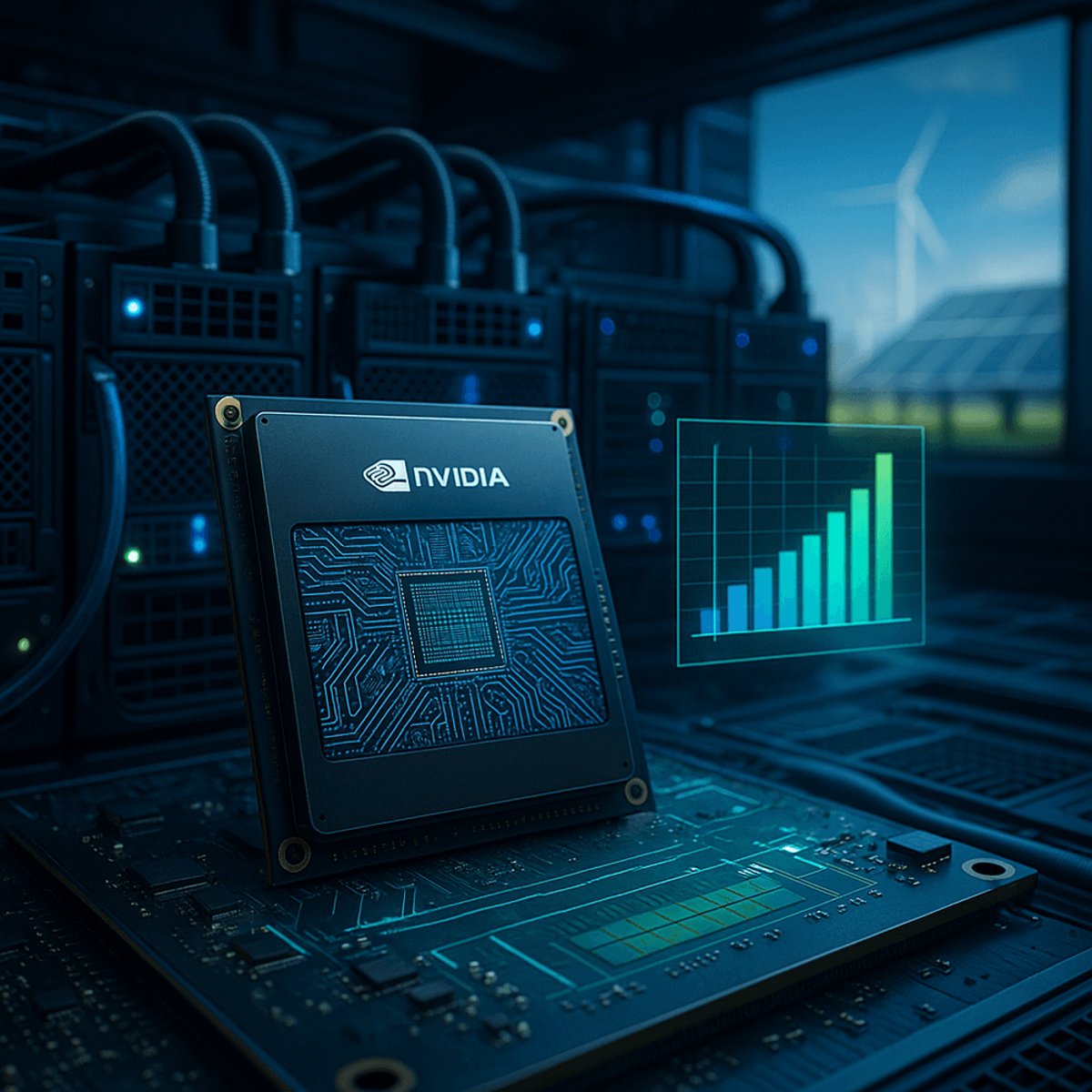
Nvidia CEO Jensen Huang just threw down the gauntlet on energy efficiency, claiming the chipmaker has built "the most energy efficient architecture in the world." The bold statement comes as AI data centers face mounting scrutiny over their massive power consumption, with some facilities drawing enough electricity to power small cities. Huang's comments signal Nvidia's strategy to position itself as the solution to AI's energy crisis, not the cause.
Nvidia CEO Jensen Huang isn't backing down from the energy efficiency debate. In a statement to CNBC, Huang declared the company has "the most energy efficient architecture in the world," a claim that comes at a critical moment for the AI industry's sustainability narrative.
The timing is no coincidence. AI data centers have become energy behemoths, with cutting-edge facilities consuming upwards of 100 megawatts of power - enough to supply tens of thousands of homes. Microsoft, Google, and Amazon have all reported year-over-year increases in carbon emissions despite net-zero pledges, with AI infrastructure cited as a primary culprit. Nvidia's chips sit at the heart of nearly every one of these facilities.
Huang's efficiency pitch is both a defense and an offense. With Nvidia commanding roughly 80% of the AI accelerator market, the company's architectural decisions ripple across the entire industry. The H100 and newer Blackwell GPUs have become the default standard for training large language models, meaning their power efficiency - or lack thereof - directly determines whether hyperscalers can meet their climate commitments.
But the claim also sets up a direct challenge to rivals. AMD has been aggressively marketing its MI300 series as more power-efficient per compute unit, while Intel positions its Gaudi accelerators as lower-power alternatives for inference workloads. Huang's statement suggests Nvidia won't cede the efficiency narrative without a fight, even as competitors chip away at its market dominance.
The stakes extend beyond environmental optics. Energy costs now represent a significant portion of AI operational expenses. For cloud providers running massive GPU clusters, even marginal efficiency improvements translate to millions in annual savings. A data center running 10,000 GPUs at 700 watts each versus 600 watts could save over $8 million yearly at typical utility rates. That's why Meta and others have begun designing custom cooling systems and negotiating directly with power utilities.
Nvidia's architectural advantage largely stems from its CUDA software ecosystem and tensor core design, which optimize matrix operations central to AI workloads. The company's latest Blackwell architecture reportedly delivers 2.5x better energy efficiency compared to the previous Hopper generation for certain tasks. But raw efficiency numbers only tell part of the story - real-world performance depends on software optimization, cooling infrastructure, and workload characteristics.
The energy debate is also reshaping data center geography. Facilities are increasingly being built near renewable energy sources or in cooler climates to reduce cooling loads. Huang's efficiency claims may help Nvidia maintain its position as hyperscalers evaluate where to build next-generation AI infrastructure and which chips to deploy.
What's conspicuously absent from Huang's statement is specific benchmark data or third-party verification. Efficiency metrics vary wildly depending on workload type, measurement methodology, and system configuration. Industry analysts have called for standardized efficiency testing similar to automotive fuel economy standards, but no consensus framework exists yet.
The broader question is whether incremental efficiency gains can keep pace with AI's explosive growth. Even if Nvidia's chips are twice as efficient as competitors, the industry's appetite for compute continues to double every few months. OpenAI's GPT-4 training reportedly consumed over 50 gigawatt-hours of electricity - more than some small countries use annually. Without fundamental breakthroughs in energy efficiency or a shift to renewable power sources, AI's sustainability crisis will intensify regardless of which chips are most efficient.
For now, Huang's declaration serves as a strategic marker. Nvidia is signaling it won't let efficiency become a weakness that rivals can exploit. But as data center operators scrutinize every watt and policymakers consider AI energy regulations, the company will need to back up its claims with transparent data and continued architectural innovation.
Huang's efficiency declaration is a calculated move in an industry where energy consumption has become a liability. Nvidia's architectural claims will face increasing scrutiny as hyperscalers demand proof and regulators eye the AI sector's environmental impact. The real test isn't whether Nvidia has the most efficient chips today, but whether the company can maintain that edge while rivals innovate and the industry's compute appetite continues its exponential climb. For now, the energy efficiency battle has a clear front-runner - but the race is just beginning.