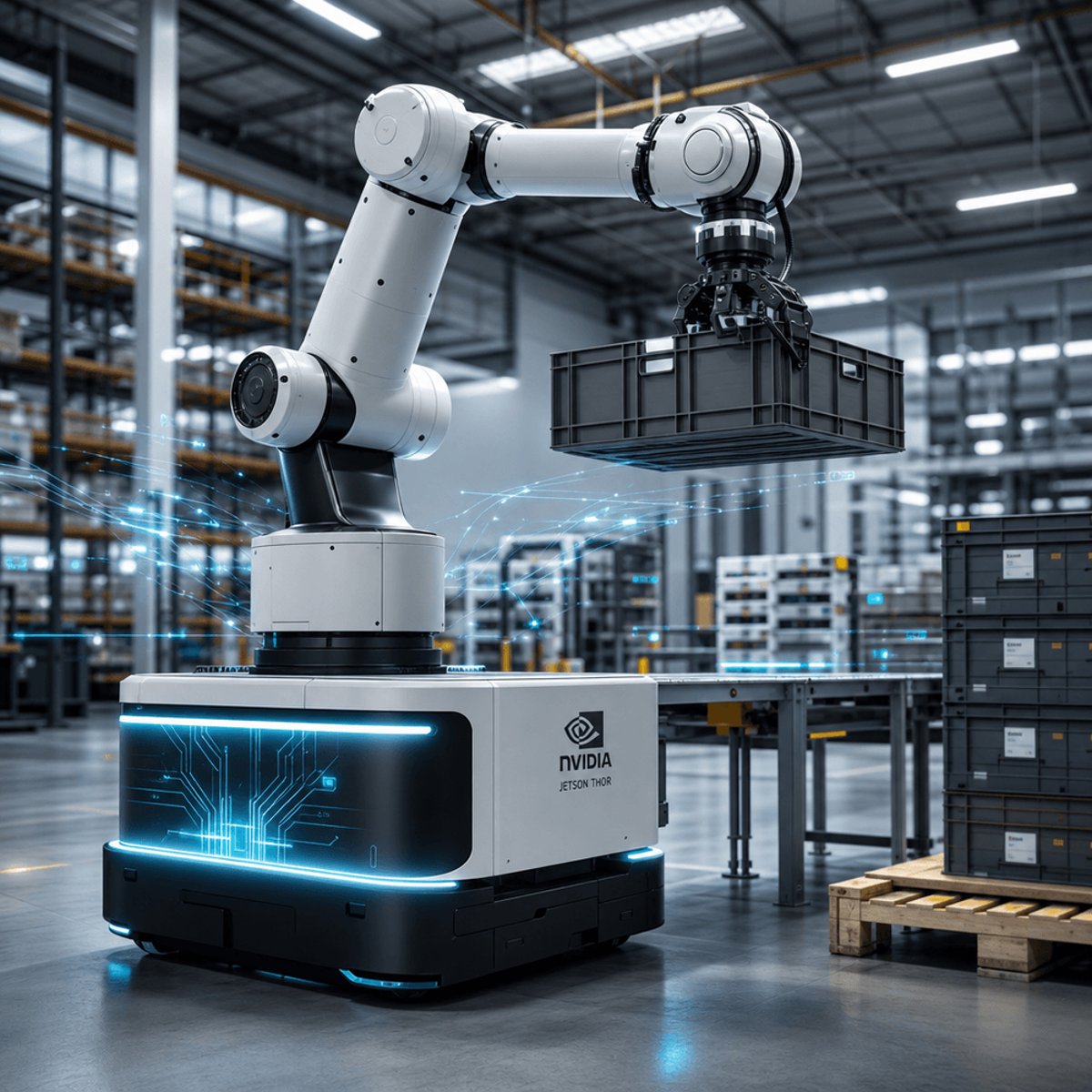
Nvidia just made a major play to put AI brains into every robot on the factory floor. The chip giant unveiled its new Jetson Thor T3000 and T2000 modules today, compact AI supercomputers designed to run foundation models directly on autonomous machines and general-purpose robots. It's a strategic bet that the robotics industry is about to explode beyond research labs into real-world deployment, and Nvidia wants to be the Intel inside every AI-powered machine.
Nvidia is making its most aggressive push yet into the robotics hardware market. The company announced the T3000 and T2000 today, new compute modules built on its Thor architecture that promise to bring data center-class AI performance to the edge. According to Nvidia's official announcement, these modules are specifically engineered to run foundation models on autonomous machines and general-purpose robots.
The timing couldn't be more deliberate. General-purpose robots are finally breaking out of controlled lab environments and heading to factory floors, warehouses, and potentially homes. That shift creates massive demand for compute that can handle the complex AI workloads these machines need, but in packages small and efficient enough to actually fit inside a robot.
Nvidia's Thor architecture is the engine under the hood here. While the company hasn't released detailed specs yet, the T3000 and T2000 designations suggest a tiered approach - likely a flagship and a more accessible variant to hit different price and performance points. This mirrors Nvidia's playbook in other markets, from gaming GPUs to data center accelerators.
What makes this launch particularly significant is the focus on foundation models at the edge. These large AI models - the same type powering chatbots and image generators - require enormous computational horsepower. Running them on a robot instead of streaming results from the cloud means lower latency, better privacy, and crucially, robots that can operate without constant internet connectivity.
The robotics industry has been waiting for hardware like this. Companies building autonomous mobile robots for logistics, humanoid robots for manufacturing, and agricultural robots have been constrained by the compute available in compact form factors. Nvidia's previous Jetson lineup served the developer community well, but foundation models demand a different class of performance.
Nvidia's dominance in AI accelerators gives it a natural advantage here. The company already powers the training infrastructure for most major AI models. Extending that ecosystem to inference at the edge creates a vertically integrated story - train on Nvidia GPUs in the cloud, deploy on Nvidia modules in robots. Developers working with CUDA and Nvidia's software stack can theoretically move their models from data center to robot with minimal friction.
But Nvidia isn't operating in a vacuum. Intel has been pushing its edge AI offerings, Qualcomm is making noise in autonomous systems, and startups like Hailo are targeting the same market with specialized chips. The difference is ecosystem maturity. Nvidia's software advantage - particularly in AI frameworks and pre-trained models - could be the differentiator that matters more than raw chip specs.
The announcement also signals where Nvidia sees the robotics market heading. By launching modules explicitly designed for "mass-market" deployment, the company is betting that we're past the experimental phase. Robotics companies are ready to scale production, and they need silicon partners who can deliver volume.
From a market perspective, this extends Nvidia's addressable opportunity significantly. The company's data center business is booming on the back of generative AI demand, but edge AI represents a parallel growth vector. Every autonomous robot, smart camera, and industrial machine running AI inference is another potential Nvidia customer.
The T3000 and T2000 modules will likely ship to partners and developers first, with production devices hitting the market in the coming quarters. Nvidia typically follows product announcements with developer kits and reference designs, giving robotics companies a blueprint for integration. Watch for early adopters in warehouse automation and manufacturing - sectors where the ROI case for autonomous machines is already proven and companies are racing to deploy at scale.
What remains to be seen is pricing and power consumption details. The edge AI market is cost-sensitive, especially for applications targeting mass deployment. If Nvidia can deliver foundation model performance at price points that work for volume robotics manufacturers, this could reshape the competitive landscape quickly.
Nvidia's Jetson Thor launch marks a clear inflection point for AI-powered robotics. By bringing foundation model compute to the edge in production-ready modules, the company is betting billions that autonomous machines are about to go mainstream. For robotics companies, this solves a critical bottleneck - the compute to make truly intelligent machines at scale. For Nvidia, it opens a massive new revenue stream just as competitors circle its data center dominance. The real test comes in the next 12 months as these modules ship and we see whether the robotics industry is actually ready to scale, or if this is another case of hardware arriving before the market matures.