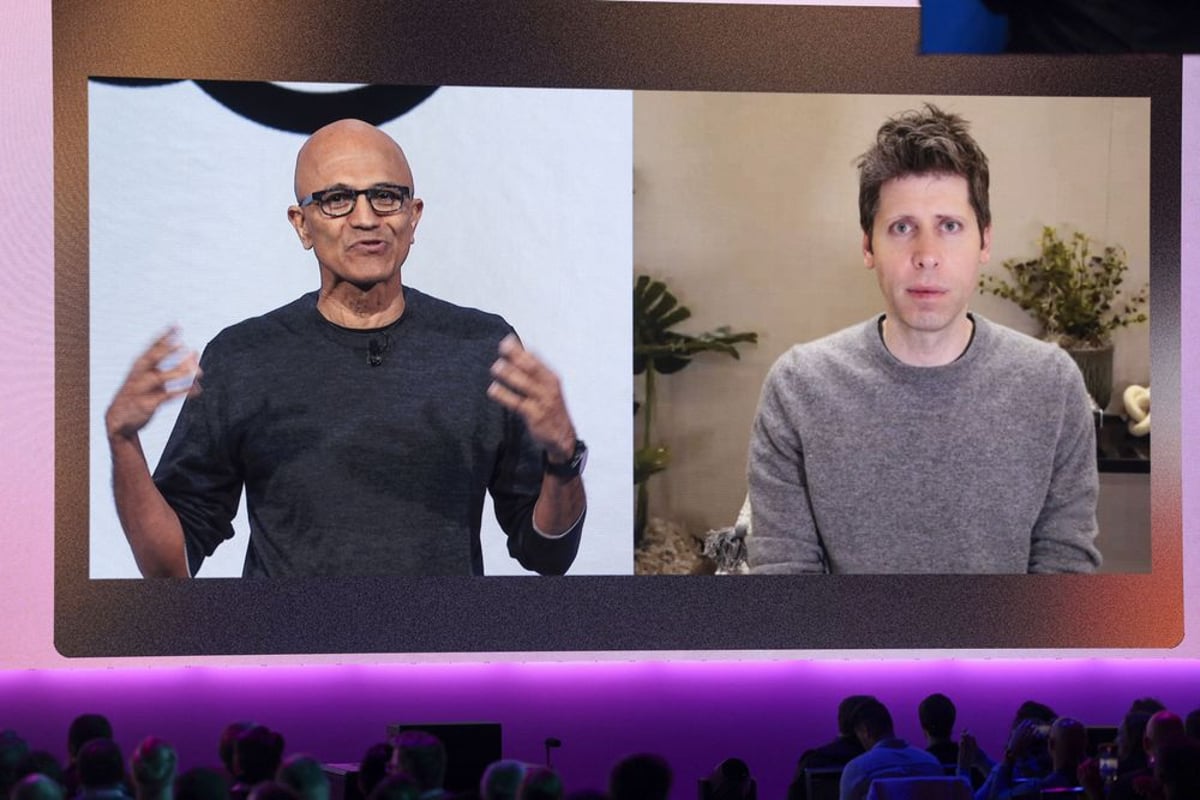
OpenAI just took a major step toward going public. The ChatGPT maker and Microsoft signed a new memorandum of understanding Thursday that restructures their complex $13 billion partnership, potentially clearing the biggest hurdle to OpenAI's anticipated IPO at a $500 billion valuation. The move comes as state regulators investigate OpenAI's unusual corporate restructuring plans.
OpenAI and Microsoft just rewrote the rules of their partnership, and it could be the key to unlocking one of tech's most anticipated IPOs. The two AI giants signed a memorandum of understanding Thursday that fundamentally restructures their increasingly tangled $13 billion relationship, removing what many saw as the biggest barrier to OpenAI going public at its eye-watering $500 billion valuation.
The timing isn't coincidental. OpenAI has been frantically working to untangle its corporate structure as it prepares for an IPO that could reshape the entire AI landscape. The company's unusual hybrid model - part nonprofit, part for-profit - has created regulatory headaches that threatened to derail any public offering plans.
But this new deal changes everything. According to OpenAI's statement, the nonprofit parent will maintain control over the for-profit business while holding an equity stake worth more than $100 billion. That's a massive stake that preserves the company's mission-driven roots while creating a clear path to public markets.
Microsoft's role in this evolution tells its own story about how quickly the AI landscape is shifting. The Redmond giant has poured $13 billion into OpenAI since 2019 and shares revenue from ChatGPT and its API. But the relationship has grown complicated as both companies now compete directly in AI markets.
During a company town hall Thursday, Microsoft CEO Satya Nadella and AI chief Mustafa Suleyman made their strategy crystal clear. "We should have the capacity to build world class frontier models in house of all sizes, but we should be very pragmatic and use other models where we need to," Suleyman told employees. Translation: Microsoft is hedging its bets by building its own AI while maintaining the OpenAI partnership.
The new MOU reflects this evolved dynamic. Microsoft now officially lists OpenAI as a competitor, allows the startup to use other cloud providers for compute power, and has ramped up investments in its own AI models. It's a far cry from the exclusive partnership that launched ChatGPT into the mainstream.
But the path to an IPO isn't completely smooth yet. State regulators aren't buying OpenAI's restructuring plans without a fight. The attorneys general of California and Delaware have opened investigations into the company's unusual corporate transformation, raising questions about whether a nonprofit can legally transfer billions in value to a for-profit entity.
Other philanthropies and nonprofits have pushed back hard against OpenAI's restructuring, arguing it sets a dangerous precedent for mission-driven organizations to essentially cash out. The regulatory scrutiny adds uncertainty to any IPO timeline, even with the Microsoft partnership hurdle cleared.
OpenAI addressed the investigations directly in its announcement, saying it continues to "work with the California and Delaware Attorneys General as an important part of strengthening our approach." The company emphasized its commitment to safety and helping everyone - the kind of language that suggests it's trying to preserve its nonprofit credentials while pursuing for-profit growth.
The $500 billion valuation that's been floated would make OpenAI one of the most valuable companies in the world, putting it in the same league as Apple, Microsoft, and Google. That's remarkable for a company that was basically unknown outside AI research circles just three years ago.
What happens next will likely determine the future of AI funding and corporate structure. If OpenAI successfully navigates the regulatory challenges and goes public, it could create a blueprint for other mission-driven startups looking to scale while preserving their values. If regulators block the restructuring, it might force a complete rethink of how AI companies balance profit and purpose.
For now, the Microsoft deal removes one major obstacle. But with state investigations ongoing and the nonprofit sector watching closely, OpenAI's path to public markets remains anything but certain. The company's next few months could reshape not just its own future, but the entire playbook for AI companies trying to go big while staying true to their missions.
OpenAI's new Microsoft deal marks a pivotal moment in AI's evolution from research project to public company. While the MOU clears one major IPO hurdle, ongoing regulatory investigations mean the company isn't out of the woods yet. The outcome will likely set the template for how other AI startups balance mission and money - and whether nonprofits can successfully transform into public market juggernauts. For investors and the broader tech industry, OpenAI's restructuring represents both the promise and perils of AI's rapid commercialization.