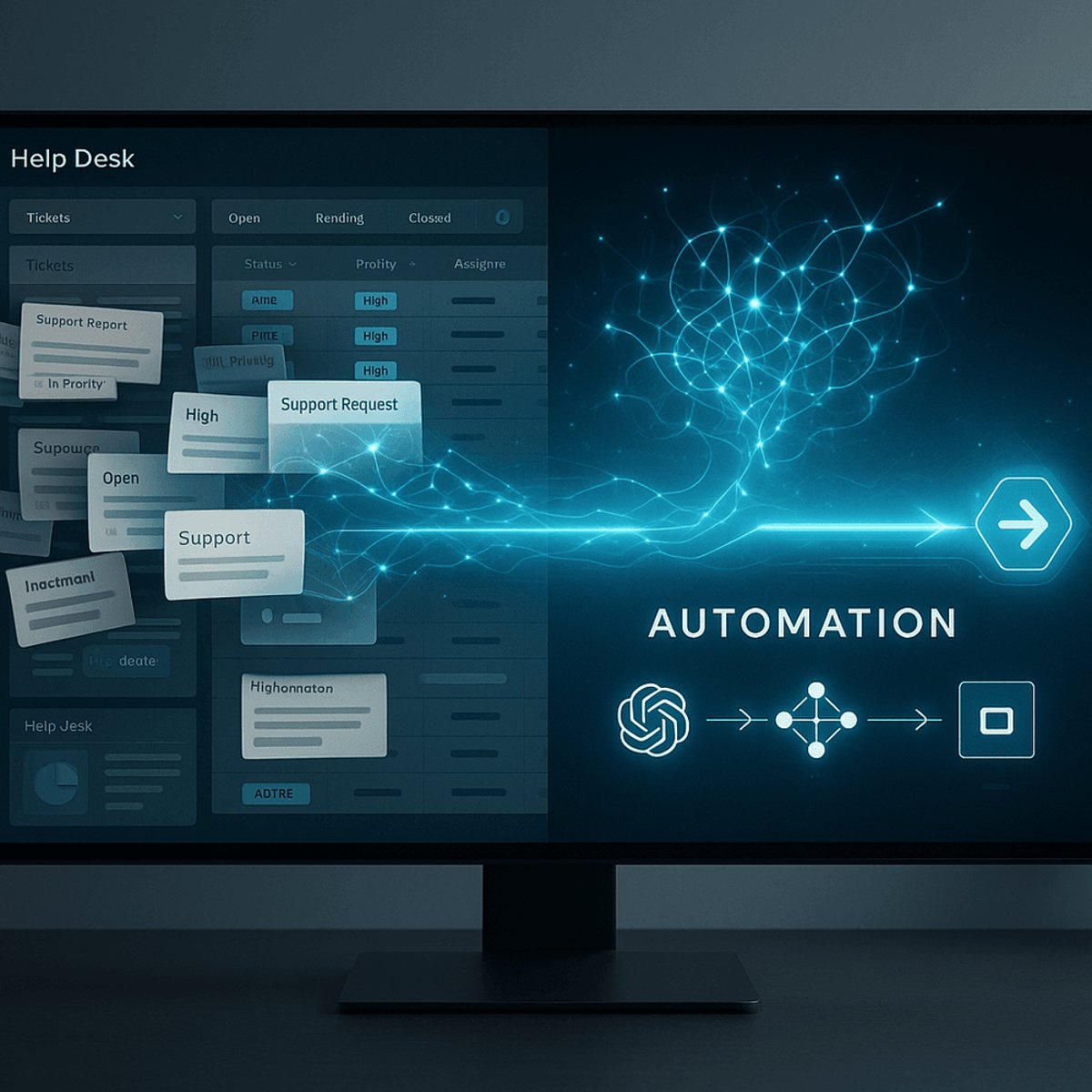
Risotto, an AI-powered help desk automation startup, just raised $10 million in seed funding led by Bonfire Ventures, with backing from 645 Ventures, Y Combinator, Ritual Capital, and Surgepoint Capital. The company's already proving its chops with clients like Gusto, where it knocked out 60% of support tickets automatically. As giants like Zendesk, ServiceNow, and Freshworks dominate the billion-dollar help desk market, Risotto's betting that AI-first infrastructure will crack open the door for newcomers to reshape how IT support actually works.
Risotto just landed $10 million to bet big on a simple premise: nobody should need four full-time employees just to manage Jira. The AI help desk automation startup announced its seed round Tuesday, led by Bonfire Ventures, with participation from 645 Ventures, Y Combinator, Ritual Capital, and Surgepoint Capital, according to TechCrunch.
Help desk automation is a billion-dollar industry, and one of the ripest targets for AI disruption. Zendesk, ServiceNow, and Freshworks currently own the market, but the AI wave is giving smaller players like Risotto an opening to reimagine the entire workflow from scratch.
The company sits in the messy middle - between ticket management systems like Jira and the complex internal tooling IT teams need to actually resolve issues. Built on a third-party foundation model, Risotto's real innovation isn't the AI itself but the infrastructure wrapped around it. CEO Aron Solberg calls it the company's "special sauce" - prompt libraries, evaluation suites, and thousands of real-world training examples that keep the non-deterministic nature of large language models from going sideways.
"Our special sauce is the prompt libraries, the eval suites, and the thousands and thousands of real-world examples that the AI gets trained on to ensure it actually does what it's expected to do," Solberg told TechCrunch in an exclusive interview.
The results speak for themselves. Working with payroll platform Gusto, Risotto automated away 60% of the company's support tickets. That's not just shaving minutes off response times - it's fundamentally changing the economics of IT support.
But Risotto isn't just optimizing the old way of doing things. The company's already positioning for a more radical shift in how enterprises think about help desks. Right now, 95% of Risotto's customers still follow the traditional model: humans receive tickets, humans solve tickets. Yet Solberg sees newer companies moving toward something different - making AI the primary interface between employees and their tech stack.
"With 95% of our customers, humans still solve tickets the traditional way," Solberg said. "But we see the newer companies shifting to have the primary interface between humans and the technology be an LLM."
In practical terms, this means tasks get managed through tools like ChatGPT for Enterprise or Google's Gemini, which coordinate help desk tickets alongside everything else knowledge workers do. Risotto's team has already built integrations with both platforms, connecting over the Model Context Protocol.
If that vision takes hold, it reshapes what enterprise SaaS even means. Instead of products competing for users' attention with slick interfaces, specialized tools like Risotto would function as APIs called by a central AI coordinator. Reliability and context management become more valuable than dashboards and dropdown menus. It's a fundamentally different paradigm - one where the software works for the AI, not the human.
The timing couldn't be better. Enterprise IT has become a tangled mess of overlapping systems, each requiring dedicated staff just to keep running. "One of our customers has four full-time employees just to manage Jira," Solberg says. "And that's to say nothing about implementing AI. That's just to wrangle the platform itself."
That complexity creates opportunity. While ServiceNow and Zendesk are scrambling to bolt AI features onto legacy architectures, startups like Risotto can build from scratch with AI as the foundation. The $10 million seed round gives the company runway to prove whether that architectural advantage translates into market share.
The help desk automation space is getting crowded. Other AI-native startups are chasing the same opportunity, betting that enterprises will swap out entrenched vendors for better AI-first tools. But Risotto's early traction with companies like Gusto - and its work integrating with next-gen platforms like ChatGPT for Enterprise - suggests it's picked the right moment to scale.
For Bonfire Ventures, the bet is on infrastructure. As AI reshapes enterprise workflows, someone needs to build the connective tissue between generic foundation models and specific business processes. Risotto's positioning itself as exactly that - the layer that makes AI reliable enough to trust with your company's IT operations.
The question now is whether enterprises are ready to hand over the keys. Automating 60% of tickets sounds great until you're the IT director explaining why the AI broke something critical. Solberg's emphasis on evaluation suites and training examples suggests he knows reliability will make or break the company. In a world where OpenAI can build a foundation model in months, the real moat is proving you won't accidentally delete someone's production database.
Risotto's $10 million seed round marks another bet that AI will reshape enterprise software from the infrastructure up. The company's early success automating support tickets at companies like Gusto proves the immediate value proposition, but the bigger opportunity lies in the paradigm shift toward AI-first workflows. As enterprises move from human-centric interfaces to LLM-coordinated systems, the winners won't be the companies with the prettiest dashboards - they'll be the ones that make AI reliable enough to trust with mission-critical operations. With backing from Bonfire Ventures and integrations already live with ChatGPT for Enterprise and Gemini, Risotto has the runway and positioning to test whether that future arrives faster than the incumbents can adapt.