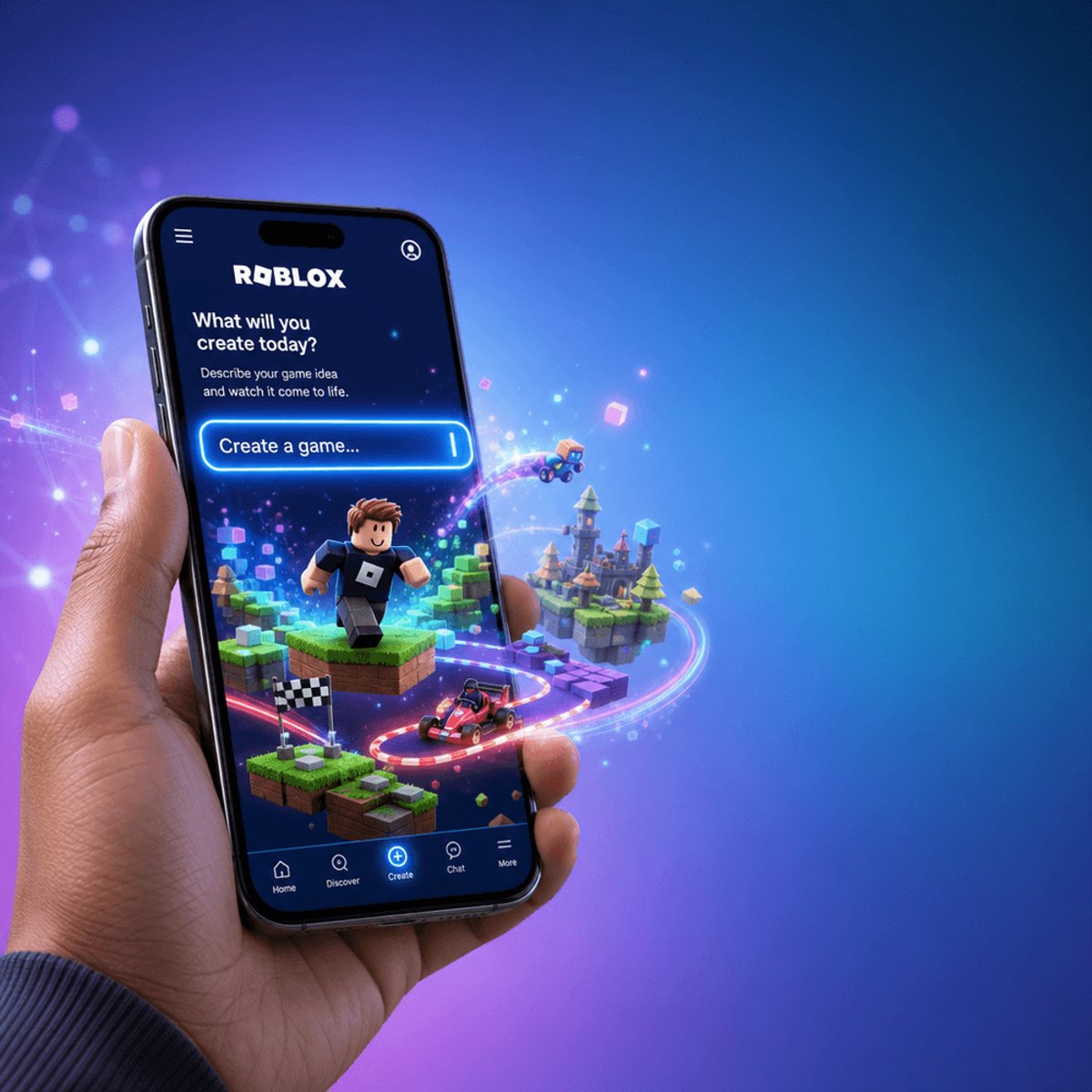
Roblox is putting AI-powered game creation directly into users' pockets. The gaming platform just launched a new "Build" feature that lets anyone generate playable games using nothing but a text prompt on their mobile device. It's a major bet that generative AI can democratize game development for Roblox's massive 70+ million daily active users, most of whom have never touched traditional development tools.
Roblox just made game creation as easy as texting. The company's new "Build" feature, rolling out now on mobile devices, lets users type a simple prompt and watch as AI generates a playable game environment in seconds. Type "racing game with loops" and you'll get a basic track. Ask for "spooky mansion" and watch walls and corridors materialize.
The timing isn't coincidental. Roblox has been quietly preparing for this moment as generative AI reshapes what's possible in user-generated content. While competitors like Epic Games focus on high-fidelity creation tools and Meta experiments with AI in Horizon Worlds, Roblox is betting on mobile-first accessibility. The platform's user base skews young - over 50% are under 13 - and they're far more likely to experiment with creation on their phones than fire up a desktop IDE.
"Build" represents the most aggressive move yet by a major gaming platform to integrate generative AI into the creative process. According to TechCrunch, the feature generates "basic games" from prompts, though the company hasn't detailed the technical limitations. Early tests suggest it handles simple mechanics - platforming, racing, exploration - but complex game logic still requires manual scripting.
The technology builds on Roblox's existing AI infrastructure, which already powers chat moderation, content recommendations, and automated translation across 70 languages. But text-to-game creation is a leap beyond content filtering. The company's been developing its own large language models and 3D generation systems, likely training them on the billions of user-created experiences already on the platform. That gives Roblox a unique advantage - a massive dataset of what actually works in games, filtered through real player behavior.
For developers who've spent years mastering Roblox Studio, this might feel threatening. The platform has minted teenage millionaires through its developer economy, which paid out over $500 million to creators last year. But Roblox appears to be positioning Build as a gateway drug, not a replacement. Users who start with AI-generated basics will likely graduate to more sophisticated tools once they understand game structure. It's the same playbook that made Roblox successful in the first place - lower the barrier to entry, then provide depth for those who want it.
The competitive landscape is watching closely. Unity and Unreal Engine have both announced AI coding assistants, but nothing this consumer-facing. Microsoft, which has invested heavily in OpenAI, could bring similar capabilities to Minecraft, its own user-generated content juggernaut. And startups like Scenario and Ludo are racing to build AI game creation tools from scratch, recently raising tens of millions to challenge the incumbents.
What sets Roblox apart is distribution. The Build feature lives inside an app that's already on hundreds of millions of devices, with an audience that's grown up expecting to create, not just consume. That's a distribution advantage no startup can match and a cultural moat that even Microsoft doesn't fully have with Minecraft.
The technical challenges are substantial. Text-to-game generation needs to handle physics, asset creation, gameplay loops, and balancing - all from ambiguous natural language. Early generative AI tools in gaming have struggled with consistency and player expectations. Nobody wants a racing game where the track randomly ends or a platformer where jump physics change mid-level. Roblox will need to constrain outputs enough to ensure quality while preserving the creative flexibility that makes prompts useful.
There's also the moderation nightmare. If users can generate game content through text, how does Roblox prevent inappropriate or harmful experiences from slipping through? The company's already faced scrutiny over child safety and content moderation. AI-generated games add another layer of complexity to an already difficult problem, potentially requiring real-time AI monitoring of AI-created content - a technical challenge that's still largely unsolved across the industry.
For now, Roblox is keeping Build focused on "basic games," likely to test the technology and gather data before expanding capabilities. It's a measured approach that mirrors how the company has historically rolled out features - start small, iterate based on user behavior, then scale aggressively once the kinks are worked out.
Roblox's Build feature is a clear signal that AI-powered creation tools are moving from professional workflows into consumer apps. Whether it actually makes game development meaningfully easier for millions of kids with smartphones remains to be seen - generative AI still struggles with the kind of coherent, intentional design that makes games fun. But by shipping this now on mobile, Roblox is gathering data and user feedback that could position it ahead of competitors still experimenting in labs. The real test won't be whether Build can generate a game from a prompt, but whether those games are actually worth playing.