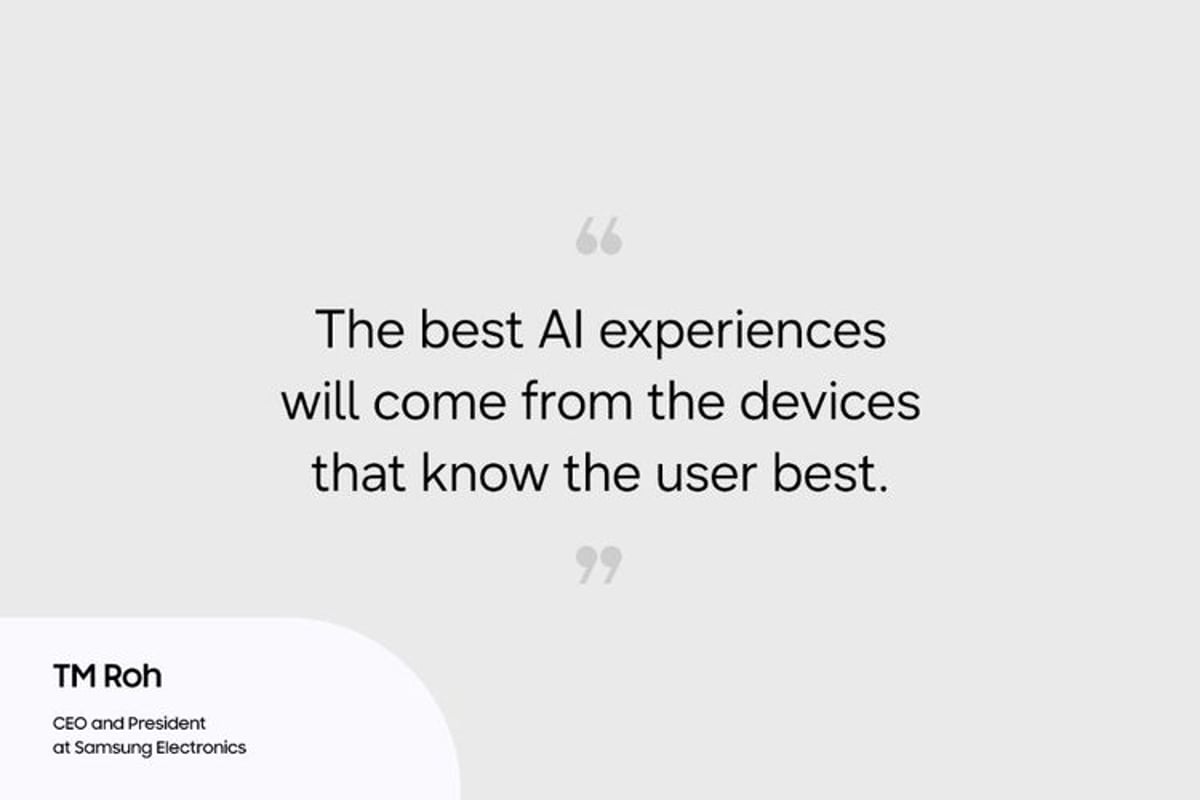
Samsung is making its pitch for the agentic AI era. In an editorial published ahead of its upcoming Galaxy Unpacked event, the company outlined a vision where artificial intelligence doesn't just answer questions but takes action on users' behalf - all while keeping data on-device and protected by Knox security. The message: the best AI isn't the smartest, it's the one that understands you best.
Samsung just laid out its philosophy for winning the AI device wars, and it's not about having the most powerful models. It's about having the most personal ones.
In an editorial published by Samsung Newsroom ahead of the company's Galaxy Unpacked event, Samsung argues that AI's breakthrough moment won't come from raw intelligence but from understanding individual users across multiple touchpoints. The phone that's always with you. The watch tracking your sleep. The TV and appliances in your home. Even the foldable in your pocket and what Samsung cryptically calls "intelligent eyewear."
"AI no longer merely answers," the editorial states. "It is entering an agentic age, taking action on our behalf while the person carries the final decision. But to act for someone, it must first know them."
It's a direct shot at the current AI landscape, where companies are racing to build the most capable large language models. Samsung's bet is different: that the winner will be whoever can weave AI most naturally into daily life, using signals from devices people already trust.
The company points to its ecosystem as the advantage. Sleep data from your Galaxy Watch could shape tomorrow's schedule. Signals from your smart home add context about where you live and how you move through your day. The phone remains the hub, but intelligence flows between devices. Samsung has spent years building this connected infrastructure through SmartThings, which now supports industry-wide open standards.
But as AI becomes more distributed and agentic, Samsung knows it has a trust problem to solve. That's where Samsung Knox comes in. The security platform that's protected Galaxy devices for years now extends to the connections between them. As intelligence moves across your phone, watch, and home, Knox is supposed to protect what flows through those pipes.
"The most personal data stays on the device," Samsung promises, "so people can understand how AI is working and remain in control." It's an implicit critique of cloud-first AI approaches where your data lives on someone else's servers.
The editorial also hints at hardware updates coming at Galaxy Unpacked. Foldables get special attention, with Samsung emphasizing it's made them "thinner, lighter, stronger and more immersive" over multiple generations. The pitch is that as AI helps users juggle more tasks simultaneously, flexible screens that fold into your hand or open to a larger canvas become more valuable.
Health is another focus. Samsung positions the Galaxy Watch as uniquely suited for AI-powered health insights because it's with you constantly, tracking sleep, recovery, and daily patterns that "add up" over time.
What's notable is what Samsung isn't saying. There are no specific product announcements, no technical specifications, no partner reveals. This is positioning, not news. The company is framing the conversation before the actual hardware drops.
The editorial comes as the AI device race heats up. Apple has pushed Apple Intelligence across its ecosystem. Google is weaving Gemini into Pixel phones and smart home products. Meta is experimenting with AI-powered smart glasses. Samsung's response appears to be: we've been building this connected foundation for years through Galaxy and SmartThings, and now AI makes it all matter more.
"The question that opens the next era is not who has the smartest AI," Samsung writes, "but who understands people best, and turns that understanding into experiences they can trust."
It's a philosophical argument that will be tested by actual products at Galaxy Unpacked. Samsung is betting that its head start in building a device ecosystem - and its emphasis on on-device processing and security - will differentiate it as AI agents become more capable and more personal.
The mention of "intelligent eyewear" is particularly intriguing, suggesting Samsung may be preparing to enter the smart glasses category where Meta and others are already competing. Combined with continued foldable innovation and deeper AI integration across watches and phones, Samsung appears to be expanding the surface area where its AI can meet users.
Whether this vision translates into compelling products remains to be seen. But Samsung is clearly positioning itself not as the company with the smartest AI, but as the one with AI in the most places - all talking to each other, all protected by Knox, all learning what makes you, you.
Samsung is making a calculated play ahead of Galaxy Unpacked: positioning itself not in the race for the smartest AI, but for the most personal one. By emphasizing its ecosystem of devices that already know you - your phone, watch, home appliances, and soon foldables and smart glasses - the company is betting that distribution and trust matter more than raw intelligence. The on-device processing and Knox security are table stakes in this vision. What matters now is whether Samsung can deliver AI experiences at Unpacked that actually feel different from the cloud-first approaches everyone else is taking. The agentic AI era is coming. Samsung wants to own the entry points.