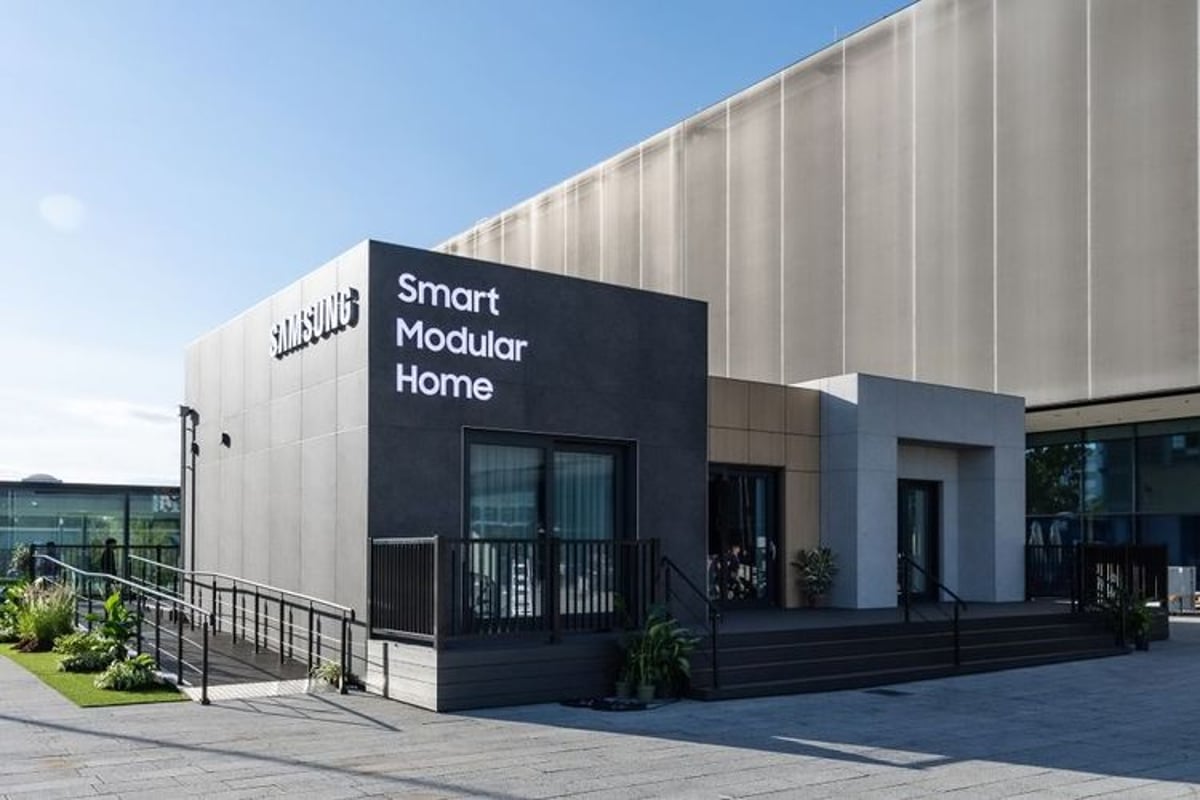
Samsung just unveiled its Smart Modular Home at IFA 2025, marking the company's boldest push yet into AI-powered residential living. The fully integrated home combines AI-enabled appliances, advanced HVAC systems, and seamless SmartThings connectivity into a single modular housing solution targeting the global B2B market. This isn't just another smart home concept – it's Samsung's vision for how AI will fundamentally reshape residential spaces.
Samsung just dropped its most ambitious smart home project yet at IFA 2025, and it's not what you'd expect from the smartphone giant. The Smart Modular Home represents a complete rethinking of residential AI integration – not just smart devices scattered throughout a traditional house, but an entire living ecosystem built from the ground up around artificial intelligence.
Walking through the demonstration unit at IFA 2025, the home's intelligence becomes immediately apparent. A wall-mounted SmartThings panel greets visitors with a 3D Map View showing real-time status of every connected appliance throughout the space. Smart security cameras powered by S-1 Corporation's Video Management System use AI to detect fire, falls, and intrusions, while the smart door lock triggers a cascade of automated responses the moment someone enters.
The magic happens in those automated sequences. As visitors step inside, the home doesn't just turn on lights – it orchestrates an entire welcome routine. SmartThings detects entry through the door lock, gradually opens curtains, adjusts air conditioning to preferred temperatures, and even commands the robot vacuum to complete its cleaning cycle and dock. It's the kind of seamless automation that makes traditional smart homes look primitive by comparison.
But Samsung's real innovation lies in energy management. The SmartThings Energy system doesn't just monitor power consumption – it actively optimizes usage patterns to minimize costs. Through what Samsung calls "Optimal Scheduling," washing machines and dishwashers automatically run during off-peak hours, while robot vacuums charge strategically throughout the day and complete charging overnight when electricity rates drop. For European markets where peak-time pricing is standard, the potential savings are significant.
The technical foundation runs deeper than surface-level automation. Samsung's EHS heat pump solutions handle underfloor heating, cooling, and hot water throughout the modular structure. For larger Smart Modular Home complexes, SmartThings Pro enables centralized HVAC management across multiple units – a clear signal that Samsung sees this as more than a consumer play.
The multipurpose room showcases the home's adaptability. Launching Game Mode through the SmartThings app triggers a complete environmental transformation: ceiling lights dim, curtains close, LED lighting syncs with game visuals and audio rhythms, and climate control adjusts for optimal gaming conditions. It's an example of how AI can transform spaces based on activity rather than just occupancy.
Industry observers see Samsung's timing as strategic. With modular housing gaining traction globally due to housing shortages and sustainability concerns, integrating comprehensive AI from the construction phase – rather than retrofitting existing structures – offers compelling advantages for developers. The B2B focus suggests Samsung learned from earlier consumer smart home struggles where adoption remained fragmented across different manufacturers' ecosystems.
The competitive implications are significant. While Google focuses on software integration and Amazon pushes Alexa-enabled devices, Samsung is betting on vertical integration – controlling everything from the appliances to the building systems to the AI that coordinates them all. It's a bold strategy that could reshape how the smart home market develops.
According to Samsung's official announcement, features and specifications remain subject to change as development continues, and availability will vary by region. But the IFA 2025 demonstration suggests Samsung is serious about moving beyond proof-of-concept into commercial deployment.
What makes this particularly significant is Samsung's focus on the B2B market rather than direct consumer sales. By partnering with modular home manufacturers and commercial developers, Samsung can achieve scale faster while avoiding the chicken-and-egg problem that has plagued many smart home initiatives. Developers get a complete turnkey solution, while Samsung secures ecosystem adoption from the construction phase.
Samsung's Smart Modular Home represents more than another smart home concept – it's a fundamental reimagining of how AI can be woven into residential spaces from the ground up. By targeting B2B markets and focusing on modular construction, Samsung is positioning itself to capture the next wave of smart home adoption as housing developers embrace AI-integrated building solutions. The success of this approach could determine whether the smart home market finally moves beyond fragmented device ecosystems toward truly integrated living spaces.