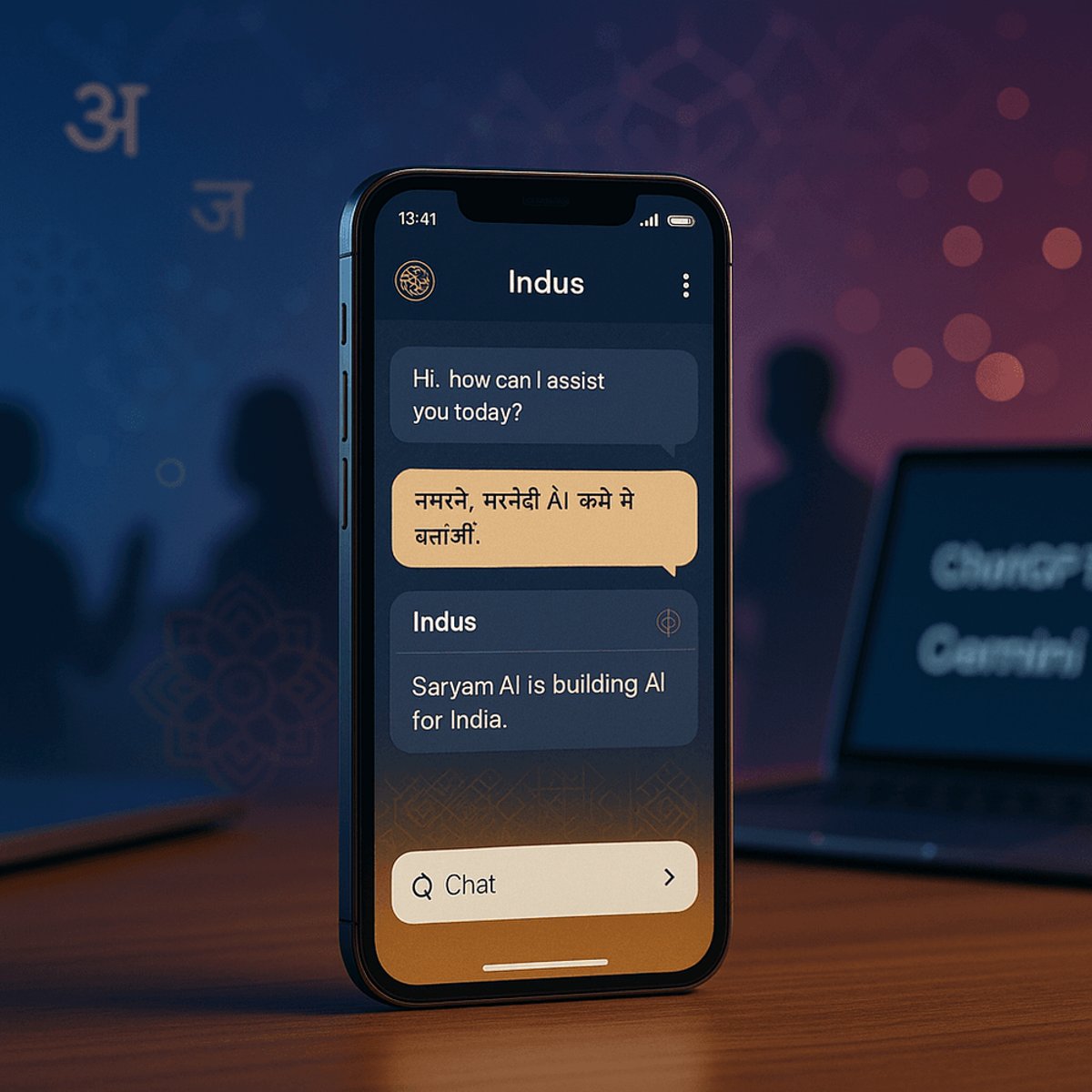
Indian AI startup Sarvam AI just entered the consumer battleground with Indus, a new chat app now available in beta. The launch puts the Bangalore-based company in direct competition with OpenAI's ChatGPT and Google's Gemini in a market where localized AI experiences could tip the scales. As global AI giants race to capture India's massive user base, Sarvam is betting that homegrown models trained on Indian languages and cultural context will resonate where one-size-fits-all solutions fall short.
Sarvam AI, one of India's most promising AI startups, is making its consumer play. The company's new Indus chat app launched in beta this week, throwing its hat into a ring already crowded with heavy hitters like OpenAI and Google. But Sarvam isn't trying to out-ChatGPT ChatGPT - it's building something specifically for India's complex linguistic and cultural landscape.
The timing couldn't be more strategic. India has become ground zero for the global AI wars, with OpenAI reporting explosive growth in the region and Google doubling down on localized AI features. Sarvam's bet is that understanding context matters as much as raw computing power. When you're serving a market of 1.4 billion people speaking dozens of languages across wildly different cultural contexts, generic AI assistants trained primarily on English data start showing their limitations.
Sarvam has been building toward this moment since its founding. The startup previously released its Sarvam 105B model, positioning itself as a serious player in large language model development. That foundation now powers Indus, giving the chat app the linguistic chops to handle Indian languages with native fluency rather than clunky translation layers. It's the difference between an AI that translates Hindi word-by-word versus one that actually thinks in Hindi.
The competitive landscape is heating up fast. OpenAI has seen massive adoption in India, while Google leverages its existing dominance through Android and Search to push Gemini integration. But both companies face the challenge of adapting global products for local nuances. Sarvam doesn't have that problem - localization isn't an afterthought, it's the entire strategy.
What makes this launch particularly interesting is the beta approach. Rather than a splashy full release, Sarvam is gathering user feedback from real Indian users dealing with real Indian use cases. That iterative mindset signals maturity in a market where too many startups overpromise and underdeliver. The beta period gives Sarvam room to refine how Indus handles everything from code-switching between English and regional languages to understanding cultural references that would sail over a Western-trained model's head.
The Indian AI startup ecosystem has been on fire lately, with venture capital pouring into companies building India-specific AI solutions. Sarvam sits at the intersection of two massive trends - the global AI boom and India's digital transformation. The country's AI market is expected to reach $7.8 billion by 2025, according to industry estimates, and consumer applications represent the next frontier after enterprise adoption.
For Sarvam, the Indus launch is both validation and challenge. The company has proven it can build competitive AI models. Now it needs to prove those models can capture consumer attention in a market where free alternatives from tech giants are just a download away. The advantage? Those giants are playing catch-up on localization while Sarvam built for it from day one.
The beta release also positions Sarvam to gather crucial data on how Indian users actually want to interact with AI assistants. Do they prefer voice over text? How often do they switch languages mid-conversation? What kinds of queries differ from Western usage patterns? This intelligence could become Sarvam's moat, creating a feedback loop where better localization drives more users, which generates better training data, which improves localization further.
What happens next will likely depend on user reception and Sarvam's ability to scale. Running large language models is expensive, and consumer applications burn through compute resources fast. The startup will need to balance quality with cost-efficiency while competing against companies with effectively infinite resources. But in a market where cultural fit matters as much as technical capability, Sarvam has a shot at carving out significant territory before the giants fully adapt.
Sarvam AI's Indus launch represents more than just another chat app entering an overcrowded market. It's a test of whether localized AI built from the ground up can compete with adapted global products in one of the world's most complex and fastest-growing markets. For Indian users, it means more choice and potentially better-suited AI assistants. For the broader AI industry, it's a reminder that the next wave of innovation might not come from Silicon Valley scaling globally, but from regional players solving local problems so well that their approaches become the new standard. Watch how users respond to Indus in beta - that feedback will tell us whether India's AI future looks more like adapted Western technology or homegrown alternatives that truly understand the market they serve.