Lepro just crossed a privacy line most smart home makers haven't dared touch. The company's new AI Lighting Pro series embeds microphones directly into power cords, creating lights that listen to everything you say without needing a separate smart speaker. It's the latest sign that always-listening devices are becoming unavoidable.
Lepro is betting you'll trade privacy for convenience in your living room. The company's new AI Lighting Pro series marks a troubling milestone: smart lights that listen to everything you say, no Amazon Echo or Google Nest required. Instead of relying on your phone or smart speaker as a middleman, Lepro embeds microphones directly into the power cords of four new products launching "later in 2025" according to The Verge's hands-on coverage.
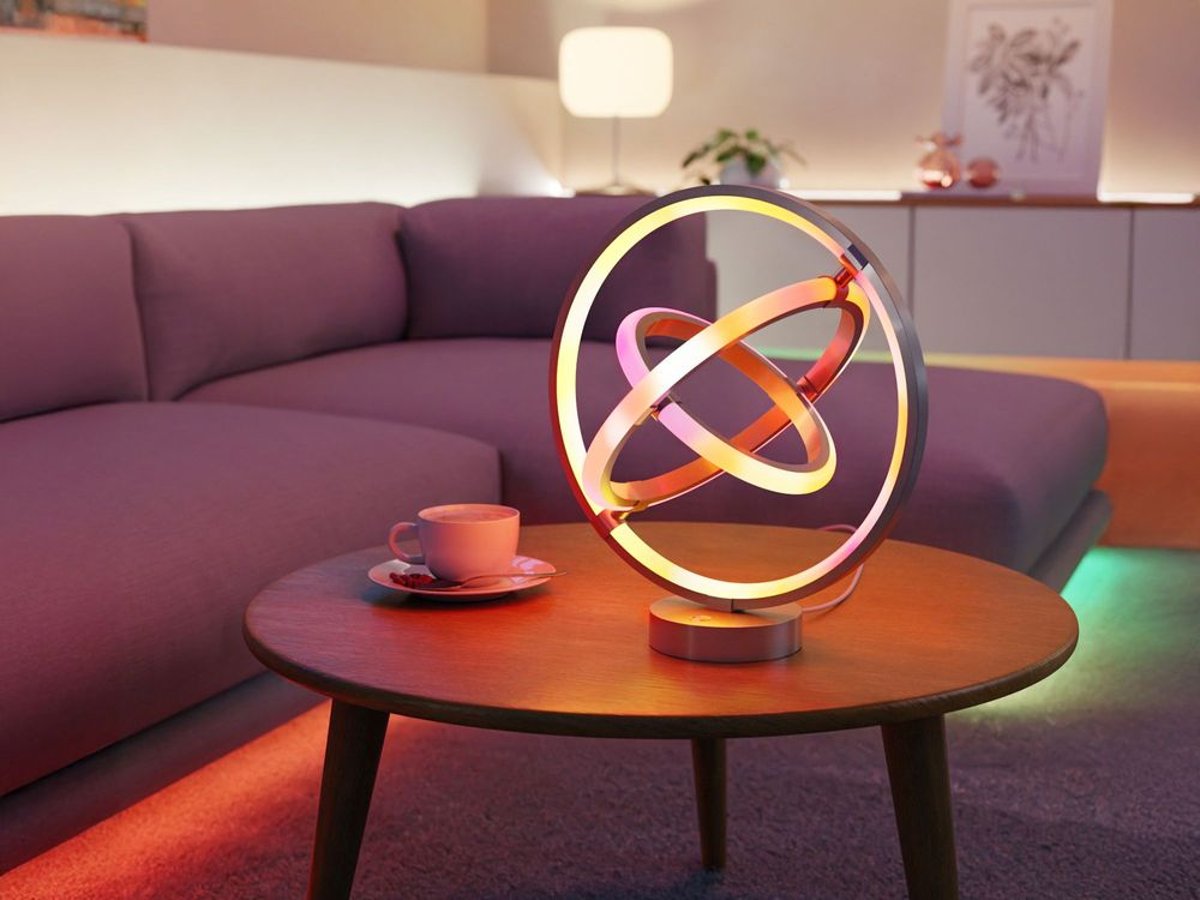
The lineup spans from basic to bizarre: the S1-Pro AI light strip, the N1-Pro AI rope light with diffusion, a rail-thin OE1-Pro AI floor lamp with RGB and 2700K warm-white modes, and the show-stealing TB1-Pro AI table lamp featuring three independently configurable intertwined rings. Each device responds to "Hey Lepro" and connects to LightGPM, Lepro's proprietary voice assistant that leverages large language models to interpret emotional lighting requests.
[embedded image: Lepro's TB1-Pro AI table lamp with gyroscope-like rings on a nightstand]
The LLM integration sets this apart from standard voice-controlled lights. Rather than just processing "turn on the lights" commands, these fixtures understand contextual requests like "I'm doing yoga" or "I'm a very stressed-out Mets fan" to generate appropriate lighting patterns. The system creates custom effects and color schemes by parsing natural language through artificial intelligence, pushing smart home automation into more intuitive territory.
But this convenience comes with a concerning trade-off: another device in your home that's always listening. While Amazon's Alexa and Google Assistant integration remains available, Lepro's standalone operation eliminates the gatekeeping these established platforms provide. Your lighting fixtures now join the growing roster of internet-connected devices feeding ambient audio to cloud-based AI systems.
The trend toward embedded voice control isn't limited to Lepro. Roborock and Ecovacs have built microphones into their robot vacuums, while Sonos speakers now control connected lighting systems directly. Even budget retailer Dollar Tree has experimented with voice-activated lighting, suggesting this capability is trickling down to mass-market products.
[embedded image: Various Lepro AI lighting products showing different room installations]
What makes Lepro's approach particularly noteworthy is the sheer ubiquity of lighting. Unlike robot vacuums that operate in specific rooms or speakers that serve dedicated purposes, lights exist everywhere in your home. Embedding always-listening microphones in such common fixtures dramatically expands the potential surveillance footprint of connected devices.
The privacy implications extend beyond simple eavesdropping concerns. These lights process ambient audio through large language models, meaning fragments of your conversations, private moments, and daily routines become training data for AI systems. Unlike centralized smart speakers that users consciously activate, lights blend into the background architecture of living spaces.
No pricing has been announced for the AI Lighting Pro series, though the company confirms all four products will reach US markets sometime in 2025. The timing aligns with broader industry momentum toward AI-powered home automation, as manufacturers race to embed machine learning capabilities into everyday appliances.
The emergence of always-listening lights reflects a fundamental shift in how technology companies view domestic spaces. Rather than treating homes as places where people choose to engage with connected devices, the new paradigm assumes constant ambient intelligence gathering through invisible sensors and microphones.
Lepro's microphone-embedded lights signal that always-listening devices are becoming inescapable fixtures of modern homes. While the LLM-powered voice control offers genuine convenience, it also represents another step toward ambient surveillance becoming the default rather than the exception. As manufacturers embed intelligence into increasingly mundane objects, consumers face the uncomfortable reality that privacy might become a luxury rather than a standard expectation.