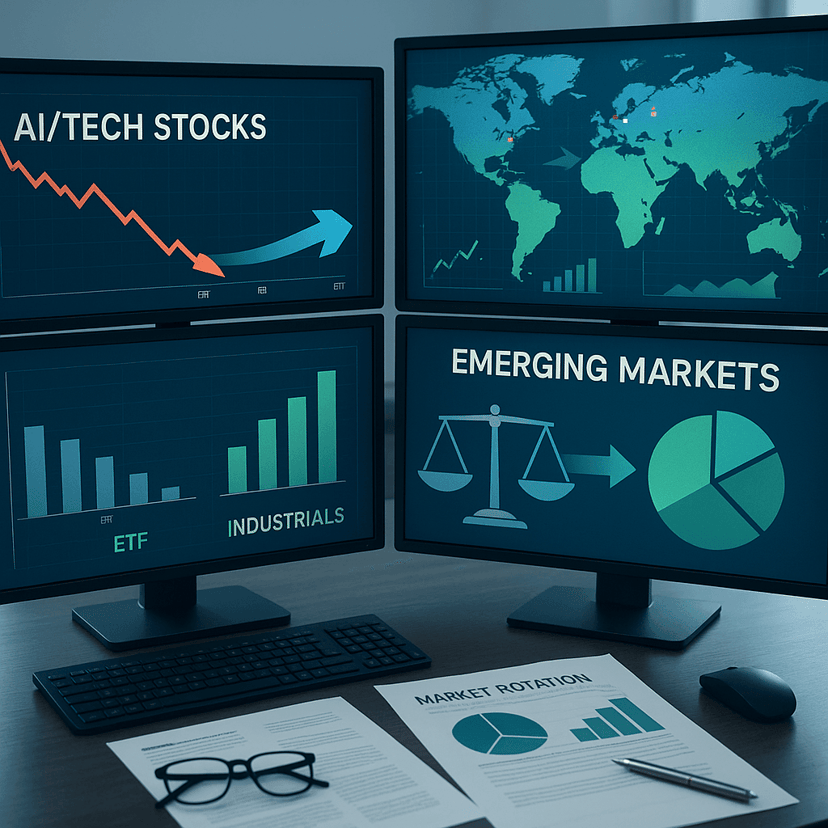
While tech investors nursed wounds from the Nasdaq's worst week since April, State Street is doubling down on artificial intelligence stocks. The investment giant's chief business officer Anna Paglia says it's still too early to bet against the AI trade, even as momentum names like Palantir tumbled over 11% this week following earnings.
State Street isn't flinching. While the Nasdaq just posted its worst week since April and AI darlings like Palantir cratered 11% after earnings, the investment management giant is sticking to its guns on artificial intelligence stocks.
"How would you not want to participate in the growth of AI technology?" Anna Paglia, State Street's chief business officer, told CNBC's ETF Edge this week. "Everybody has been waiting for the cycle to change from growth to value. I don't think it's happening just yet because of the momentum."
Paglia's conviction comes at a pivotal moment. The firm's SPDR NYSE Technology ETF has surged 38% year-to-date but pulled back over 4% this week as investors took profits in AI-linked names. Palantir, the fund's second-largest holding, got hammered despite reporting strong quarterly results Monday, highlighting how quickly sentiment can shift in momentum trades.
But Paglia, who's spent 25 years in the exchange-traded funds industry, sees the current weakness as temporary noise rather than a fundamental shift. "I don't think the rebalancing trade is going to happen until we see a signal from the market indicating a slowdown in these big trends," she explained.
The market's hesitation is understandable. AI stocks have been the year's defining trade, with Nvidia leading a charge that's pushed tech valuations to stretched levels. When these names stumble, they stumble hard - and this week's selling pressure reminded investors just how concentrated their bets have become.
Yet State Street isn't alone in maintaining faith. The firm manages several technology-focused ETFs that have captured massive inflows throughout 2025, reflecting broader investor appetite for AI exposure despite periodic volatility.
There are early signs of rotation, though. Todd Rosenbluth, State Street's head of research, points to renewed interest in healthcare stocks as a potential harbinger. "The Health Care Select Sector SPDR Fund... which has been out of favor for much of the year, started a return to favor in October," he noted in the same interview.
The healthcare fund has gained 5% since October 1st and was the second-best performing S&P 500 sector group this week - a stark contrast to technology's struggles. "Health care tends to be a more defensive sector, so we're watching to see if people continue to gravitate towards that as a way of diversifying away from some of those sectors like technology," Rosenbluth added.
This emerging rotation could signal the beginning of the end for AI's dominance, but Paglia doesn't think so. Not yet. She sees a higher likelihood that momentum cooling happens early next year, when "there will be much more focus about the diversification."
For now, State Street is betting that investor reluctance to abandon the AI growth story will keep the trade alive through year-end. It's a calculated risk - one that acknowledges the current volatility while maintaining conviction in the underlying technology transformation driving these gains.
State Street's unwavering AI optimism reflects Wall Street's broader dilemma - how long can momentum trades defy gravity? While healthcare's recent outperformance hints at rotation, Paglia's 25 years of market experience suggests the AI story has more chapters to write. For investors, the question isn't whether volatility will continue, but whether they're willing to ride it out for what could be the technology transformation of our time.