TL;DR:
• Tensor launches claiming first consumer Level 4 autonomous vehicle
• USPTO trademark filing reveals Tensor is affiliated with Chinese AV company AutoX
• Company targets 2026 launch with 37 cameras, 5 lidars, and "AGI agent" marketing
• Move likely sidesteps US restrictions on Chinese automotive software
A mystery startup called Tensor just claimed it will launch the first consumer-ready autonomous vehicle by 2026 — but trademark filings reveal it's actually Chinese robotaxi company AutoX operating under a new name. The timing couldn't be more strategic, coming as the Biden administration cracks down on Chinese vehicle software.
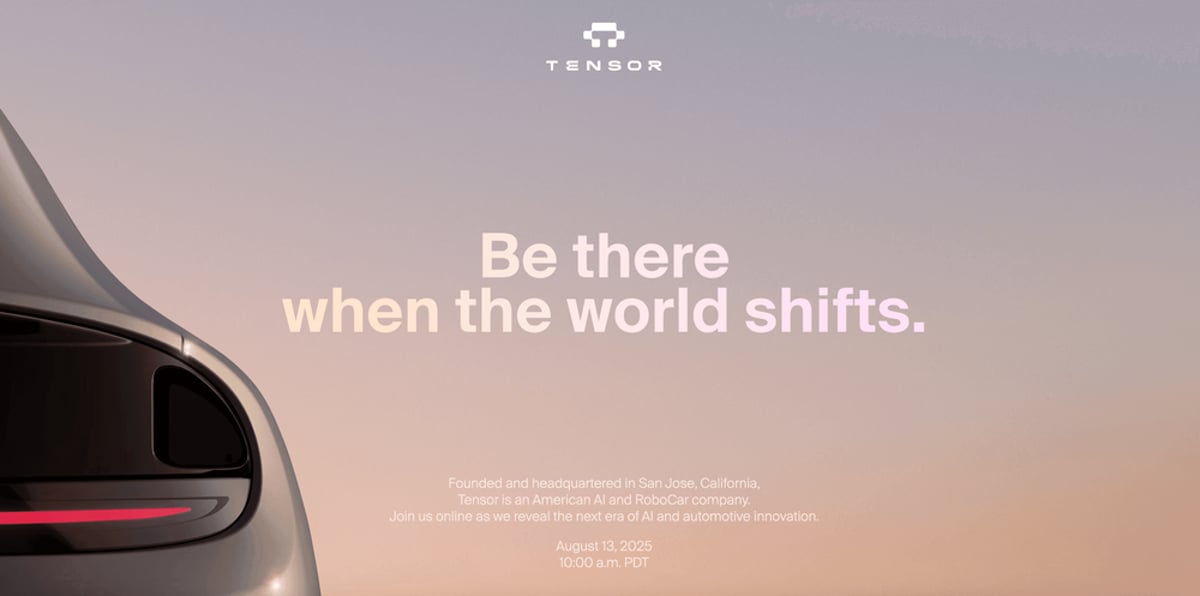
Tensor just dropped what might be the most audacious claim in autonomous vehicles: the first consumer-ready "robocar" designed for personal ownership, not ride-sharing. But here's the twist nobody saw coming — the San Jose startup isn't actually a startup at all.
Trademark documents filed last April reveal Tensor is affiliated with AutoX, a Chinese autonomous vehicle developer that's been quietly testing in California since 2016. The timing feels anything but coincidental, coming months after the Biden administration announced sweeping restrictions on Chinese software in vehicles.
"We are building a world where individuals own their personal AGI agents, enhancing freedom, privacy and autonomy," Tensor CMO Amy Luca declared in today's press release. "This isn't a car as we know it. It's an embodied personal agent that moves you." The AI-heavy messaging feels like a deliberate pivot from traditional automotive language — positioning the company alongside OpenAI and Anthropic rather than Tesla or Waymo.
Behind the rebrand lies AutoX, founded by former Princeton professor Jianxiong Xiao (who goes by "Professor X" on LinkedIn). The company secured backing from Alibaba and China's Dongfeng Motor Group, partnered with Stellantis for robotaxi services in China, and opened a San Francisco operation center in 2022.
Now Tensor — which California DMV records show holds one of only six permits for fully driverless testing alongside Waymo and Zoox — is pivoting from robotaxis to personal "robocars." The vehicle promises Level 4 autonomy with an overwhelming sensor array: 37 cameras, 5 lidars, 11 radars, 22 microphones, plus everything from collision detectors to a smoke detector.
The consumer angle represents uncharted territory. While Tesla CEO Elon Musk keeps promising "unsupervised" Full Self-Driving is imminent, and GM has hinted at eventual consumer sales, no company has cracked the liability and cost challenges of selling truly autonomous vehicles to individuals.
Tensor plans launches across the US, Europe, and Middle East starting 2026, though pricing remains undisclosed. The company's silence on AutoX connections and Chinese origins suggests a calculated strategy to navigate increasingly complex US-China tech relations.
"When the world shifts… how will you move?" Luca asked in the announcement. For AutoX, the answer appears to be strategic rebranding — trading robotaxi ambitions for AGI buzzwords and consumer dreams. Whether American buyers will embrace a "robocar" with mysterious Chinese origins remains the billion-dollar question facing this newly minted startup that isn't quite what it seems.
The Tensor reveal exposes how Chinese tech companies are navigating US regulatory restrictions through strategic rebranding. While the technology may be real — AutoX has nearly a decade of autonomous vehicle development — the consumer robotaxi market remains unproven territory where liability, pricing, and regulatory hurdles could easily derail even the most ambitious 2026 launch timeline.