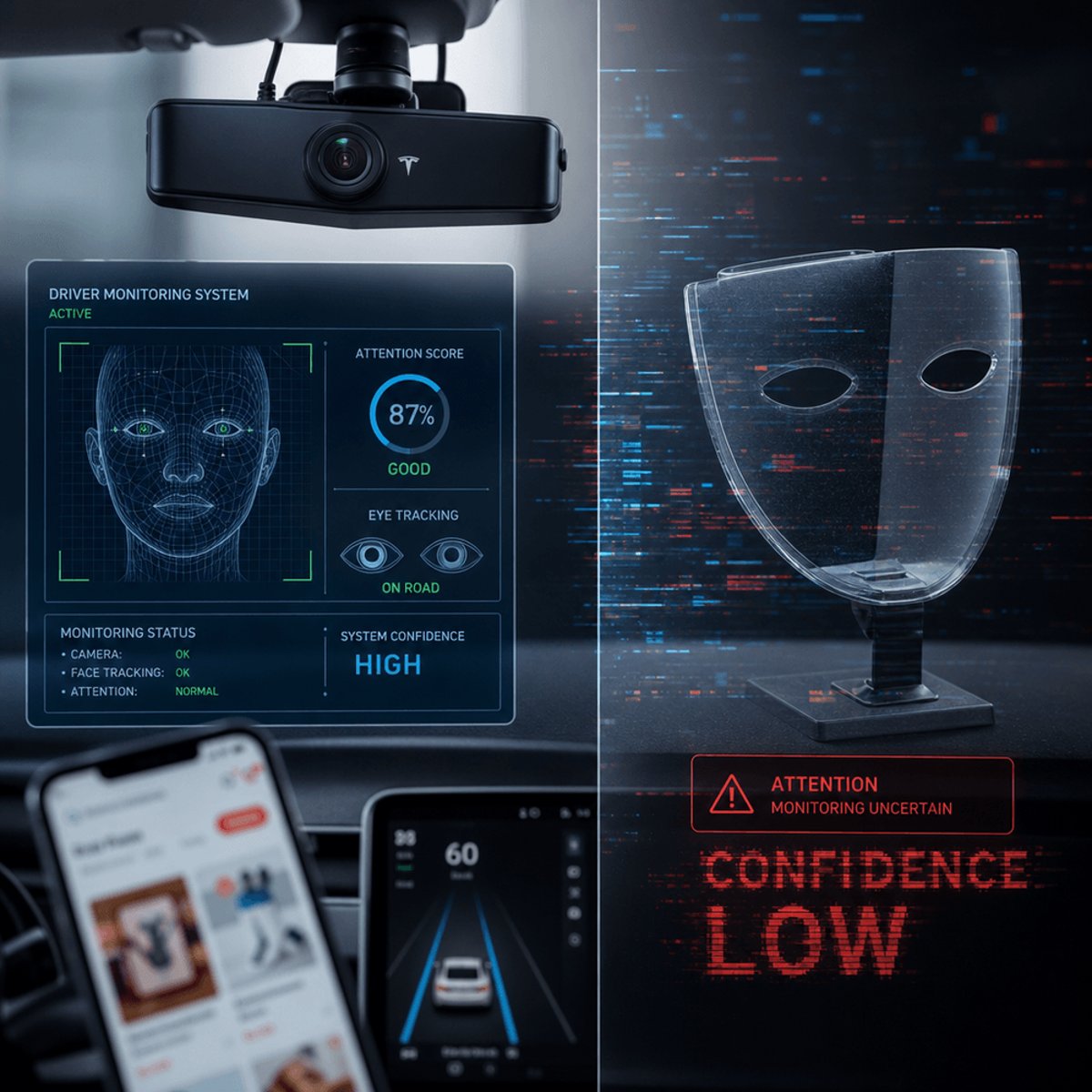
A thriving black market has emerged in China where drivers are buying plastic figurines, blinking screens, and other DIY devices designed to trick Tesla's Autopilot safety monitoring systems. The cottage industry raises serious questions about the effectiveness of autonomous vehicle safeguards and whether AI-powered driver monitoring can be outsmarted by simple physical hacks. As Tesla pushes deeper into the Chinese market, the phenomenon exposes a critical vulnerability in how self-driving systems verify human attention.
A strange new product category is booming on Chinese e-commerce platforms, and it's giving automotive safety experts serious heartburn. Drivers are snapping up tiny plastic heads, blinking LED screens, and other ingenious contraptions designed for one purpose: fooling Tesla's Autopilot into thinking they're paying attention when they're not.
The devices exploit a fundamental weakness in how Tesla's driver monitoring works. The system uses cabin-facing cameras to track head position and eye movement, ensuring drivers keep their eyes on the road while Autopilot handles steering and acceleration. But those same AI-powered cameras can apparently be tricked by strategically placed objects that mimic a human face looking forward.
According to Wired, the black market includes everything from celebrity figurines positioned to face the windshield to screens that display blinking eyes. Some sellers have gotten creative, offering custom solutions that attach directly to seat headrests or dashboards. The products typically cost between $20 and $50, a small price for drivers determined to use Autopilot hands-free despite the technology's limitations.
This isn't just a quirky cultural phenomenon - it's a red flag for the entire autonomous vehicle industry. Tesla has long maintained that Autopilot requires active driver supervision, with the system designed to disengage if it detects inattention. The company added cabin cameras specifically to combat drivers who were placing weights on steering wheels or using other tricks to bypass earlier safety measures. But the new wave of workarounds suggests the arms race between safety engineers and rule-breaking drivers is far from over.
The timing couldn't be worse for Tesla. The company has been aggressively expanding in China, where it faces intense competition from domestic EV makers like BYD and NIO. China represents Tesla's second-largest market, and any safety incidents linked to Autopilot misuse could trigger regulatory crackdowns that harm sales.
Safety advocates have been sounding alarms about driver monitoring systems for years. The concern is that semi-autonomous features like Autopilot create a dangerous middle ground where drivers become complacent but still bear ultimate responsibility. When systems can be easily fooled, that complacency becomes potentially fatal. U.S. regulators have investigated multiple crashes involving Tesla vehicles where Autopilot was engaged and drivers appeared distracted.
The phenomenon also highlights a broader challenge facing AI safety systems. As machine learning models become more sophisticated at recognizing patterns, adversaries get better at finding edge cases and exploits. What works in controlled testing environments doesn't always hold up when millions of users actively try to game the system. A plastic head might seem like a crude hack, but if it works, it exposes the gap between lab performance and real-world robustness.
Tesla hasn't publicly commented on the Chinese bypass devices, but the company has historically responded to safety workarounds by updating its software. Earlier versions of Autopilot could be tricked by steering wheel weights; newer iterations detect torque patterns and require more active engagement. The cabin camera monitoring itself was a response to previous bypass methods. Whether Tesla can stay ahead of determined users remains an open question.
The regulatory implications extend beyond China. If simple physical objects can defeat driver monitoring, regulators in Europe and North America may demand more robust verification systems before approving higher levels of autonomy. That could slow the rollout of features Tesla and competitors are racing to deploy.
For now, the plastic head sellers are thriving, advertising their wares with winking references to "travel companions" and "dashboard decorations." The euphemisms barely disguise the products' true purpose, and the customer reviews make clear what buyers are really after: freedom to look at their phones, eat, or even nap while Autopilot drives.
That's the nightmare scenario keeping safety engineers up at night. Semi-autonomous systems aren't designed for unsupervised operation, but if users treat them that way anyway, crashes become inevitable. The question is whether technology can ever truly enforce human attention, or whether the only solution is full autonomy that doesn't require human backup at all.
The plastic head phenomenon is more than a bizarre footnote in automotive history - it's a stress test for the entire promise of semi-autonomous driving. As Tesla and rivals push toward full self-driving capabilities, the gap between what the technology can safely do and what users want it to do keeps widening. Until that gap closes, expect the cat-and-mouse game between safety systems and creative workarounds to continue. The real question is whether regulators will step in before the inevitable crashes force their hand, or whether the industry can develop monitoring systems that actually can't be fooled by a $30 trinket from an online marketplace.