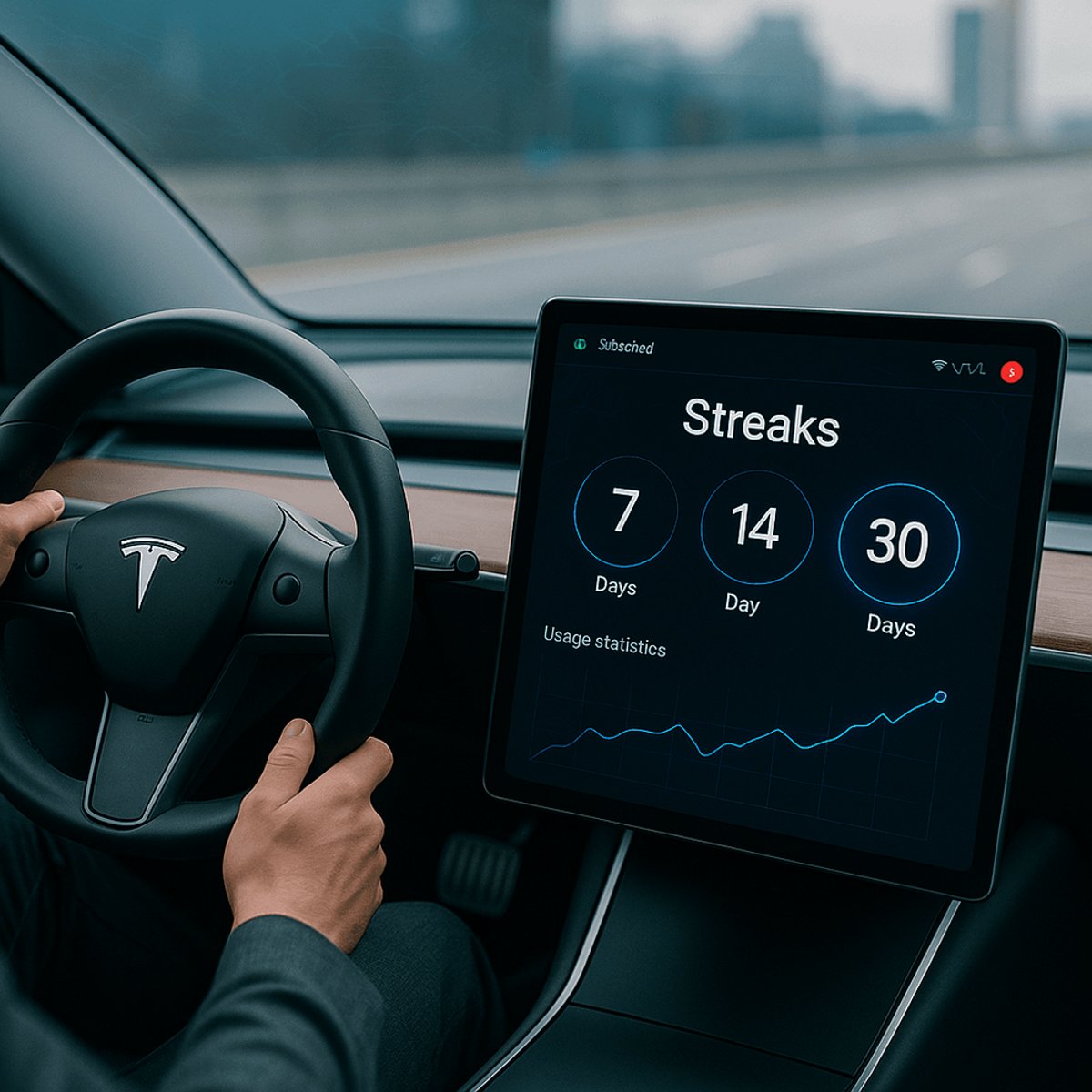
Tesla just borrowed a page from fitness apps and social media platforms. The automaker rolled out a 'streaks' feature and usage statistics to track how often drivers engage with its Full Self-Driving software, while simultaneously streamlining the subscription process. The move signals Tesla's push to convert more owners into paying FSD customers at a time when the company faces mounting pressure to prove the technology's value and recoup massive AI infrastructure investments.
Tesla is taking a page from the social media playbook to drive adoption of its most controversial feature. The electric vehicle maker quietly pushed an update that adds usage statistics and a 'streaks' counter to Full Self-Driving, tracking how many consecutive days drivers engage with the advanced driver assistance system.
The timing isn't coincidental. Tesla has spent years and roughly $10 billion building the AI infrastructure behind FSD, yet adoption remains stubbornly low among the company's fleet of over 6 million vehicles on the road. By gamifying the experience, Tesla appears to be betting that the psychological tricks that keep users coming back to Snapchat or Duolingo might work just as well for autonomous driving software.
Alongside the gamification features, Tesla streamlined its FSD subscription process, removing friction points that previously required multiple steps through the car's touchscreen interface. The $199-per-month subscription option now sits more prominently in the vehicle's software menu, making it easier for curious owners to take the plunge without committing to the $12,000 upfront purchase price.
The strategy reflects a broader shift in how Tesla is thinking about FSD as a business. CEO Elon Musk has repeatedly claimed the technology will eventually enable a robotaxi network that could make Tesla the world's most valuable company. But that vision requires data, and lots of it. Every mile driven with FSD engaged feeds the neural networks that power future improvements.
That's where the streaks come in. The feature works exactly like you'd expect: use FSD on consecutive days and watch your streak counter climb. Break the chain by skipping a day, and you're back to zero. It's a simple psychological hook that tech companies have exploited for years to drive habitual behavior.
The move comes as competition in the autonomous driving space intensifies. Waymo, owned by Google parent Alphabet, continues expanding its driverless taxi service in San Francisco, Phoenix, and Los Angeles. GM's Cruise is attempting a comeback after last year's pedestrian dragging incident forced a complete operational shutdown. Meanwhile, Chinese automakers like Xpeng are rolling out their own advanced driver assistance systems at aggressive price points.
But Tesla's approach differs fundamentally from competitors. While Waymo uses expensive lidar sensors and operates in geofenced areas, Tesla relies on cameras and neural networks trained across millions of miles of real-world driving data. The company needs that data pipeline flowing constantly to maintain its edge.
The gamification update also arrives amid increased regulatory scrutiny of FSD's naming and capabilities. The National Highway Traffic Safety Administration has opened multiple investigations into crashes involving Tesla vehicles with Autopilot or FSD engaged. Critics argue the technology's name misleads drivers into believing the cars can drive themselves, when in reality the system requires constant human supervision.
Tesla has always maintained that FSD is a Level 2 driver assistance system requiring active supervision, despite the aspirational branding. The addition of usage statistics might actually help the company's regulatory position by creating a clear record of how often drivers engage the system and under what conditions.
From a business perspective, the subscription model has become increasingly important to Tesla's financial story. As vehicle deliveries face headwinds from increased competition and market saturation in key regions, recurring software revenue offers a path to improved margins and more predictable cash flow. Wall Street has taken notice, with several analysts highlighting FSD subscription revenue as a potential catalyst for the stock.
The question is whether gamification actually works for something as serious as driving. Fitness apps can motivate you to take an extra walk. Language learning apps make daily practice feel like a game. But will drivers really change their routes or driving patterns just to maintain a streak in their Tesla?
The answer might matter less than the signal it sends. By adding these features, Tesla is acknowledging that adoption, not just capability, is the challenge. The technology can be impressive and the AI infrastructure world-class, but if drivers don't use it, none of that matters. Every unused FSD subscription is $199 in monthly recurring revenue left on the table, and every mile not driven with the system engaged is data that could have improved the neural networks.
Competitors are watching closely. If Tesla's gamification strategy drives measurable increases in FSD engagement, expect Ford, GM, and others to follow suit with their own advanced driver assistance systems. The race to autonomous driving might increasingly be won not just with better sensors or smarter algorithms, but with better user experience design and engagement psychology.
Tesla's gamification play reveals where the autonomous driving battle is really being fought. It's not just about the technology anymore - it's about convincing drivers to actually use it. The streaks feature might seem trivial, but it represents a fundamental shift in strategy: treating FSD adoption as a user engagement problem, not just an engineering challenge. Whether that translates to meaningful subscription growth and better AI training data remains to be seen, but it's a reminder that even the most advanced technology fails if people don't develop the habit of using it. For Tesla, every streak maintained is another data point collected, another subscription dollar earned, and another step toward the robotaxi future Musk keeps promising.