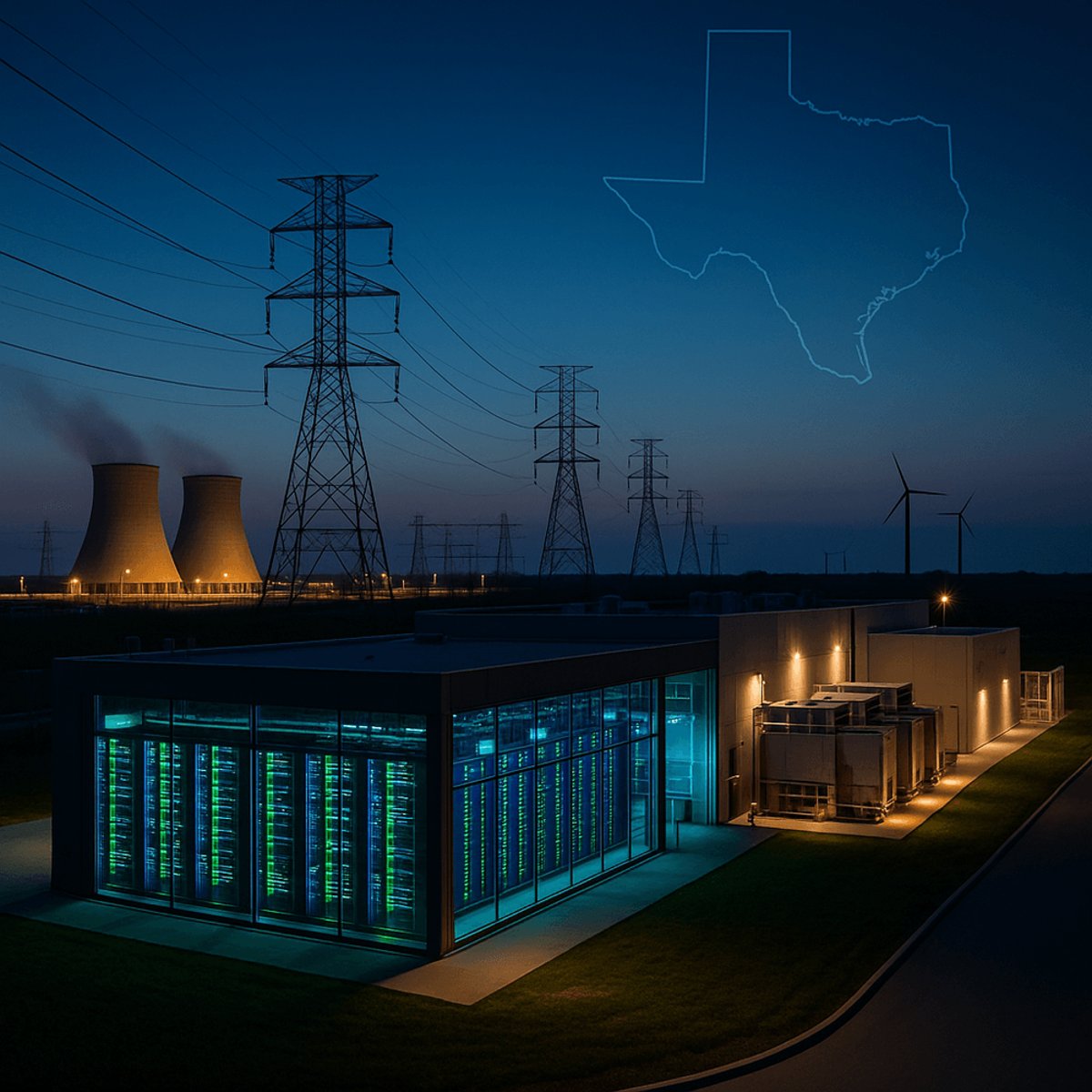
The global data center map just got redrawn. Texas is poised to overtake Virginia as the world's largest data center market, marking a historic shift in cloud infrastructure geography, according to a new report from real estate giant JLL. The development signals what the firm calls an 'inflection point' in data center expansion, driven largely by insatiable AI computing demands and the scramble for power and land in traditional tech hubs.
The data center industry just hit a turning point that real estate analysts have been predicting for months. Texas is about to unseat Virginia as the world's largest data center market, according to fresh research from JLL, ending Northern Virginia's decades-long reign as the undisputed capital of cloud infrastructure.
The shift isn't just about square footage. It reflects a fundamental recalculation of where hyperscale operators can find the power, land, and regulatory environment needed to support AI training clusters that can consume as much electricity as small cities. Virginia's Loudoun County, known as 'Data Center Alley,' simply can't expand fast enough to keep pace with demand.
Texas brings a compelling value proposition that's proving irresistible to cloud providers and enterprise operators alike. The state offers virtually unlimited land for campus-style developments, wholesale power costs that undercut most competing markets, and a political climate that fast-tracks permits and infrastructure upgrades. When Meta needs to spin up a new AI training facility, waiting months for Virginia zoning approvals isn't an option anymore.
The numbers tell the story of an industry in hypergrowth mode. Data center construction pipelines have exploded across the Dallas-Fort Worth metroplex, Houston, San Antonio, and Austin. Google recently broke ground on a massive expansion in Midlothian, while Amazon Web Services continues building out capacity across multiple Texas metros to support its AI services rollout.
Northern Virginia isn't going anywhere - it remains critical infrastructure for the East Coast and benefits from proximity to federal agencies and financial services firms. But the market faces real constraints. Power grid capacity is increasingly strained, land prices have skyrocketed, and local communities are pushing back against the environmental impact of power-hungry facilities. One data center campus can require as much power as 80,000 homes.
The Texas ascendance mirrors broader trends reshaping the data center landscape. Operators are prioritizing access to renewable energy sources, proximity to power generation rather than population centers, and room to scale. Texas scores high on all three metrics, with abundant wind and solar resources and a deregulated power market that lets large consumers negotiate directly with generators.
Microsoft has been particularly aggressive in its Texas expansion, viewing the state as essential to its Azure AI ambitions. The company's been quietly securing multi-hundred-megawatt power deals across the state, according to industry sources familiar with the negotiations. When you're training frontier models that require thousands of Nvidia H100 GPUs running continuously, power availability becomes the primary site selection criterion.
The inflection point language from JLL isn't hyperbole. The firm's data suggests we're witnessing a permanent geographic redistribution of computing infrastructure, not just a temporary buildout cycle. As AI workloads continue their exponential growth trajectory, expect more capacity to flow toward markets that can deliver industrial-scale power and cooling at competitive rates.
What makes this shift particularly significant is the speed. Virginia built its dominance over two decades of steady growth. Texas is catching up in a fraction of that time, compressed by the urgency of the AI infrastructure race. Hyperscalers can't afford to wait - every quarter of delayed capacity means losing ground to competitors or constraining their own AI product roadmaps.
The implications extend beyond real estate. Texas is positioning itself as the backbone of America's AI ambitions, much like Taiwan became indispensable for chip manufacturing. State officials understand the strategic value and are rolling out incentives to accelerate development. When infrastructure becomes geopolitically significant, the stakes change entirely.
Texas overtaking Virginia as the world's largest data center market isn't just a real estate story - it's a window into how AI is reshaping physical infrastructure at continental scale. The companies building these facilities are making 20-year bets on where computing power needs to live, and right now those bets are flowing toward markets that can deliver industrial-grade power and space without the constraints choking traditional hubs. As AI workloads continue their explosive growth, expect the data center map to keep evolving, with implications for everything from regional power grids to state economic development strategies. The inflection point JLL identifies may be just the beginning of a broader infrastructure realignment.