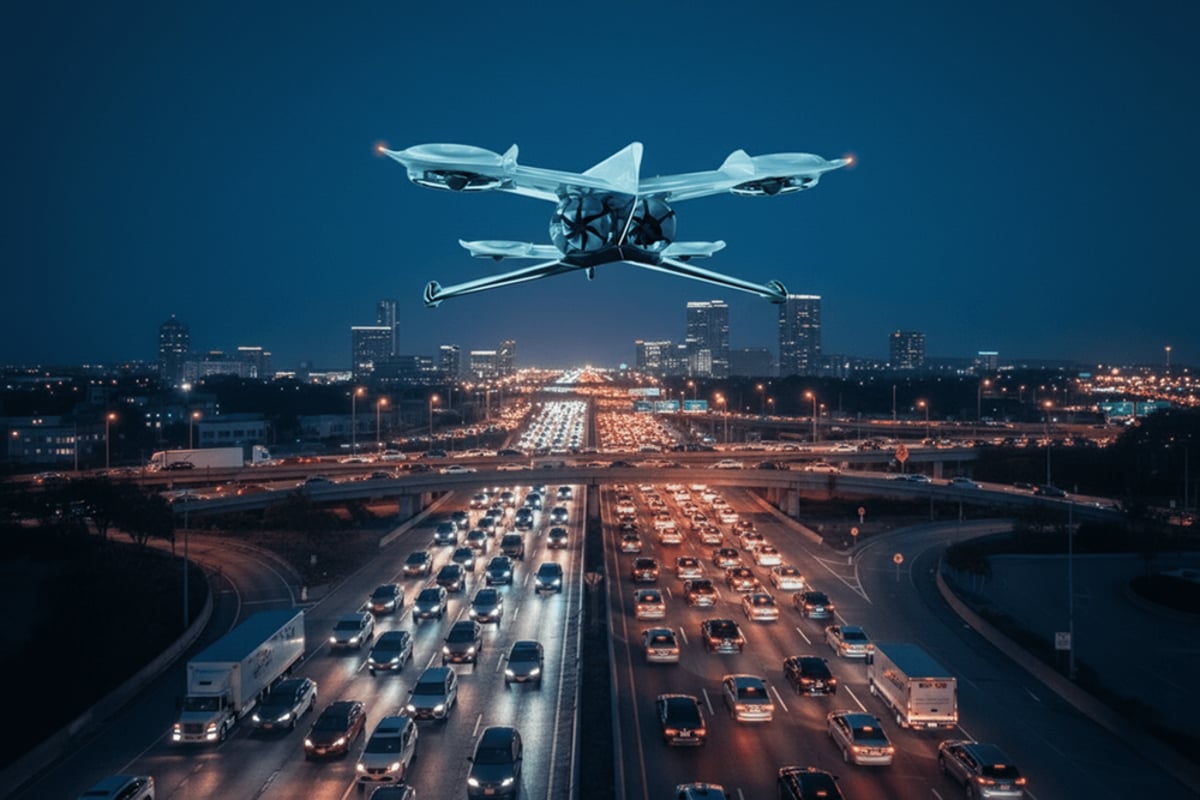
For years, flying cars, one of the largest ambitions of the tech world, has been stuck in a loop of undeliverable prototypes and doubt. Recently, that idea has been shifted towards “Air Taxis”, commercial fleets operated by industry players like Joby Aviation and Archer, designed for quick transportation in cities. But while these major players chase an Uber-like model, the real disruption in 2026 is not ride-sharing, it is now personal ownership.
Doroni Aerospace is capturing this opportunity by building the H1-X, a personal eVTOL (electric Vertical Takeoff and Landing) aircraft designed to do what no competitor can: fit in a standard two-car garage, charge like a Tesla, and fly with just 25 hours of training. With $11.5M currently raised and a $175M potential pre-order pipeline, Doroni is defining a new asset in the $1 trillion Urban Air Mobility (UAM) sector.
Divergence in Urban Air Mobility
Currently, the eVTOL industry is split into two distinct paths: Commercially managed Fleets (Air Taxis), and Personal Mobility. Companies such as Lillium, Archer, and Joby are building large aircrafts that require infrastructure known as “Vertiports”. These takeoff spots make it so they cannot scale their operations until cities build new mini-airports and upgrade their power grids.
Although Doroni bypasses this entirely with a garage-ready design. The H1-X charges from 20% to 80% in roughly 25 minutes using standard EV charging technology. Also, it allows owners to takeoff from their driveway or private land, fly at 100-120mph, and land without needing a “Vertiport”.
The Regulatory Advantage
The most significant differentiator between Doroni and its competitors is the pilot. Commercial Air Taxis require commercially rated pilots, a resource that’s in shortage. This week, Joby Aviation just announced a positive step by launching simulators to train up to 250 pilots annually in an effort to scale their operations. While this is an impressive feat, this highlights a scalability limit; their business can only grow as fast as they can train pilots.
However, Doroni is not constrained by this, because the customer is the pilot. They leverage the FAA’s (Federal Aviation Administration) new MOSAIC (Modernization of the Special Airworthiness Certification) rule which was made effective in October, 2025. Instead of the 1,500 hours required for commercial operations, an H1-X owner can now qualify with a Sport Pilot Certificate in as little as 20-25 hours. So Doroni’s customers, high-net worth individuals, can easily become qualified to fly on their own in one weekend. While competitors are working to certify hundreds of pilots a year, Doroni is positioned to certify thousands of owner-operators, expanding the Total Addressable Market to millions.
Proprietary Technology and Safety
Doroni’s valuation is bolstered by its proprietary operating system designed for ease of use and intelligence. SOUL.AI, Doroni’s own operating system, acts as a real-time copilot and manages airspace tracking, voice-command interactions, and self-diagnostic monitoring. It also simplifies flying the aircraft so the pilot can focus on navigation, making it more suitable for amateur pilots.
From a safety perspective, Doroni uses patented Ducted Fan technology. Unlike the open-rotor designs of many competitors, which have exposed spinning blades, the H1-X’s are enclosed within the wings. Eliminating risk to bystanders, reducing noise, increasing thrust efficiency, and making it suitable for suburban use. And as an ultimate fail-safe, every unit is equipped with an airframe ballistic parachute.
Investment Highlights and Outlook
For investors, Doroni is backed by tangible milestones rather than pre-seed projections. The company has established strategic partnerships focused on scaling production capabilities and expanding into key international markets. The company has also already achieved its FAA Special Airworthiness Certificate for the H1-X prototype and completed 70 test flights. Their trajectory is further validated by other key pillars including:
- Commercial Traction: 600+ pre-orders which lead into a potential $175M+ revenue pipeline.
- Regulatory Advantage: Optimized for the FAA MOSAIC rule, reducing pilot training down to 25 hours.
- Projected Growth: Targeted first deliveries in 2028 with a roadmap to $1.4B in revenue in 2032.
The next major catalyst is the global unveiling of the full-scale showroom model later in 2026. Historically, valuations in the aerospace sector see significant movement following the reveal of a production-intent design.
Doroni is currently open for a Reg CF bridge round at a share price of $3.10 (Valuation Cap: $175M). This round allows investors to secure equity before the company proceeds to a larger $45M Reg A+ raise.
Exclusive Perks for Early Action:
- $2,500+: 10% Bonus Shares.
- **$10,000+: ** 15% Bonus Shares + Exclusive Invite to the H1-X Unveiling.
- $25,000+: 30% Bonus Shares + VIP Access + Doroni Flight Club Package.
While giants like Joby and Archer build the infrastructure for transit, Doroni is building the freedom to fly from your own home. With regulatory clearance in hand and a technology stack that distances them from the competition, Doroni Aerospace is becoming the market leader in the potentially $1 Trillion Urban Air Mobility space.
View the Campaign: invest.doroni.io
Inquiries: investors@doroni.io
This is a paid advertisement for Doroni’s Regulation CF offering. Please read the offering circular at https://invest.doroni.io/