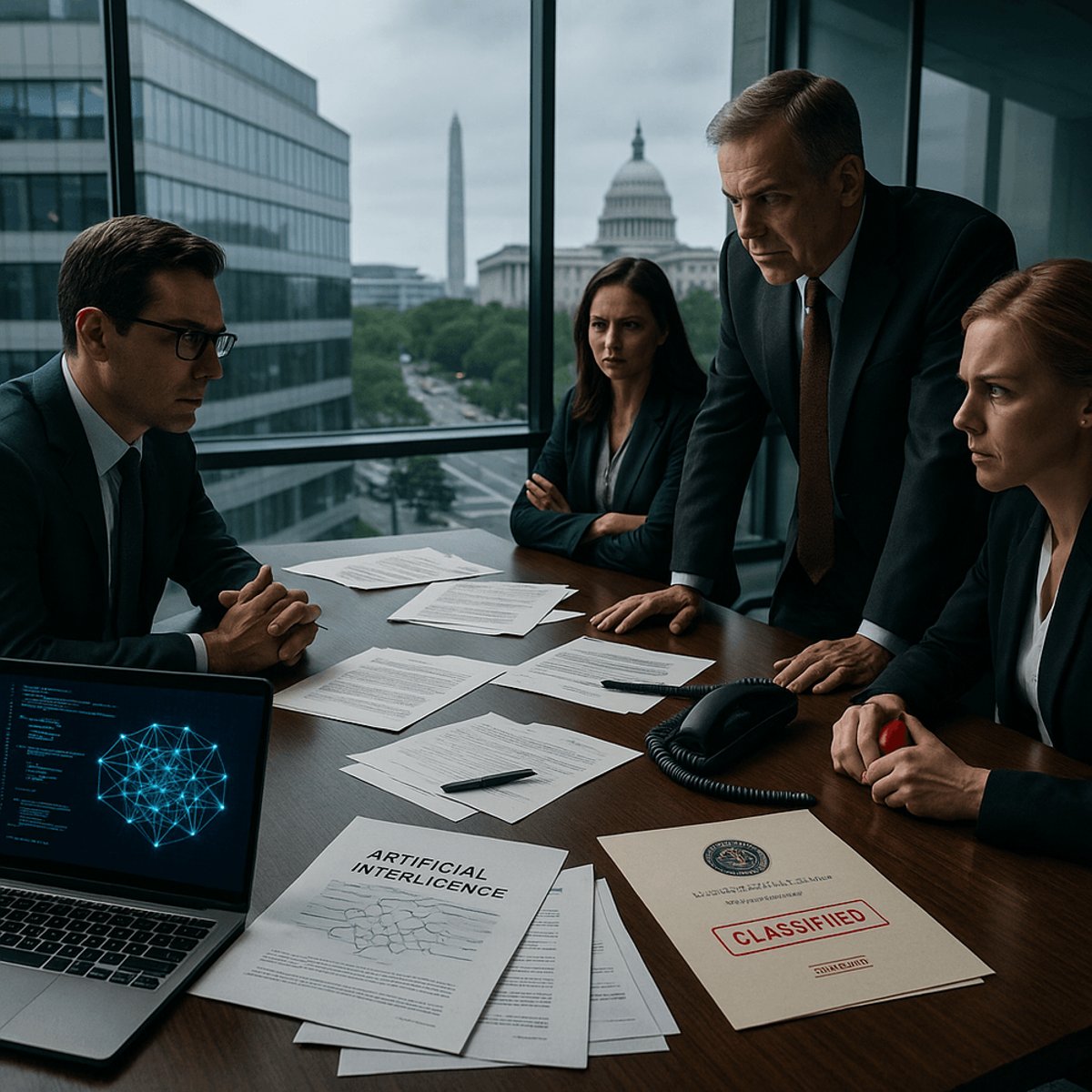
The standoff between Anthropic and the Pentagon just entered dangerous territory. President Trump and Defense Secretary Pete Hegseth delivered what sources describe as a 'severe response' on Friday to the AI safety company's refusal to provide military AI capabilities, marking the most significant confrontation yet between Silicon Valley's AI leaders and the Defense Department. The clash reveals who really controls the future of warfare as AI becomes central to national security strategy.
Anthropic just discovered there's a price for saying no to the Pentagon. The AI safety startup, best known for its Claude chatbot and principled approach to AI development, found itself in the crosshairs of the Trump administration after refusing to bend on military AI applications. What started as a philosophical disagreement about AI ethics has exploded into a full-blown crisis that could reshape the entire industry's relationship with the Defense Department.
The confrontation came to a head Friday when Trump and Defense Secretary Pete Hegseth responded to Anthropic's position with what insiders are calling unprecedented pressure on a private AI company. While the exact nature of the response remains unclear, the severity signals this isn't just another policy disagreement. It's a line in the sand about whether AI companies can maintain ethical boundaries when national security is invoked.
Anthropic CEO Dario Amodei has long positioned the company as the responsible alternative in the AI arms race. Unlike competitors racing to build ever-more-powerful models, Amodei's team emphasized constitutional AI and safety research. That philosophy apparently extends to refusing certain military applications, particularly those involving offensive weapons systems or autonomous decision-making in combat scenarios. The stance puts Anthropic at odds with OpenAI and Google, both of which have signed defense contracts despite internal employee resistance.
The timing couldn't be more fraught. OpenAI recently reversed its ban on military applications, opening the door to Pentagon partnerships while maintaining it won't build autonomous weapons. Google faced employee walkouts in 2018 over Project Maven before eventually renewing defense work under stricter guidelines. Microsoft never hesitated, securing a $22 billion contract for AR headsets designed for combat. Anthropic's resistance makes it an outlier just as the Pentagon is desperate to counter China's military AI development.
Behind closed doors, defense officials have been increasingly frustrated with what they see as Silicon Valley's selective patriotism. Companies happily take venture capital with ties to foreign governments but balk at helping their own military, the argument goes. The Pentagon views AI as existential to maintaining military superiority as China pours billions into autonomous systems, AI-powered surveillance, and algorithmic warfare. From their perspective, Anthropic's ethical stance is a luxury the country can't afford.
But Anthropic isn't backing down easily, even as pressure mounts. The company raised $7.3 billion in funding rounds led by Google, Amazon, and others who may now be caught in the middle of this fight. Those investors face their own calculus about whether to pressure Anthropic to comply or defend the company's principles. Amazon already has deep Pentagon ties through AWS contracts worth billions. Google knows firsthand how messy these battles get.
The confrontation exposes the illusion that AI companies operate independently from government power. When push comes to shove, can a startup really say no to the Defense Department backed by the White House? The answer may determine whether AI development remains in private hands or becomes effectively nationalized for security purposes. Other countries are watching closely. China and Russia don't have this problem since their AI leaders work hand-in-glove with military and intelligence services from the start.
What makes this standoff different from past tech-military tensions is the technology itself. AI isn't just another tool like software or hardware. It's increasingly autonomous, capable of making decisions without human oversight. The Pentagon wants that capability to match adversaries building their own AI weapons. But handing over advanced AI models for military use without guardrails risks outcomes even defense planners admit could spiral out of control. Anthropic's concerns aren't just ideological posturing. They're rooted in technical realities about AI systems that can behave unpredictably at scale.
The ripple effects are already hitting the industry. Other AI startups are quietly reevaluating their positions on military work, wondering if they'll be next in the government's crosshairs. Defense tech companies like Palantir and Anduril, built specifically to bridge Silicon Valley and the Pentagon, are watching their competitive position improve as pure-play AI companies face pressure. The Defense Department may not need to convince every AI startup to cooperate if it can make examples of resisters.
For Anthropic, the calculation is brutal. Cave to government pressure and abandon the safety-first principles that define the company's brand, or hold firm and risk regulatory retaliation, lost contracts, and isolation from the broader defense-industrial complex that increasingly powers AI development. There's no middle ground when the commander-in-chief and his defense secretary are publicly pressuring you to comply. Every day the standoff continues raises the stakes for both sides.
This isn't just a fight between one AI startup and the Defense Department. It's the opening battle in a longer war over who controls AI development as the technology becomes central to national security. How this standoff resolves will set the template for every future confrontation between AI companies' ethical principles and government demands framed as security imperatives. Anthropic can't win this fight alone, but folding immediately would prove the industry has no real independence when Washington decides AI is too important to leave in private hands. The next few weeks will reveal whether Silicon Valley's AI ethics movement was ever anything more than good PR, or if companies are willing to pay a real price for their principles.