Venture capitalist Alexa von Tobel just made a bold prediction that's turning heads in Silicon Valley. The Inspired Capital co-founder believes quantum computing will unlock bigger breakthroughs than artificial general intelligence - and she's putting her $1 billion fund's money where her mouth is. Her latest bet: Logiqal, a Princeton-born quantum startup attempting to build the world's first scaled quantum computer.
Alexa von Tobel doesn't mince words about her latest investment thesis. The Inspired Capital co-founder thinks quantum computing will deliver the earth-moving scientific breakthroughs that most people associate with artificial general intelligence - and she's betting big on hardware to get there first.
"AI's compute demands are going to reshape infrastructure, which means quantum has a greater likelihood of success," von Tobel told WIRED from her New York office. The Harvard dropout turned VC manages nearly $1 billion in assets alongside former US Commerce Secretary Penny Pritzker, backing everything from Uber to AI infrastructure startups.
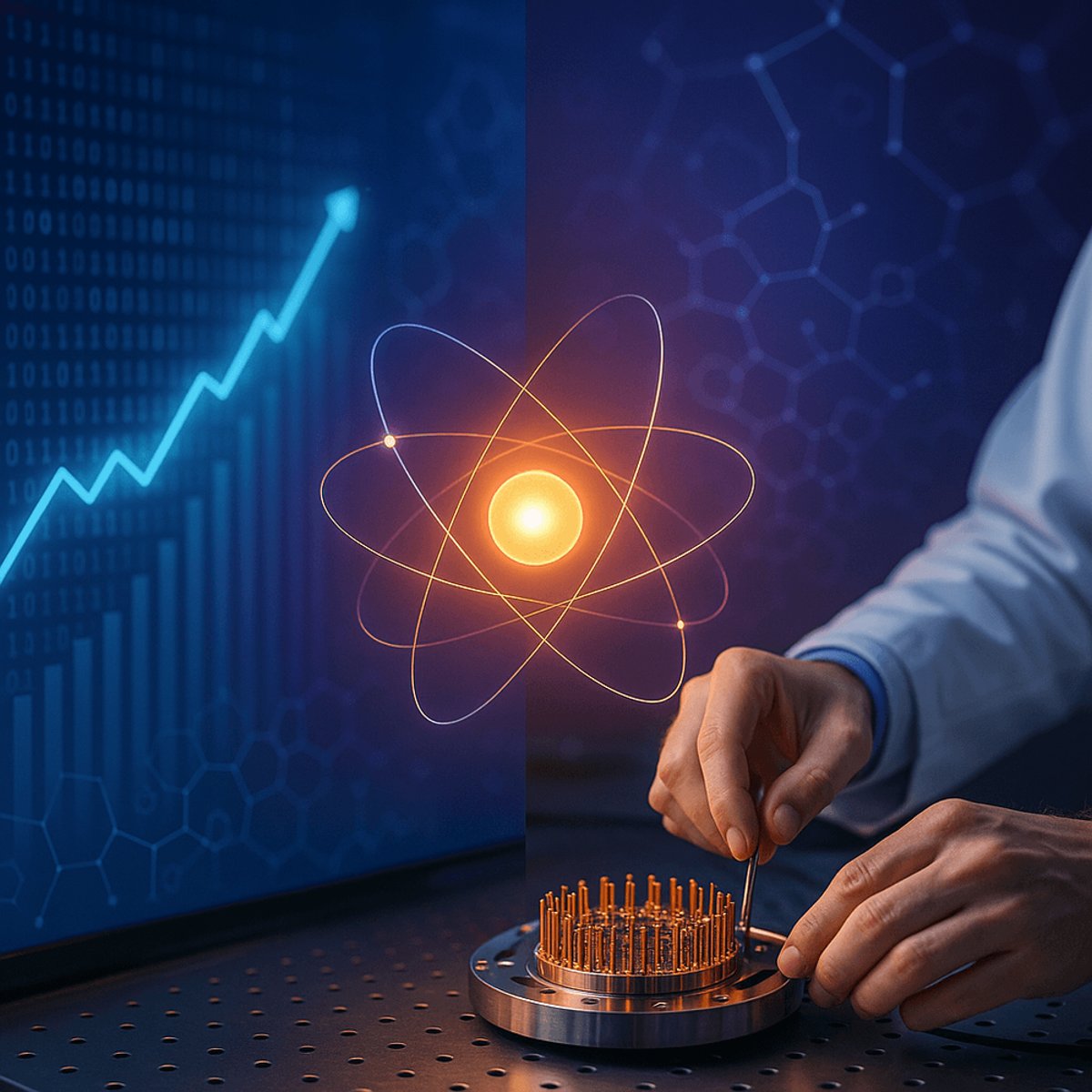
But it's her quantum bet that's raising eyebrows across the venture community. In late 2023, von Tobel led an investment in Logiqal, a Princeton-based startup founded by professor Jeffrey Thompson that's pursuing a "neutral atom" approach using ytterbium to build scalable quantum computers.
The timing feels deliberately contrarian. While OpenAI, Google, and Microsoft battle over AGI supremacy, von Tobel sees quantum as "today where AI was back in 2015" - lots of research finally hitting practical applications. Her calculation? There are only hundreds of genuine quantum experts worldwide, compared to the thousands claiming AI expertise.
"You can't pretend to be a quantum expert," she explains. "Quantum experts are PhDs with decades of work. So you can really put your hands around the talent in a way where you can really learn from them."
The investment thesis centers on hardware breakthroughs first. Even a quantum computer with 10,000 to 100,000 qubits would create "significant value for society" before reaching the theoretical ideal of hundreds of thousands of qubits needed for a "perfect" quantum computer.
Von Tobel's vision for quantum's impact sounds like science fiction: pharmaceutical advances extending human life 20-30 years, revolutionary materials science enabling Mars missions, and computational engines reshaping everything from logistics to financial markets. "That is what quantum computing unlocks," she says.
The bet reflects her broader skepticism about AI's long-term value capture. "There are so many companies being built in AI that when you extrapolate them 5 to 10 years will not have a true genuine moat outside of brand or speed," von Tobel argues. She points to Microsoft and Google as examples - with billions of users each, they can launch mediocre products and still win through distribution power.
That's why Inspired Capital focuses on AI companies with physical moats, like BrightAI, which places monitoring stickers on infrastructure for decades-long observation cycles. "That's a pretty good moat. You're not ripping all those stickers off," she notes.
Von Tobel's personal AI usage tells a different story about the technology's current plateau. She uses AI "dozens of times a day" for everything from research to sourcing, essentially replacing Google entirely. "Today I probably used it 25 times," she says. "There's nothing you don't use AI for."
But that ubiquity is precisely why she's looking beyond AI for the next breakthrough. The quantum bet represents classic VC convexity thinking - "taking risks on things that most likely won't work, but if they do work could be 500x in value."
The risk is real. "The risk of being too early is a real risk," von Tobel admits. Quantum computing has promised breakthroughs for decades without delivering commercial applications. But with AI's compute demands creating new infrastructure pressures, she sees quantum's moment approaching.
Industry watchers are split on the timing. Some see quantum as perpetually five years away, while others point to recent advances in error correction and qubit stability as signs of acceleration. Von Tobel's bet on Princeton's erasure conversion approach represents one of several competing hardware strategies, from superconducting qubits to trapped ions.
The broader implications extend beyond Inspired Capital's portfolio. If von Tobel is right about quantum's trajectory, it could reshape the entire AI infrastructure stack and create new winners in the next computing paradigm.
Von Tobel's quantum thesis represents a fascinating contrarian bet in a market obsessed with AI scaling. Whether she's right about quantum delivering AGI-level breakthroughs remains to be seen, but her track record with early-stage bets and focus on defensible moats suggests this isn't just hype-driven investing. If quantum hardware does reach the 10,000+ qubit threshold she describes, the implications could indeed dwarf today's AI revolution. For now, the quantum computing space just got a serious vote of confidence from one of venture capital's sharpest operators.