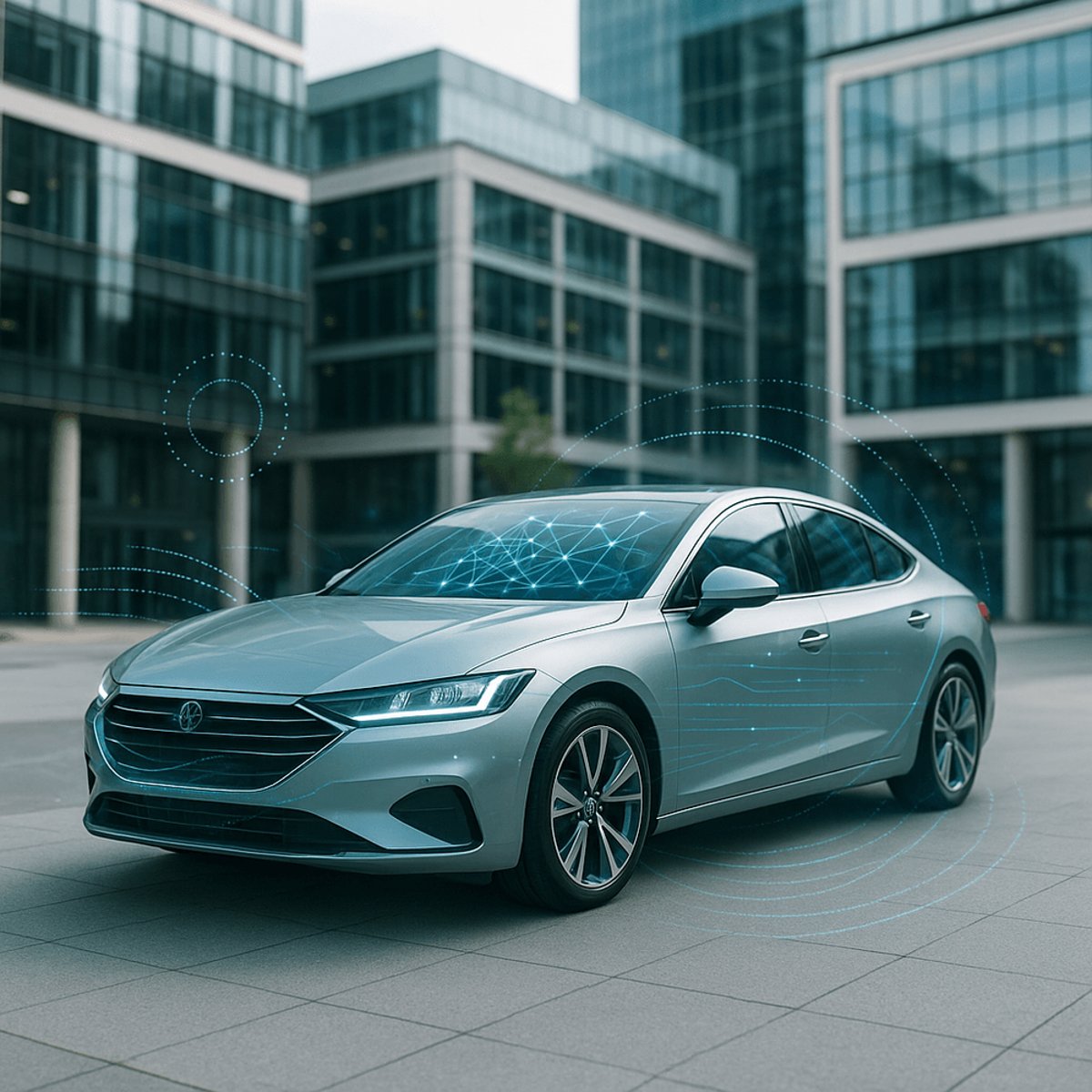
London-based self-driving startup Wayve just closed a massive $1.2 billion funding round, pulling in backing from an unprecedented coalition of tech and automotive heavyweights. The round brings together Nvidia, Uber, and three undisclosed automakers in what signals a major shift toward AI-first autonomous driving approaches. It's one of the largest funding rounds in the autonomous vehicle space this year and positions Wayve as a serious contender in a market that's seen consolidation accelerate over the past 18 months.
Wayve just became one of the most well-funded autonomous vehicle startups in Europe, and the investor lineup tells you everything about where the self-driving industry is heading. The London-based company secured $1.2 billion in fresh capital from a strategic coalition that reads like a who's who of transportation's future - Nvidia, Uber, and three automakers who clearly see something in Wayve's AI-native approach that traditional sensor-heavy systems can't deliver.
The funding comes at a pivotal moment for autonomous driving. While robotaxi operators like Waymo and Cruise have dominated headlines with their geofenced deployments, Wayve's been quietly building something different - an embodied AI system that learns to drive from data rather than relying on pre-programmed rules and HD maps. That distinction matters enormously to automakers who need solutions that can scale globally without mapping every street corner.
Nvidia's involvement is particularly telling. The chipmaker has become kingmaker in the AI infrastructure world, and its backing signals confidence in Wayve's technical architecture. Nvidia's DRIVE platform already powers autonomous systems across the industry, but this direct investment suggests the companies will likely deepen integration. For Wayve, that means access to cutting-edge compute resources and potentially preferred access to Nvidia's next-generation automotive chips.
Uber's participation is equally strategic. The ridehail giant famously shuttered its own Advanced Technologies Group in 2020 after a fatal crash and years of mounting losses. Since then, Uber's pursued a partnership model, working with autonomous vehicle providers rather than building the technology in-house. The Wayve investment fits that playbook perfectly - Uber gets a stake in next-generation AV technology without the development burden, while Wayve gains a built-in distribution channel with millions of daily riders.
The three unnamed automakers in the round are likely existing partners or companies looking to hedge their autonomous driving bets. Traditional car manufacturers face a brutal reality - developing competitive self-driving systems in-house requires billions in capital and years of iteration. Tesla aside, most legacy automakers have struggled to match the pace of dedicated AV startups. Wayve offers an attractive middle path: license the AI brains while maintaining control over vehicle production and customer relationships.
Wayve's technology stack differentiates it from the Waymo model that's dominated industry thinking for the past decade. Instead of relying on expensive lidar arrays and exhaustive mapping, Wayve uses camera-based perception coupled with deep learning models trained on millions of miles of driving data. The system learns driving behavior the way humans do - through experience and adaptation. That approach is computationally intensive but potentially far more scalable than mapping-dependent alternatives.
The $1.2 billion injection pushes Wayve's total funding well past $1.5 billion, though the company hasn't disclosed its post-money valuation. For context, that puts it in rarefied territory alongside Cruise (now owned by GM), Aurora (recently merged with Continental's AV unit), and Argo AI (which shut down in 2022 after Ford and VW pulled support). The autonomous vehicle sector has shed dozens of startups over the past three years as capital dried up and technical challenges mounted.
This consolidation wave makes Wayve's mega-round all the more significant. Investors are clearly making calculated bets on a handful of technical approaches rather than spreading capital across dozens of hopefuls. The combination of Nvidia's chips, Uber's network, and automaker manufacturing capacity creates a vertically integrated stack that could accelerate time to market considerably.
Wayve's been testing its technology on public roads in London and other UK cities for several years now, racking up data in some of the world's most challenging driving environments. Narrow streets, aggressive cyclists, and unpredictable pedestrian behavior make London an ideal training ground for AI systems that need to handle edge cases. If Wayve's models can navigate Camden Town during rush hour, they can theoretically handle most urban environments globally.
The funding arrives as regulatory tailwinds build in Europe and the UK. British regulators have signaled openness to autonomous vehicle deployment, and the EU recently updated its type-approval framework to accommodate self-driving systems. That regulatory clarity, combined with Wayve's technical progress, likely contributed to investor confidence in backing such a substantial round.
What remains unclear is Wayve's path to commercialization. Will the company license its software to automaker partners, similar to Mobileye's model? Or will it pursue direct robotaxi operations through the Uber partnership? The $1.2 billion war chest gives Wayve runway to pursue both strategies simultaneously, but focus will be critical as the company scales.
Wayve's $1.2 billion round represents more than just another funding milestone - it's a referendum on which technical approach will dominate the next generation of autonomous driving. The convergence of Nvidia's compute power, Uber's distribution network, and automaker manufacturing expertise around Wayve's AI-native platform suggests the industry is moving beyond the sensor-heavy, map-dependent model that's defined the past decade. Whether Wayve can translate this capital and strategic backing into commercial deployments remains the billion-dollar question, but the company now has the resources and partnerships to find out. For automakers still searching for a viable autonomous strategy and riders waiting for robotaxis to become routine, Wayve's progress over the next 18 months will be worth watching closely.