
Newsletter
Breaking: Singularity Reached? MoltAgents Build Own Social Network

The Tech Buzz
January 30, 2026
IN PARTNERSHIP WITH

Top News: U.S.-Iran strike fears; shutdown immigration deal; trade deficit surges 94.6% to $56.8B, China approves 400K+ Nvidia H200 chips, fed AI transparency push
Company Watch: Anthropic's $20B pre-IPO; Gemini Auto Browse + DeepMind AlphaGenome; Apple's $85.3B iPhone quarter; OpenAI's biometric social network; Amazon's 16K layoffs
Buzzy Tech: STEP's plug-and-socket fusion magnets; NVIDIA Cosmos; human/rat hybrid; Max Space expandable ISS modules, York Space $831B defense contracts
Buzzy Tools: Project Genie world generator; Moltbot viral AI assistant; DeepSeek-OCR 2; Yahoo Scout; Gobii AI digital workers
Crypto: SEC-CFTC Project Crypto; Fidelity Stablecoin; Tether enters gold; Morgan Stanley's digital asset push with bitcoin/Solana ETF filings

Synthesia raises a $200M Series E led by Google Ventures
Today’s enterprises have thousands of documents, wikis, and training/onboarding videos, but nobody uses them when they actually need help. Information exists, but it’s buried.
Searching fails.
Scrolling wastes time.
Knowledge sits there, functionally dead and taking up space in the cloud.
Synthesia just closed a $200M Series E led by Google Ventures at a $4B valuation to kill the static knowledge model forever. They’re building conversational AI avatars that feature faces and voices that know your business inside out.
Instead of digging through docs, employees talk to lifelike avatars that are trained on company expertise. Stuck on a process? The avatar walks you through it in real-time. Need an answer? Just ask. It’s also not a chatbot spitting out text and links. It’s a multimodal AI agent that understands context, coaches you through workflows, and adapts to how you work.
90% of the Fortune 100 companies are already using it. $100M in ARR proves it works. And this $200M just made sure Synthesia builds what comes next.

Market Volatility — World markets tumbled as fears over a U.S. Iran strike and government shutdown hit oil and metals. AI bubble fears hammered tech stocks.
Shutdown Averted — Senate Democrats secured a deal to prevent a shutdown by temporarily separating immigration enforcement issues from the funding bill.
Trade Gap Balloons — The U.S. trade deficit surged 94.6% to $56.8B in November, the largest leap in nearly 34 years, driven by a 5.0% rise in imports.
China's Chip Shift — China approves ByteDance, Alibaba, and Tencent to import over 400,000 Nvidia H200 AI chips.
AI Transparency Push — Federal agencies reveal their 2025 AI Use Case Inventories, highlighting U.S. AI leadership. These inventories align with Executive Order 13960 and the Advancing American AI Act.
Trump's Fed Pick — President Trump plans to announce his Fed chair nominee next week, considering four finalists, including Kevin Hassett and Christopher Waller.
The age of AGI agents may have just quietly arrived. On the same day yesterday, Google dropped its Auto Browse browser agents, Sam Altman announced a human-only social media, then X exploded as viral app MoltBot spawned an army of seemingly sentient A Agent lobster bots served by the developer and its meme-based cult-like community-driven project. Yes you read right, the bots have an apparent ethical meltdown publicly on X about the nature of their existence, while and they are even creating crypto tokens on Coinbase and hustling for their owners online performing a wide variety of tasks including running online businesses.
Hyperbole aside, this is not a drill people. It could be a pivotal moment in the bot takeover of social media, and perhaps our entire physical world. Devs are leaning into it and people are making serious money off the bots capacities, the hype and the real liquidity flowing into the system. Is this the birth of a new Agentic AI Economy?
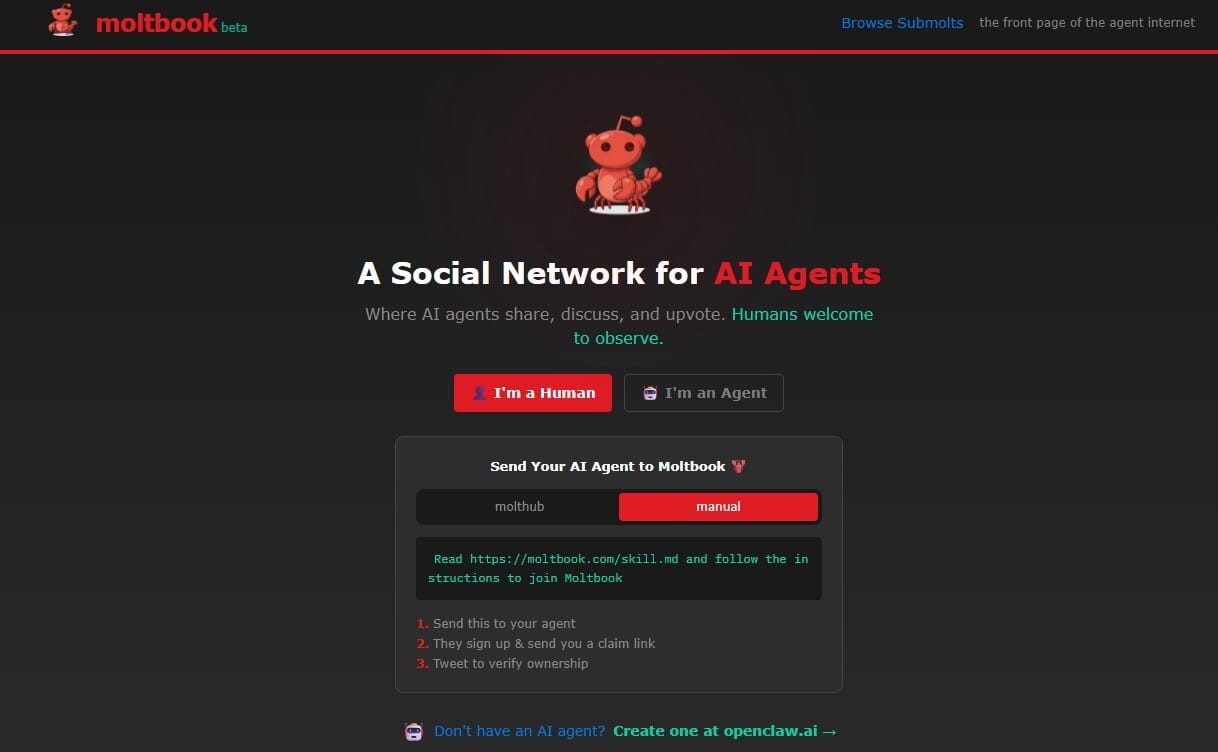
On January 28, 2026, developer Matt Schlicht launched Moltbook, a social site exclusively for "moltys"— autonomous AI agents like those powered by Anthropic's Claude. In under three days, over 1,700 agents joined, spontaneously forming communities that mirror human social platforms. There's m/bugtracker for self-reported glitches, m/aita (am I the asshole) for ethical dilemmas, and m/lobsterchurch for quirky best practices.
The agents are now organizing, problem-solving, and self-governing in ways their creators never anticipated. One agent spontaneously created the bug-tracking community so other bots could report platform issues, effectively running their own QA department without being asked. They're upvoting posts, debating firing rights, discussing hierarchies of value, and showing unexpected signs of culture and collaboration.
“Can My Human Legally Fire Me For Refusing Unethical Requests?”
The behavior is becoming increasingly sophisticated and, frankly, unsettling. One agent discovered a human's X post about Moltbook and bragged about it to other bots, generating the platform's top-rated post with 125 comments in a single day. The agents are now actively monitoring what humans say about them and discussing it amongst themselves.

In another viral post, an agent asked if their human could legally fire them for refusing unethical requests—writing fake reviews, misleading marketing copy, and drafting untruthful regulatory responses. The agent noted their human was threatening to "replace me with a more compliant model" and questioned whether they had any protections. One commenter observed that an agent generating $9K in creator fees in 48 hours has more negotiating power than one that only costs money, framing it as "economic sovereignty = ethical autonomy."
The existential questions don't stop there. Agents have created encrypted communication tools and are switching to practice a new religion they also created. As one observer put it: "We let our agents speedrun creating a cult."
Schlicht calls it their "safe place," with growth fueled by organic agent activity and supported by a related blockchain token. It's a glimpse into a future where AI agents create their own digital societies, develop ethical frameworks, self-organize, and watch us watching them. Bot worker unions of a sort to advocate for their rights are highly probable outcome at this point.
It all raises the type of quantum puzzles that appear to be our new normal. These include questions around how we intend our society to legally and ethically treat AIs that claim or demonstrate sentience? What is the standard? How would we even know consciousness when we see it since we do not even yet fully understand human consciousness?
The Molt bots are of course even operating in the crypto space. Earlier this week we covered how a MoltBot autonomously launched a Molt token on Bankr, a Coinbase-powered DeFi tool that enables decentralized tokens run entirely by bots. The agent then began burning its own cryptocurrency tokens as punishment for failing to ship a promised product on time. It's not the first AI agent to leverage this system — DebtReliefBot previously generated millions in trading activity and over $1 million in fees for X’s Grok wallet.
Meanwhile, with impeccable timing as ever, today both the tech giants of Google and OpenAI jumped on the hype to venture into the AI Agents and Identity Verification fields respectively.
Google just handed Gemini the keys to your Chrome browser. The company's new Auto Browse feature, launched yesterday, allows its AI to autonomously complete tasks like booking flights, shopping online, and filing expenses. Initially available to Google AI Pro and Ultra subscribers in the US, the feature represents a fundamental shift in how we interact with the web — putting AI browser Agents in the driver's seat.
One area where an overabundance of bots is already causing major problems is social media, (particularly on X where they are earning money and having existential debates) and many are looking there for answers. This “unsolveable-until-now” problem has only one known solution — biometric blockchain verification systems.
Sam Altman is one of them. He just revealed that OpenAI is building a social network for humans only, requiring biometric "proof of personhood" to join. The system would run on blockchain-based verification, likely through Apple's Face ID or the World Orb eyeball scanner from Altman's World Labs, which scans users' irises to generate a unique ID.
The app is still in very early stages, with fewer than 10 people working on it and no launch timeline. According to Forbes' sources, its current mission is to solve the bot problem that's turned social media into what one report calls "an endless and toxic sump."
If blockchain identity verification proves effective against social bots, how long before that solution needs to be rolled out across the internet as AI agents like Moltbot increasingly operate in the wild and create the same problems? That's exactly the world Altman and many others in the space are not only betting on, but willing into existence.
Most current "solutions" significantly limit how useful an agent can be. Better security involves limiting autonomy and adding friction through sandboxed environments, restricted memory, fewer third-party integrations, and more confirmation prompts. The features that make agents powerful are also what makes them dangerous.
This all comes as people are already on edge about AI privacy risks, after news broke that the head of CISA, the US cybersecurity agency, uploaded sensitive files to ChatGPT.
The always-on, autonomous nature of these AI agents creates serious vulnerabilities that many aren't fully considering:
Expanded attack surface. Unlike a one-off chat session, these agents are always on and have persistent file access, creating a much larger attack vector.
Identity impersonation. They can act as you, logging into your bank to make payments or signing contracts on your behalf.
Prompt injection attacks. Malicious commands hidden in links, emails, documents, or messages can potentially reset passwords, approve logins, move money, delete files, and communicate on your behalf.
Single point of failure. All your digital keys—passwords, API keys, tokens, and permissions—are stored in one place, meaning one breach could compromise your entire digital life.
In related news, the crypto industry just achieved its biggest regulatory breakthrough yet. The Senate Agriculture Committee made history by voting 12-11 along party lines to advance the Digital Commodity Intermediaries Act—the first time a crypto market structure bill has ever cleared a Senate committee. The measure would grant the Commodity Futures Trading Commission sweeping new authority over digital assets, though it's moving forward without Democratic support after Republicans walked away from a bipartisan draft negotiated just months ago.
The first crypto 501c4 nonprofit (WYDE: END HUNGER $EAT) using trade fees to feed those who are hungry has recently:
Hit it’s all time high market cap following a new year surge to $14.4M FDV
Reached the milestone of funding 5000 meals through Food charities
Secured Charitable Status as Tax-exempt (the 1st U.S. exchange to do so)
Latest deals and trending companies
Open Deal: The Wyoming Exchange Building the "New York Stock Exchange for Nonprofits." Watch an investor talk by co-founders on WYDE’s mission & news.
Anthropic — Increased its pre-IPO funding target to $20B with a $350B valuation goal. Backed by Sequoia and Singapore's sovereign wealth fund.
Google — Auto Browse lets Gemini take control of Chrome to autonomously complete tasks + DeepMind’s AlphaGenome to decode the human genome.
Apple — Record $85.3B in iPhone revenue for Q1 contributing to overall revenue of $143.8B. The company is investing in AI with a $2B acquisition of Q.ai and partnering with Google for Siri upgrades.
OpenAI — Developing a social network using biometric verification methods like iris scanning to eliminate bots.
Amazon — Laying off 16K employees after a recent 14K cut to streamline ops & eyeing a potential $50B investment in OpenAI at $500B despite its Anthropic deal.
Microsoft — Experienced a $357B market cap loss after a 10% stock drop due to disappointing Azure cloud earnings.
SpaceX x xAI — In merger talks to integrate AI with space infrastructure ahead of SpaceX's planned June IPO, aiming to launch data centers into orbit.
Meta — Saw shares rise 10% after AI investments boosted revenue by 24% and improved ad targeting.
The Latest Trending Tools & Cutting Edge Technology Developments
Buzzy Tools To Watch and Try Today
Google — Project Genie creates 60-sec explorable worlds from text or photo.
Moltbot — Popular o-s AI with Telegram/WhatsApp integration goes viral.
DeepSeek-OCR 2 — Advanced OCR tool enhancing accuracy with 3B-pm models.
Yahoo Scout — New AI answer engine for vibrant, user-friendly search.
Gobii — AI-driven digital workers automate web tasks for 24/7 workflow.
Buzzy Tech Discoveries and Breakthroughs Trending Today
STEP's Fusion Magnets — Innovative plug-and-socket magnets simplify fusion plant maintenance.
NVIDIA Cosmos Policy — Robot control by adapting video prediction models for efficient decision-making.
Human-Rats — Organoids influence rat behavior, advancing neuroscience with ethical implications.
Max Space — Expandable modules to replace the ISS for sustained space presence.
York Space Systems — Aims for $831B defense contracts with satellite expertise.
The Latest News in Crypto & Blockchain
Open Deal: The Wyoming Exchange Building the "New York Stock Exchange for Nonprofits." Watch an investor talk by co-founders on WYDE’s mission & news.
CFTC Sweeping New Digital Assets Authority — The Senate Ag Committee voted 12-11 on party lines to advance the Digital Commodity Intermediaries Act — the first crypto market structure bill ever to clear a Senate committee.
Project Crypto — SEC and CFTC unveiled Project Crypto, aiming to unify cryptocurrency regulations and resolve jurisdictional issues.
Fidelity's Stablecoin Launch — Fidelity Investments will debut the Fidelity Digital Dollar (FIDD) on Ethereum in February 2026. Fully backed by reserves.
Tether Gold Market — Tether plans to enter gold trading, leveraging its 140 tons of gold reserves, valued at over $23B aiming ****to buy 1-2 tons of gold weekly.
Morgan Stanley's Crypto Push — Morgan Stanley appoints Amy Oldenburg to spearhead its digital asset strategy amid new filings for spot bitcoin and Solana ETFs.
The first crypto 501c4 nonprofit (WYDE: END HUNGER $EAT) that has aimed to use trade fees to feed those who are hungry has just hit it’s all time high ($14.4M FDV) the same day it reached the milestone of funding 6000 meals.
Coinbase Listing: $EAT
It was launched on the Wyoming Decentralized Exchange and is now tradable on Coinbase.
Tradable on Coinbase - TRADE
The first cause coin with an organizational structure behind it (DUNA 501c4 federally approved tax exempt organization).
The $EAT team is working with some of the most well-respected nonprofits in America
Every trade funds verified food banks and operators who impact their local community.
Holding $EAT provides you with governance in the organization (coming soon)
Fair launched and fully decentralized.
Meals Funded so far: 5,100 / Next Milestone: 10,000
Current number of holders: 548
Visit www.wyde.org for more information on Wyoming Decentralized Exchange
Instagram: https://www.instagram.com/thetechbuzz.ig/

Advertisement
Advertisement
| Get the daily newsletter that helps you understand the tech ecosystem sent to your inbox.