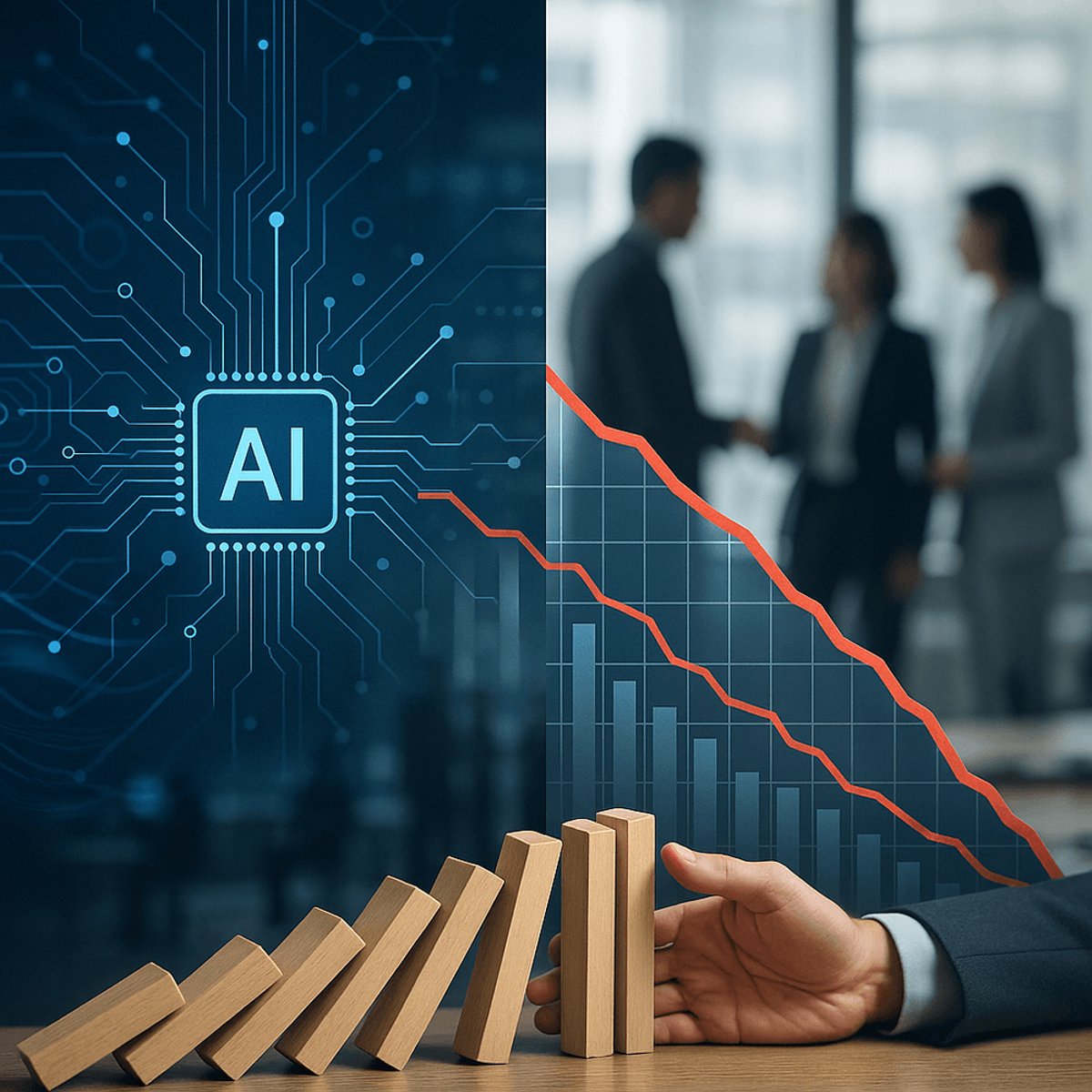
A provocative new report from Citrini Research paints a dystopian picture of AI's economic impact, projecting that autonomous AI agents could double unemployment rates and slash stock market valuations by over a third within just two years. The analysis, framed as a dispatch from 2028, challenges the tech industry's relentless push toward AI automation with a sobering question: what happens when the efficiency gains become economic catastrophe?
Citrini Research just dropped a bomb on the AI hype cycle. The firm's latest analysis imagines a report written in 2028, looking back at how the rapid deployment of AI agents triggered an economic meltdown that doubled unemployment and wiped out more than a third of stock market value. It's a stark counternarrative to the productivity paradise promised by OpenAI, Microsoft, and Google as they race to put autonomous AI systems in every workplace.
The timing couldn't be more pointed. Just as enterprises are scaling up AI agent deployments - systems that can autonomously handle customer service, write code, manage schedules, and execute complex workflows - Citrini Research is asking the uncomfortable question everyone's been avoiding: what happens when all those efficiency gains translate into massive job losses?
The report's framework is deliberately provocative, using a future-backward approach to trace how today's decisions could cascade into tomorrow's crisis. By imagining the aftermath rather than just modeling probabilities, Citrini Research forces readers to confront the human cost of automation in concrete terms. Doubled unemployment doesn't just mean statistics - it means millions of workers displaced faster than the economy can absorb them.
What makes this analysis particularly relevant right now is the breakneck pace of AI agent adoption. Microsoft has been aggressively pushing its Copilot agents across enterprise software. Google is embedding AI agents into workspace tools used by millions. OpenAI recently showcased agents that can perform multi-step tasks with minimal human oversight. The technology has moved from research labs to production environments in months, not years.
But the economic modeling around this shift has been remarkably rosy. Tech companies tout productivity gains and cost savings without seriously grappling with the labor market disruption. If an AI agent can do the work of five customer service reps, that's fantastic for the bottom line - until those five people can't find new jobs, stop spending money, and trigger a demand collapse.
The 35% market crash scenario isn't just about tech stocks taking a hit. Citrini Research appears to be modeling a broader economic contraction where consumer spending plummets as unemployment spikes, corporate revenues fall, and investor confidence evaporates. It's the kind of cascading failure that turns a labor market disruption into a full-blown economic crisis.
This also touches on what some are calling the "death of SaaS" - the idea that AI agents could collapse the entire software-as-a-service business model by automating away the need for many enterprise tools. If AI agents can handle tasks currently requiring multiple software platforms, the $200 billion SaaS industry could face an existential reckoning. Companies might need fewer seats, fewer tools, and fewer vendors.
The investment implications are massive. Venture capital has poured hundreds of billions into AI startups on the assumption that automation creates value. But if that automation triggers economic instability, the entire thesis falls apart. Market valuations for AI companies assume continued growth and adoption - not a scenario where AI's success becomes its own worst enemy.
There's also a policy dimension lurking beneath this analysis. If Citrini Research's projections have any merit, governments may need to intervene far more aggressively than currently planned. Universal basic income, aggressive retraining programs, or even restrictions on AI deployment could move from fringe ideas to urgent necessities. The tech industry has consistently pushed for light-touch regulation, but an unemployment crisis might force a different calculation.
What's striking about this report is how it reframes the AI conversation from technical capability to societal impact. The question isn't whether AI agents can do the work - clearly they can, and they're getting better fast. The question is whether the economic and social systems can handle the transition speed. History suggests that rapid labor market disruptions tend to end badly, from the Luddite riots to the Rust Belt collapse.
Critics will argue that Citrini Research is fearmongering, that markets adapt, and that new jobs will emerge to replace the old ones. That's been true in past technological transitions. But those transitions typically played out over decades, giving workers time to retrain and economies time to adjust. AI agents are compressing that timeline into years or even months. The speed is unprecedented.
The report also arrives as cracks are starting to show in the AI boom. Some companies that rushed to deploy AI agents are discovering they're not quite ready for primetime, with errors and hallucinations creating new problems. But even if the technology takes longer to mature than hyped, the trajectory is clear - and so is the potential for disruption.
Citrini Research's stark warning might sound alarmist, but it's asking the right questions at exactly the right moment. As AI agents move from demos to deployment, the tech industry needs to grapple with consequences that extend far beyond quarterly earnings. Whether this specific scenario plays out or not, the underlying tension is real: automation that's too successful, happening too fast, could trigger exactly the kind of economic crisis that derails the entire AI revolution. The challenge for policymakers, business leaders, and investors is figuring out how to capture AI's benefits without triggering its catastrophic downside - and that conversation needs to happen now, not after the damage is done.