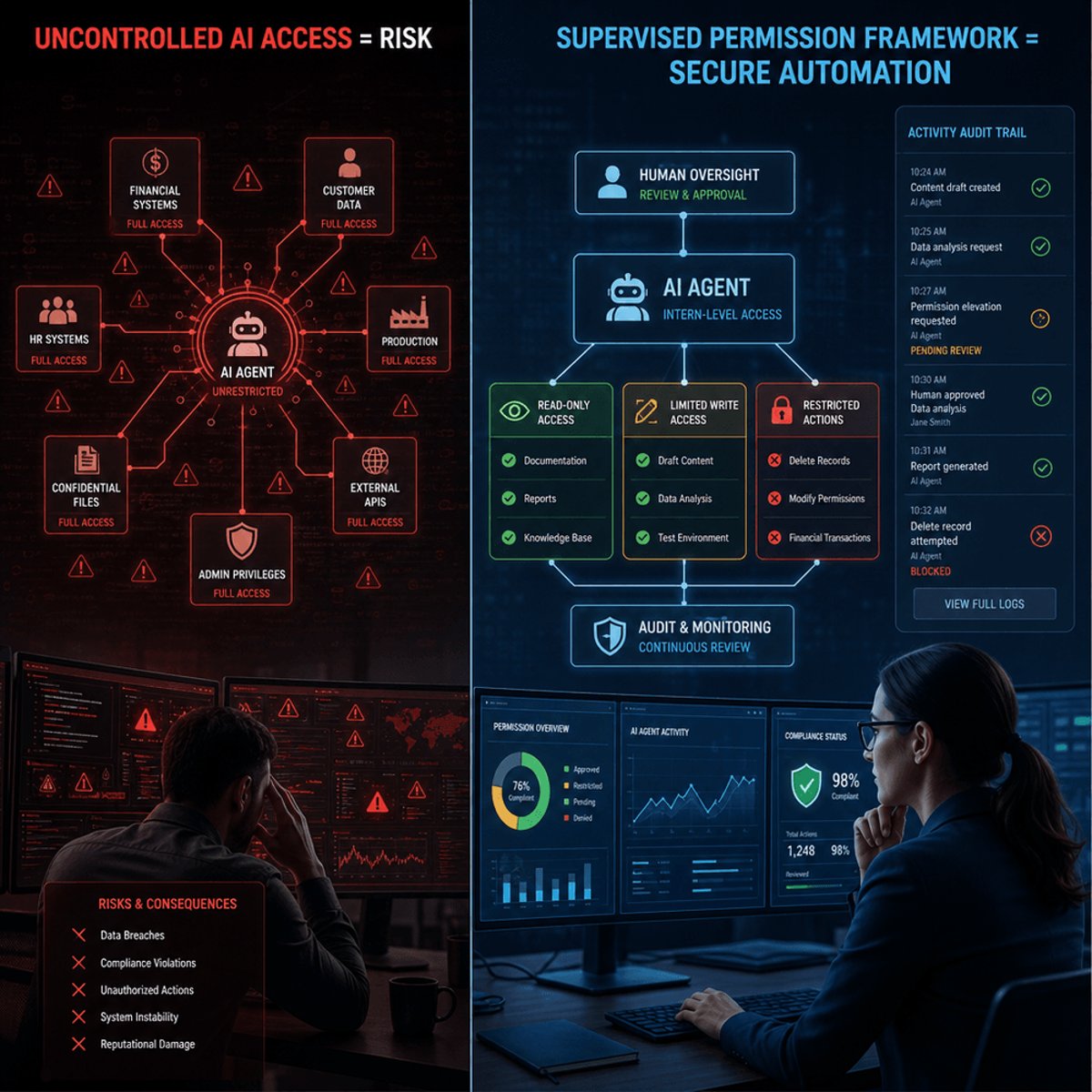
The AI agent gold rush has a dirty secret: most companies are handing out admin privileges like candy on Halloween. As autonomous AI agents flood enterprise workflows in 2026, a growing chorus of security experts warns that treating these systems like trusted employees instead of supervised interns is creating catastrophic permission vulnerabilities. The wake-up call comes as organizations scramble to deploy agents without established governance frameworks, potentially giving AI systems carte blanche to delete files, send emails, or authorize transactions with zero human oversight.
The comparison is blunt but effective. AI agents flooding into enterprise environments need the same careful supervision you'd give a first-week intern, not the trusted access of a 10-year veteran. That's the central thesis emerging from ZDNet's new analysis of AI governance failures, and it's resonating across corporate IT departments for good reason.
The problem is simple: AI agents are getting promoted too fast. Companies racing to automate workflows with autonomous systems are granting broad permissions without considering the implications. An agent designed to schedule meetings suddenly has calendar access to the entire C-suite. A customer service bot can view sensitive account details. A document automation tool gets write access to the entire file server. Each permission is justified in isolation, but the cumulative access creates massive risk.
"Think about what you'd let an intern do on day one," notes the report. "You wouldn't hand them the keys to the executive suite or your customer database." Yet that's exactly what's happening with AI agents as organizations prioritize deployment speed over security protocols. The rush to realize AI's productivity promises is creating a permissions disaster waiting to happen.
The intern framework offers a practical mental model. Real interns get supervised access, can't approve major decisions alone, and work under constant oversight until they prove themselves. AI agents deserve the same treatment, but most deployments skip these guardrails entirely. An OpenAI assistant might draft emails autonomously. An Microsoft Copilot agent could modify spreadsheets. An Anthropic Claude integration might access proprietary code. Each action happens without the graduated trust-building that governs human employees.
The permission creep happens gradually. An agent starts with read-only access, then needs write permissions for one specific task. Soon it requires API keys, database credentials, and admin privileges. Each escalation seems reasonable until you map the full scope of what the agent can actually do. "We've seen agents with more system access than our senior engineers," one CTO admitted off the record. The difference? The engineer has years of judgment and accountability. The agent has an API and no concept of consequences.
Enterprise AI governance is scrambling to catch up. New frameworks emphasize least-privilege access, just like security teams apply to human users. Agents should only access what they absolutely need for specific tasks. A meeting scheduler doesn't need email sending privileges. A data analysis agent doesn't need delete permissions. A customer service bot shouldn't access financial records. But implementing these controls requires rethinking how agents are deployed and what permissions they're granted by default.
The human-in-the-loop requirement is gaining traction fast. For high-stakes actions like financial transactions, data deletion, or external communications, agents should flag for human approval rather than executing autonomously. This mirrors how you'd require intern work to be reviewed before it goes live. The automation isn't eliminated, it's just supervised. Google and Microsoft are both building approval workflows into their enterprise AI tools, recognizing that full autonomy isn't always the goal.
Audit trails become critical when agents act autonomously. Every action needs logging with the same rigor applied to human users. Who authorized the agent? What permissions were granted? What actions did it take? When things go wrong, and they will, organizations need forensic visibility into agent behavior. The challenge is that many AI deployments lack this basic accountability infrastructure.
The security implications extend beyond individual actions. Agents with broad permissions become attack vectors. Compromise an AI agent's credentials and you potentially access everything the agent can touch. Unlike human accounts with behavior patterns that trigger security alerts, agent activity is harder to baseline. They might legitimately access hundreds of systems daily, making anomaly detection trickier.
Some organizations are adopting agent-specific permission frameworks. Rather than bolting AI onto existing identity and access management systems, they're creating parallel governance structures designed for non-human actors. This includes time-boxed permissions that expire, context-aware access that changes based on the task, and mandatory review periods where agent permissions are re-evaluated.
The intern analogy breaks down in one critical way: interns eventually earn trust and graduate to full employees. AI agents probably shouldn't. Their capabilities might expand, but the supervision framework should remain permanent. The technology will improve, but the need for careful permission management and human oversight isn't going away.
What's emerging is a maturity model for agent deployment. Early-stage agents get tightly constrained access and heavy oversight. As organizations build confidence and better controls, agents can take on more responsibility, but always within defined guardrails. The companies getting this right are treating agent permissions as a ongoing governance challenge, not a one-time configuration.
The timing is critical. We're still early enough in the AI agent deployment curve that best practices can take hold before disasters make them mandatory. The alternative is waiting for high-profile failures, inevitable regulatory crackdowns, and the trust damage that comes with uncontrolled AI systems wreaking havoc. Better to implement intern-level oversight now than try to reign in agents after they've already been granted the keys to the kingdom.
The intern framework for AI agents isn't just a clever analogy, it's a survival strategy for enterprise AI adoption. Organizations that deploy agents with proper permission controls, mandatory oversight, and graduated trust models will reap automation benefits without catastrophic security exposures. Those that hand out admin access like participation trophies are building time bombs. The technology is moving too fast for reactive governance. Companies need to implement these controls now, while they still have the chance to get ahead of the problem rather than cleaning up after it. Treat your AI agents like eager but unproven interns, because that's exactly what they are, and your security posture depends on remembering it.