TL;DR
- - NASA & Google develop an AI tool for space health management
- - CMO-DA shows over 74% diagnostic accuracy in initial tests
- - Future implications for Earth-based medical applications
- - AI in space health fosters independent medical care solutions
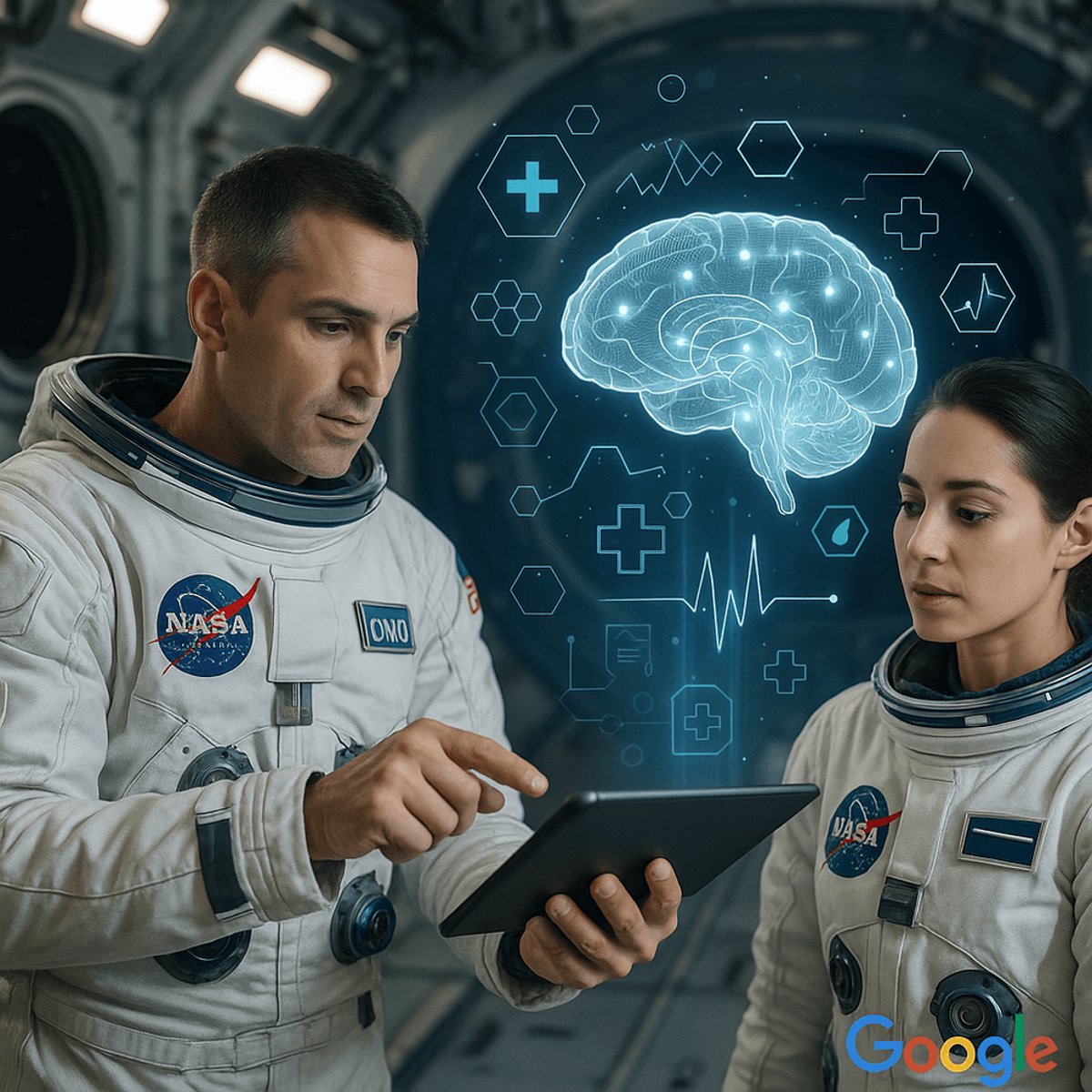
As space missions extend beyond Earth's reach, traditional medical support becomes inadequate. NASA and Google are leveraging AI to overcome this hurdle, introducing the Crew Medical Officer Digital Assistant—a tool designed to diagnose and treat astronauts' health issues in space. This innovation is crucial now as missions prepare for the Moon and Mars, ensuring astronauts' safety and mission success.
Opening Analysis
The space frontier is expanding, with NASA targeting longer missions to the Moon and Mars. Such ventures make Earth-independent medical care imperative. The collaboration between NASA and Google on the Crew Medical Officer Digital Assistant (CMO-DA) represents a monumental step in this direction. This tool, operating on Google Cloud’s Vertex AI, intends to diagnose and manage health issues without direct Earth communication—a need paramount for deep-space missions.
Market Dynamics
In the competitive landscape of space health technologies, AI offers an edge. The necessity for independent medical capabilities in space fuels collaborations such as Google's and NASA's. This partnership not only sets a precedent in space innovation but also could influence future tech-driven medical solutions globally.
Technical Innovation
CMO-DA utilizes multi-modal AI, leveraging text, speech, and images to provide diagnoses. Undergoing tests with ailments such as ankle injuries and ear pain, it has achieved actionable accuracy rates of 88% and 80% respectively. The AI operates on a scalable framework within Google’s Vertex AI, allowing continuous enhancement—essential as more data from space becomes available.
Financial Analysis
Funded through a fixed-price agreement with Google Public Sector, this project highlights a robust investment in cross-industry tech development. The financial model ensures a controlled expenditure while allowing NASA proprietary control of the source code, ensuring its adaptability for future enhancements.
Strategic Outlook
As the project progresses, it may potentially transition toward regulatory approvals for Earth applications, expanding its utility beyond space. The roadmap includes integrating complex medical devices and addressing space-specific conditions, which will further cement its role as a transformative tool in both space and terrestrial medical fields.
The success of CMO-DA could pivot healthcare, making AI-driven solutions indispensable in remote or resource-scarce environments on Earth, reflecting a strategic vision for ubiquitous, AI-enhanced medical care.
Projections
In the next 3–6 months, expect incremental data integrations and accuracy improvements. Within 1–2 years, possible applications on Earth will become viable if space trials validate its effectiveness, heralding a new era in AI medical care.
Key Takeaways:
- CMO-DA enhances astronaut autonomy in health management.
- Strategic partnerships in AI can redefine space travel and Earth applications.
- Future developments in AI health tools promise broad applicability beyond space missions.