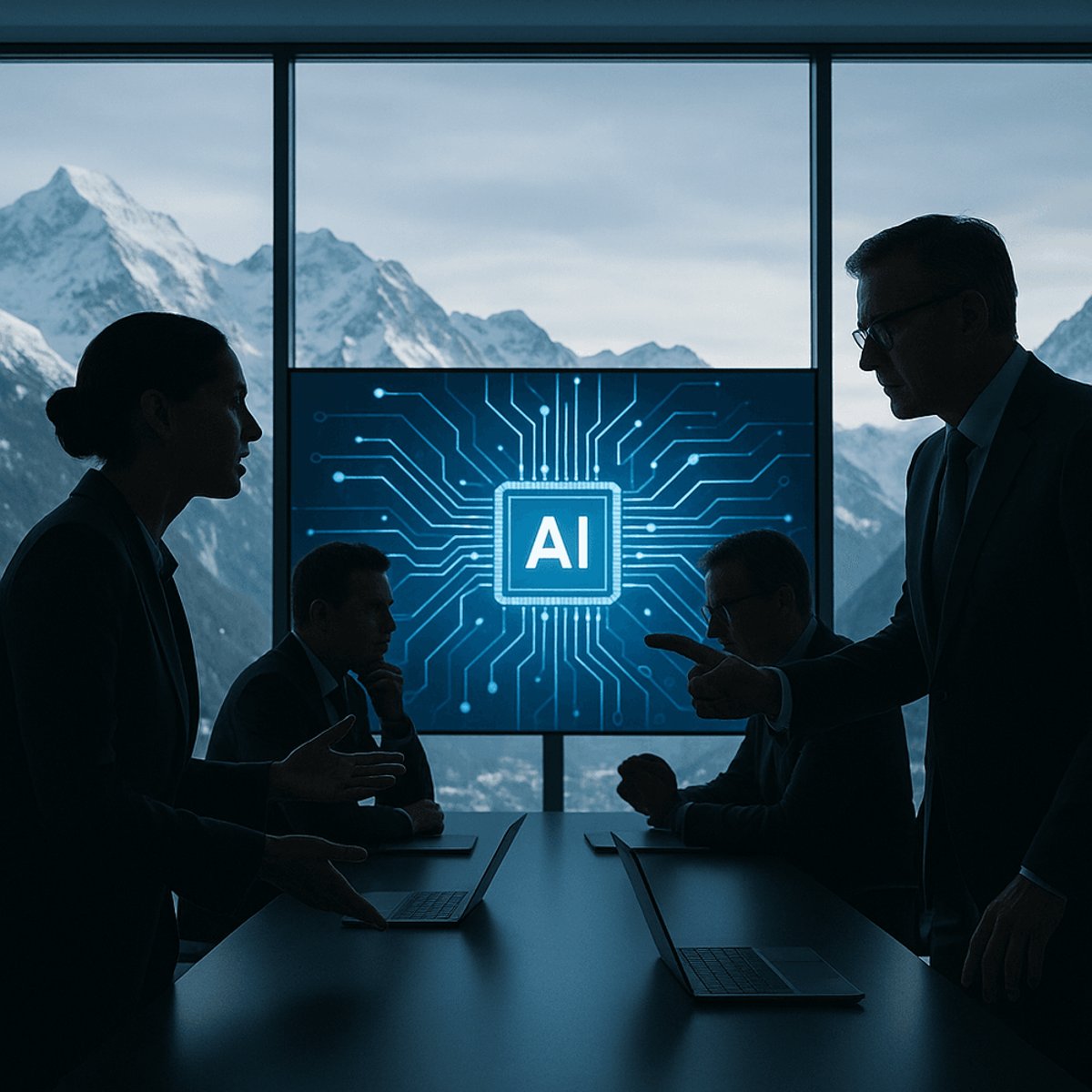
The World Economic Forum turned into a high-stakes AI battleground this week as tech's most powerful CEOs traded barbs and warnings from the Swiss Alps. Anthropic CEO Dario Amodei publicly attacked Nvidia over chip exports to China, while Microsoft's Satya Nadella warned the industry needs mass adoption or faces a bubble burst. The unusual public tension among executives who are often partners and competitors revealed deepening anxieties about AI's trajectory as investment hits unprecedented levels.
The Swiss ski resort of Davos just witnessed something unusual: AI's biggest power players dropping their carefully calibrated messaging and openly challenging each other's strategies. What emerged from this week's World Economic Forum wasn't just the standard hype cycle - it was a rare glimpse at the fractures forming as billions pour into artificial intelligence infrastructure.
Anthropic CEO Dario Amodei fired the sharpest salvo, directly criticizing the Trump administration's decision to let Nvidia export advanced H200 chips to China. The attack carries extra bite because Anthropic runs its Claude AI models on Nvidia GPUs, making Amodei's company both customer and critic. 'An AI data center is like a country full of geniuses,' Amodei said, according to TechCrunch's coverage of his remarks. 'How could we possibly send all these chips to China if we're worried about China? Because essentially we're sending a country full of geniuses over to China and letting them control it.'
The comment encapsulates AI's dual nature in current discourse - simultaneously a national security threat and a transformative technology requiring hyperbolic language to justify eye-watering capital expenditures. But Amodei wasn't the only executive revealing the industry's pressure points.
Microsoft CEO Satya Nadella took a different angle, essentially admitting the quiet part out loud about AI adoption. Speaking at the conference, Nadella warned that AI risks becoming a bubble without mass usage, telling the crowd that 'more people need to be using this or else it's going to be a bubble and a popped bubble,' according to Yahoo Finance reporting. He's been calling data centers 'token factories' - a clinical abstraction that strips away the revolutionary rhetoric to focus on raw computational output.
Nadella's push for equitable AI distribution across communities and geographies reads as both altruistic mission statement and desperate customer acquisition strategy. Microsoft has bet enormous sums on OpenAI and its own AI infrastructure. The company needs enterprises and consumers actually using these 'token factories' to justify the spend.
Nvidia CEO Jensen Huang countered from yet another position, arguing the industry hasn't invested enough. During his appearance with BlackRock CEO Larry Fink, Huang framed the AI buildout as job creation, sidestepping questions about what happens when infrastructure expansion inevitably slows. Nvidia has become the AI gold rush's primary shovel seller, with its GPU dominance giving Huang an incentive to keep capital flowing regardless of utilization rates or returns.
The optics at Davos reinforced tech's takeover of global business conversation. Companies like Meta and Salesforce commandeered prime storefronts on the main promenade, while the USA House - sponsored by McKinsey and Microsoft - became the conference's largest presence. Traditional WEF topics like climate change and global poverty drew smaller crowds, a shift that longtime attendees found striking.
Even Tesla CEO Elon Musk showed up, despite previously avoiding Davos. His appearance via video link offered the usual blend of bold predictions and vague timelines, but Wired noted the symbolic weight of Musk engaging with the forum after years of public skepticism.
What made this year different wasn't just the concentration of tech power in one place - it was the visible tension among executives who usually maintain careful diplomatic distance. These CEOs are simultaneously partners, competitors, and co-dependents in an ecosystem where Anthropic needs Nvidia's chips, Microsoft needs OpenAI's models, and everyone needs continued investor faith that AI will eventually generate returns matching the investment.
The sniping revealed deeper anxieties. Amodei's willingness to attack Nvidia over geopolitics while depending on their hardware suggests confidence in his negotiating position - or desperation to differentiate Anthropic's national security posture. Nadella's bubble warning acknowledges what many suspect: that AI's current trajectory resembles past tech manias more than sustainable business transformation. Huang's investment demands betray concern that capital could dry up before the technology proves itself.
None of these executives used Davos to present concrete metrics on AI productivity gains or return on investment. Instead, they leaned into abstraction - geniuses in boxes, token factories, job creation - while simultaneously warning about inadequate adoption, insufficient investment, and geopolitical threats. It's the language of an industry that knows it's running on faith but can't quite admit it.
The conference format forced these carefully managed CEO brands into unscripted proximity. When you put Nadella, Huang, and Amodei in the same 48-hour news cycle, the contradictions become obvious. One says we're not investing enough, another warns we're building a bubble, a third worries we're handing strategic advantage to China. All three claim to be describing the same technology.
What Davos made clear is that AI's leadership tier doesn't have a unified vision - they have competing business models dressed up as philosophical differences about the technology's trajectory. The venture capitalists, sovereign wealth funds, and corporate giants writing checks to fuel this expansion just got a rare honest look at how uncertain even the insiders are about where this goes next.
Davos 2026 pulled back the curtain on AI's power structure at a critical moment. With hundreds of billions already deployed and questions mounting about returns, the industry's leaders can't maintain unified messaging anymore. The public tensions between Amodei, Nadella, and Huang aren't just personality clashes - they're symptoms of an industry grappling with whether it's building the future or inflating the biggest bubble in tech history. Investors and enterprises watching these executives contradict each other in real time now have a clearer picture of the uncertainty driving AI's breakneck expansion. The question isn't whether these leaders will keep pushing forward - it's whether the rest of the world will keep believing them.