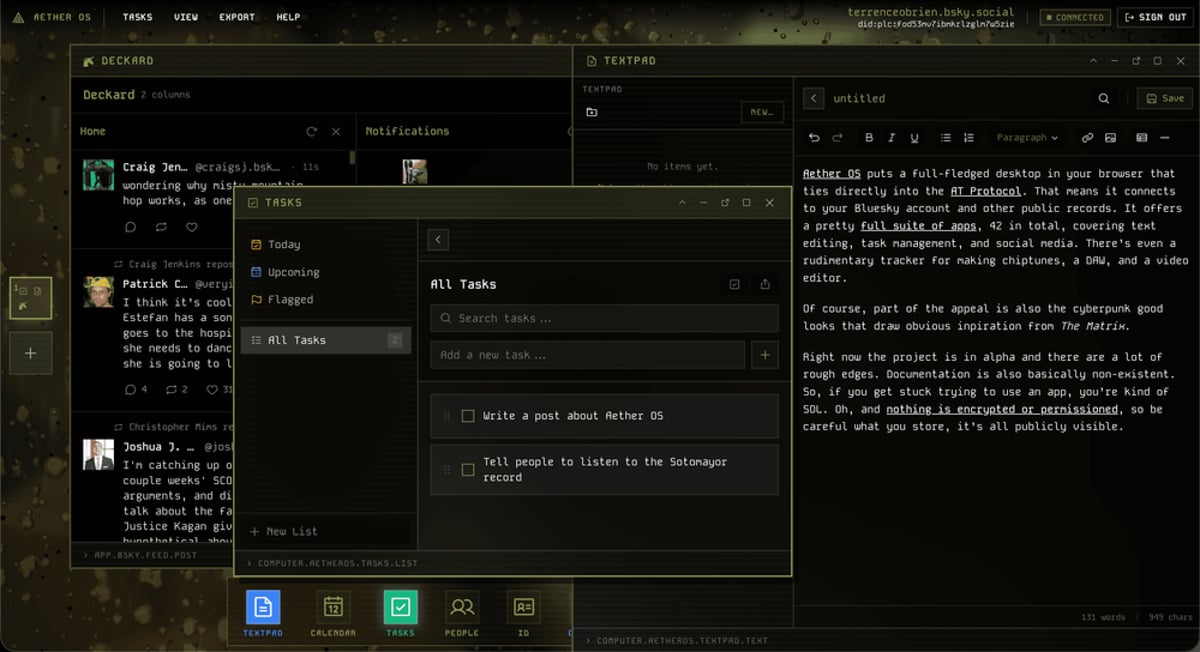
A new browser-based operating system called Aether OS just dropped into alpha, bringing a full desktop environment directly into your web browser with native integration for Bluesky's AT Protocol. The project ships with 42 built-in applications ranging from text editors and task managers to a chiptune tracker and video editor, all wrapped in a cyberpunk aesthetic straight out of The Matrix. It's rough around the edges and lacks documentation, but it represents an ambitious experiment in decentralized computing.
Aether OS just launched as one of the more ambitious experiments in decentralized computing. The project puts an entire desktop environment inside your browser, complete with window management, file systems, and a suite of 42 applications that tie directly into Bluesky's AT Protocol.
The integration means Aether OS can connect to your Bluesky account and other public records on the AT Protocol network. You're not just accessing social media through a web app, you're running a full operating system that treats decentralized protocols as first-class citizens. It's a fundamentally different approach from how we typically interact with social platforms.
According to The Verge's hands-on coverage, the app roster spans productivity tools like text editors and task managers, creative software including a digital audio workstation and video editor, plus a tracker for making chiptunes. There's even a Bluesky client called Deckard, continuing the project's heavy Matrix theming.
The cyberpunk aesthetic isn't just window dressing. The entire interface channels that green-on-black terminal vibe that defined The Matrix's visual language. For developers and users already invested in decentralized social protocols, the look reinforces the ethos: this is computing outside the traditional tech platform silos.
But style only gets you so far. Right now, Aether OS is firmly in alpha territory with all the rough edges that implies. Documentation is basically nonexistent, which means if you hit a wall trying to figure out how an app works, you're mostly on your own. The project needs users willing to experiment and potentially contribute back to the community.
The timing is interesting. Bluesky has been gaining momentum as an alternative to traditional social platforms, crossing 20 million users earlier this year. The AT Protocol that powers it was designed to be open and extensible, allowing exactly this kind of third-party innovation. Aether OS takes that openness to its logical extreme: what if your entire computing environment was protocol-native?
This isn't the first browser-based OS experiment. Projects like Chrome OS proved you could build a functional operating system around web technologies. But those efforts were backed by major corporations and focused on cloud services. Aether OS is aiming for something different: a community-driven, protocol-first environment that puts decentralized networks at the center.
The challenge will be moving from alpha curiosity to practical tool. Forty-two apps sounds impressive until you realize most are likely basic implementations compared to native desktop software. The lack of documentation suggests the project is still very much developer-focused, not ready for mainstream users who expect polish and support.
What makes Aether OS worth watching isn't its current state but what it represents. As decentralized protocols like AT Protocol mature, we're going to see more experiments in protocol-native applications. Some will be simple clients, but others might reimagine entire computing paradigms. Aether OS is testing whether users want their operating system to be as decentralized as their social networks.
The project also highlights a broader shift in how developers think about application architecture. Instead of building for specific platforms or cloud providers, protocol-first design means apps can potentially work across any implementation of the underlying standard. That's powerful, even if the execution is still rough.
For now, Aether OS is a project for the curious and technically inclined. The alpha label means exactly what it says: expect bugs, missing features, and frustrating gaps in functionality. But if you're already deep in the Bluesky ecosystem and want to see how far protocol integration can go, it's worth exploring.
Aether OS is still very much an experiment, one that asks whether we're ready for operating systems built around decentralized protocols instead of corporate platforms. The alpha release is rough and underdocumented, but it's pushing the boundaries of what protocol-native computing could look like. As Bluesky and the AT Protocol continue growing, expect more projects like this testing how deep that integration can go. Whether Aether OS itself becomes practical software or remains a proof of concept, it's mapping territory that matters for the future of decentralized computing.